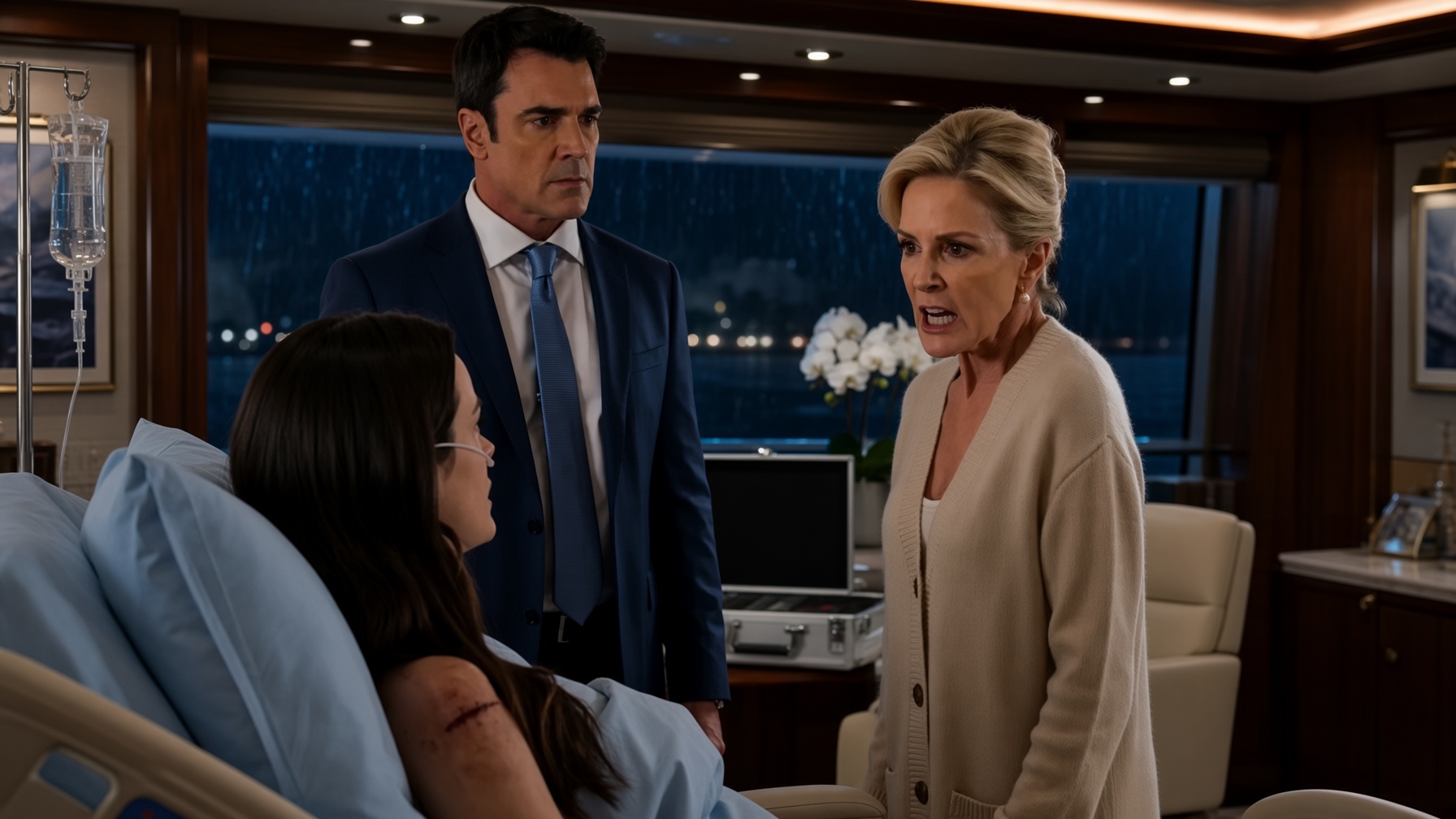
Eleanor Whitmore swung her open palm across Evelyn’s face so fast that Evelyn only understood what had happened when her head turned toward the black windows.
For half a second, the storm outside disappeared.
There was only heat spreading across her cheek.
Then Adrian moved.
He caught his mother’s wrist before she could raise her arm again.
“Enough.”
He did not shout.
That made the word more frightening.
Adrian had always lowered his voice when he was truly angry.
Outside the reinforced glass, lightning opened the Atlantic into a pale field of broken waves. Rain struck the yacht so heavily it sounded like handfuls of gravel being thrown against the windows.
Evelyn remained half-reclined in the medical bed that had been installed in the yacht’s main suite three days earlier.
The Whitmore family could have put her in any private hospital in New York.
Instead, Eleanor had insisted that Evelyn recover aboard the family yacht.
Privacy, Eleanor had called it.
Protection from reporters.
Protection from photographers.
Protection from questions.
Evelyn had begun to wonder exactly who was being protected.
White bandages crossed her left shoulder and disappeared beneath the thin gown Dr. Lena Brooks had brought from the hospital. Smaller dressings covered the side of her ribs.
Her skin no longer felt as though it were burning every second, but certain movements pulled painfully beneath the bandages.
An IV line ran from her right wrist to a metal stand beside the bed.
The heart monitor began beeping faster.
Evelyn hated the sound.
It announced every emotion before she could hide it.
Eleanor stared at her as Adrian lowered her wrist.
“You survived that fire,” Eleanor said, “and this is what you do?”
Evelyn moved her tongue over the inside of her cheek. Her teeth had cut the skin.
She tasted blood.
“You accuse my son,” Eleanor continued. “You bring investigators onto this boat. You let the press destroy our family name.”
“I didn’t invite the press.”
“You didn’t have to.”
“Mrs. Whitmore.”
Dr. Lena Brooks stepped away from the monitor.
She was forty-two, calm in the particular way of doctors who had learned that raising their voices rarely helped anything.
“If you strike my patient again, you leave the room.”
Eleanor turned.
“My daughter-in-law is not your possession.”
“No,” Lena said. “She’s my patient.”
Detective Marcus Hale remained near the suite door.
He had been standing there since Eleanor arrived twenty minutes earlier.
Dark suit.
No tie.
Rain still drying along one shoulder from his trip across the deck.
He had the patient expression of a man willing to let people make mistakes in front of him.
Evelyn had noticed that about him during their first interview.
He rarely pushed too soon.
He waited.
People filled silence because silence made them uncomfortable.
Tonight, the Whitmores were doing most of his work for him.
Adrian released his mother.
Eleanor adjusted the sleeve of her cream blouse as if nothing unusual had happened.
No apology came.
Evelyn was not surprised.
Eleanor Whitmore had never apologized to anyone in the eight years Evelyn had known her.
Not waiters.
Not assistants.
Not her husband before he died.
Certainly not Evelyn.
Another burst of lightning illuminated the room.
Evelyn slowly turned her head back.
Her eyes were watering from the sting in her cheek.
She hated that too.
Eleanor would call the tears weakness.
Adrian might call them pain.
Neither deserved an explanation.
Evelyn let the silence remain between them until Eleanor’s expression changed from outrage to uncertainty.
Then Evelyn looked directly at her husband.
“I never said Adrian started the fire.”
His face tightened.
“I said he locked the door.”
Nobody moved.
Even Eleanor went quiet.
Adrian’s right thumb stopped rubbing the inside of his wedding ring.
Evelyn noticed immediately.
She had watched him make that movement for years.
During uncomfortable dinners.
Before investor presentations.
Whenever Eleanor called unexpectedly.
The afternoon Evelyn told him she was not ready to have children.
The night they signed the mortgage papers for their house in Connecticut, even though his family could have purchased ten houses without needing a bank.
Adrian rubbed the ring whenever he needed time to decide what version of himself he wanted other people to see.
His hand dropped.
For one strange moment, Evelyn remembered a different man.
Barefoot in their kitchen at two in the morning.
Eating cereal from a mixing bowl because every regular bowl was inside the dishwasher.
Laughing after milk ran down his chin.
Telling her that his mother would probably consider cereal from a mixing bowl evidence of social collapse.
That man had once seemed real.
Evelyn no longer knew.
Adrian looked toward the walnut console beneath a vase of white orchids.
A silver security case sat there.
Locked.
Detective Hale noticed.
So did Lena.
And Evelyn.
Adrian realized his mistake.
His gaze returned to his wife.
“Evelyn,” he said carefully. “Your memory hasn’t fully returned.”
Thunder rolled above them.
Hale stepped away from the door.
He did not grab Adrian or make any threatening movement.
He simply placed himself between Adrian and the only exit.
“Then help us,” Hale said. “Why was your security card found inside the burned room?”
Eleanor turned so quickly one pearl earring swung beneath her hair.
“What security card?”
Adrian looked at Hale.
“The detective is leaving out context.”
“I haven’t offered any context yet,” Hale replied.
Evelyn watched her husband.
She had spent eleven days trying to remember what happened in the room before the fire.
Fragments came without order.
Smoke beneath a door.
Her shoulder driving into wood.
The metallic click of a lock.
Adrian’s voice.
Footsteps.
Then heat.
Then nothing.
Lena had explained that memory after trauma rarely returned like a movie.
Sometimes it returned as smell.
Sometimes sound.
Sometimes a single image.
Sometimes it never returned completely.
Evelyn had accepted that.
What she had not accepted was Adrian telling everyone what she did and did not remember.
“Mom,” Adrian said, “go downstairs.”
Eleanor gave a short laugh.
“You let a detective accuse you in front of your wife and expect me to leave?”
“I didn’t invite him.”
“No,” Hale said. “I invited myself.”
Eleanor faced him.
“On whose authority?”
“The captain’s.”
“The captain works for my family.”
“The captain is responsible for the vessel while it is within American waters. Your employment agreement doesn’t cancel maritime law.”
Eleanor’s mouth closed.
Adrian moved one step toward the console.
Hale’s voice hardened.
“Don’t.”
Adrian stopped.
It lasted less than a second.
But Evelyn saw him calculate the distance between himself and the silver case.
That frightened her more than anger would have.
Lena moved closer to Evelyn’s bed.
“Marcus,” she said. “Her heart rate is too high.”
Hale nodded.
“We’re finished for tonight.”
“No,” Evelyn said.
Every face turned toward her.
She pulled herself slightly higher against the pillows.
Pain tightened beneath the bandages.
She waited for it to settle.
“I’m tired of people deciding when I’m finished.”
Lena studied her.
“Your body needs rest.”
“My body has been resting for eleven days while everybody else builds a story around me.”
Adrian stepped forward.
“Evie—”
“Don’t call me that.”
He stopped.
Eleanor rolled her eyes.
“For heaven’s sake.”
Evelyn looked at her.
“You can leave.”
“This is my family’s yacht.”
“And this is my medical room.”
“It is the owner’s suite.”
“Then I suppose tonight you can decide which matters more.”
For once, Eleanor had no immediate reply.
Hale almost smiled.
Almost.
Adrian looked at Lena.
“She needs medication.”
Evelyn stared at him.
“You don’t get to decide that either.”
“I’m your husband.”
“You keep saying that like it answers questions.”
His face changed.
Only slightly.
But Evelyn saw it.
That had become her entire life lately.
Slight changes.
Tiny hesitations.
Small choices that suddenly mattered.
Eight years earlier, Adrian Whitmore had seemed nothing like the rest of his family.
That was why Evelyn married him.
At least, that was what she had believed.
They met at a charity dinner in Boston.
Evelyn had been twenty-seven and working as an architectural preservation consultant. She spent her days measuring old buildings, studying water damage, arguing with contractors, and trying to convince wealthy owners that replacing everything with polished marble was not the same thing as restoration.
She had attended the dinner because her firm was helping restore a nineteenth-century library funded partly by the Whitmore Foundation.
Adrian sat beside her because the seating chart placed them together.
He wore an expensive tuxedo badly.
His bow tie was crooked.
Halfway through the appetizer, he leaned toward her and whispered, “If anyone asks, I absolutely understand what that man has been saying for the last six minutes.”
Evelyn kept her face straight.
“You’re on the foundation board.”
“Unfortunately.”
“He’s explaining your project.”
“I know.”
“That makes this worse.”
“Much worse.”
She laughed.
Eleanor Whitmore, seated across the table, noticed.
Evelyn remembered that too.
The first inspection.
The quiet calculation behind Eleanor’s smile.
Evelyn did not come from a famous family.
Her father taught history at a public high school.
Her mother ran the office of a dental clinic.
They lived comfortably but normally.
Family dinners happened in a kitchen with mismatched chairs.
Birthdays involved supermarket cake.
Nobody owned a yacht.
Nobody discussed what newspapers might say before deciding whether to attend a wedding.
Adrian told Evelyn that normality was exactly what he loved about her.
For the first few years, she believed him.
He cooked.
Badly.
He forgot where he left his keys.
He hated formal dinners.
They bought a modest farmhouse outside Greenwich instead of moving into one of the Whitmore estates.
Eleanor called the house “charming” in a tone that made the word sound like an illness.
Still, Adrian defended Evelyn then.
At least in small ways.
When Eleanor complained that Evelyn worked too much, Adrian said he admired her career.
When Eleanor suggested Evelyn should hire a stylist, Adrian laughed and told her Evelyn could dress herself.
When Eleanor wanted their wedding at a hotel owned by a family friend, Adrian supported Evelyn’s choice of a garden ceremony at her parents’ house.
Those memories were real.
Evelyn knew they were real.
That was what made everything after them so difficult.
People liked simple stories.
Good husband becomes bad husband.
Happy marriage becomes unhappy marriage.
Trust disappears.
But real life rarely changed so neatly.
Adrian had not become another person overnight.
He changed by degrees.
A postponed dinner.
A call from his mother taken outside.
A financial decision he said was too complicated to explain.
A family meeting Evelyn learned about afterward.
Nothing looked dangerous alone.
Together, they slowly created a marriage in which Evelyn realized she knew less and less about the man sleeping beside her.
The fire happened at the Whitmore family’s coastal estate in Rhode Island.
They had gone there for Eleanor’s sixtieth birthday.
Twenty-eight guests.
Two caterers.
A private chef.
Three security employees.
A string quartet Eleanor insisted was “less intrusive” than a band.
Evelyn had almost stayed home.
She had been exhausted from a preservation project in Providence, but Adrian asked her to come.
“My mother will make it unbearable if you don’t.”
“That isn’t a convincing reason.”
“I need you there.”
That was different.
So she went.
The party lasted until nearly midnight.
Evelyn remembered the champagne.
The music.
Eleanor accepting compliments as though she had personally invented birthdays.
She remembered Adrian disappearing repeatedly.
She remembered asking his younger sister, Natalie, where he had gone.
“Business.”
“At eleven-thirty?”
“You married a Whitmore.”
Natalie had smiled when she said it, but there had been something tired beneath the joke.
Near midnight, Evelyn went upstairs looking for her phone charger.
That was the last part of the night she remembered clearly.
Until now.
“Open the case,” Evelyn said.
Adrian looked toward the silver box again.
Eleanor frowned.
“What is in there?”
Hale answered.
“Materials recovered after the fire.”
“Recovered by whom?”
“Investigators.”
“Then why are they here?”
“Because Mrs. Whitmore requested that part of the evidence be reviewed in her presence.”
Eleanor stared at Evelyn.
“You requested this?”
“I asked questions.”
“You were barely conscious three days ago.”
“That didn’t make me stupid.”
Adrian drew in a slow breath.
“Hale, this is irresponsible.”
“Maybe.”
“You know she’s recovering from medication, smoke exposure and head trauma.”
“I know what the medical reports say.”
“And you’re letting her build conclusions from fragments.”
Hale folded his arms.
“I haven’t heard her conclusion.”
Adrian’s jaw shifted.
Evelyn looked at Lena.
“Can I continue?”
Lena glanced at the monitor.
“For a few minutes. If your numbers climb further, we stop.”
“Fine.”
Evelyn looked at Hale.
“Open it.”
He crossed the room.
The security case had been delivered that afternoon under police seal.
Hale entered the combination.
The locks released.
Eleanor stepped closer despite Adrian’s warning glance.
Inside were several plastic evidence sleeves.
A blackened keycard.
Part of a damaged phone.
A melted metal pen.
A small brass key.
And a partially burned leather folder.
Evelyn stopped breathing for a moment.
The folder.
She knew it.
Not from the fire.
From Adrian’s office.
Dark brown leather.
His initials embossed in one corner.
AW.
She had seen it on his desk two weeks before Eleanor’s party.
“What is that?” Eleanor asked.
Nobody answered immediately.
Adrian spoke first.
“Business documents.”
Evelyn looked at him.
“What business documents?”
“Old contracts.”
“Why were they in the guest bedroom?”
“They weren’t.”
Hale lifted the evidence bag containing the folder.
“It was recovered behind the built-in cabinet.”
Eleanor stared at her son.
Adrian remained remarkably still.
Evelyn felt something shift inside her mind.
Not a full memory.
A sound.
Paper sliding.
A drawer.
Adrian saying, “You shouldn’t have gone through that.”
She closed her eyes.
“Evelyn?”
Lena’s voice seemed far away.
She saw the upstairs bedroom again.
Not burning.
Before.
A lamp beside the bed.
Her purse on the chair.
A phone charger plugged into the wall.
And the leather folder lying partly open on a small desk.
She opened her eyes.
“I found it.”
Adrian’s face lost color.
Evelyn continued slowly.
“I went upstairs for my charger.”
“Stop,” Adrian said.
Hale looked at him.
Evelyn ignored him.
“The folder was on the desk.”
Another piece returned.
“I thought it was mine.”
That was true.
Her firm used similar document folders.
She had carried architectural drawings into the house earlier that afternoon.
“I opened it.”
Eleanor said, “What was inside?”
Evelyn looked at Adrian.
“Property transfers.”
He did not deny it.
“From the Whitmore Foundation.”
Eleanor’s expression became blank.
“What?”
“Several buildings.”
“What buildings?”
“I don’t remember every name.”
Adrian finally spoke.
“They were restructuring documents.”
Hale looked at him.
“Interesting.”
“What?”
“You told us you had never seen the folder.”
“I said I didn’t remember bringing it upstairs.”
“That isn’t what you said.”
Adrian looked toward his mother.
Eleanor had moved closer to the console.
“What buildings, Evelyn?”
“One in Boston. Two in New York.”
A memory surfaced.
Numbers printed beside property addresses.
A shell company.
Then another.
She frowned.
“There was a company called Harbor North Holdings.”
Eleanor gripped the edge of the console.
“That company belongs to Natalie.”
“No,” Adrian said quickly.
Eleanor turned.
“It was created for Natalie’s trust.”
“It’s more complicated.”
“Then make it simple.”
“Mom.”
“Make it simple.”
The storm continued battering the yacht.
Evelyn watched them.
For years, she had thought Eleanor and Adrian understood each other without speaking.
Now she realized that might not be true.
Maybe powerful families looked united because outsiders rarely remained long enough to see the cracks.
Hale removed another evidence bag.
Inside was the damaged keycard.
“This opened the hallway security doors and private office rooms at the estate.”
Eleanor nodded impatiently.
“Everyone in the family has one.”
“This one was assigned to Adrian.”
“So?”
“It was found underneath the carpet inside the room where Evelyn was trapped.”
Eleanor looked at her son.
Adrian’s voice remained controlled.
“I went into the room earlier.”
“When?” Hale asked.
“During the party.”
“Why?”
“To speak with my wife.”
Evelyn stared at him.
“No.”
He turned.
“You don’t remember.”
“I remember enough.”
“You were upset.”
“About what?”
He hesitated.
There it was again.
That tiny delay.
Evelyn knew it better than anyone.
“About our marriage,” he said.
Eleanor made an irritated sound.
“This is ridiculous.”
Evelyn kept watching Adrian.
“What about our marriage?”
“We’d been arguing.”
“We argued the week before.”
“And that night.”
“No.”
“You were drinking.”
“I had two glasses of champagne.”
“You took pain medication that afternoon.”
Lena interrupted.
“Prescription anti-inflammatory medication does not produce the type of memory loss you’re implying.”
Adrian looked at her.
“I’m explaining context.”
“You’re creating context,” Evelyn said.
His eyes returned to her.
“Why?”
“Because you were angry.”
“Why?”
“You saw documents you didn’t understand.”
“And?”
“You accused me of hiding things.”
“Were you?”
Silence.
Eleanor looked between them.
Hale waited.
Adrian exhaled.
“Yes.”
The answer startled everyone.
Even Evelyn.
He continued.
“I was hiding financial problems.”
“What kind?”
“Company problems.”
“The foundation?” Eleanor asked.
“No.”
“Then what?”
“My division.”
Eleanor’s face hardened.
Whitmore Maritime had begun with Adrian’s grandfather and expanded into commercial shipping, port logistics, security technology and real estate.
Adrian controlled the investment division.
His title was president.
Eleanor remained chairwoman.
For the last three years, newspapers had described Adrian as the future of the family empire.
Evelyn never cared much about those stories.
Adrian used to pretend he did not either.
“What problems?” Eleanor asked.
Adrian looked tired now.
Genuinely tired.
“Losses.”
“How much?”
“Mom.”
“How much?”
He rubbed the inside of his wedding ring.
Evelyn almost laughed.
Even now.
“About forty million.”
Eleanor’s face changed.
The yacht seemed to become quieter despite the storm.
“Forty million dollars?”
“Not all at once.”
“How does someone lose forty million dollars slowly enough that I don’t notice?”
“Because the losses were covered.”
“With what?”
Adrian looked at the leather folder.
Eleanor followed his gaze.
Her voice fell.
“No.”
Adrian did not answer.
“You moved foundation property?”
“I temporarily leveraged assets.”
“You stole from the foundation.”
“I borrowed against assets.”
“You moved them into Natalie’s trust company.”
“For collateral.”
“Natalie doesn’t know anything about finance.”
“That was the point.”
Eleanor stepped backward.
Evelyn had never seen her look old before.
Not even at her husband’s funeral.
Tonight, under the medical lights, she suddenly did.
Hale watched Adrian closely.
“Was Evelyn going to expose you?”
Adrian looked at him.
“She didn’t understand what she saw.”
“I understood enough to know you were hiding it.”
Evelyn’s memory continued returning.
The bedroom.
The folder.
Adrian entering.
His face when he saw the papers in her hands.
She remembered standing.
“What is Harbor North?”
“Put that down.”
“What is it?”
“Evelyn.”
“You moved foundation property.”
“You don’t understand.”
“Then explain it.”
“I can’t explain it here.”
“Why not?”
“Because my mother is downstairs.”
Then something else.
Evelyn looked at Adrian.
“You took my phone.”
His face tightened.
Hale straightened.
“What?”
Evelyn spoke more quickly now.
“I photographed the pages.”
Adrian said, “You were threatening me.”
“No. I said I was going to ask Eleanor what they meant.”
“You said you would send them to your attorney.”
“I don’t have an attorney.”
“You said you were leaving me.”
The room became still again.
Evelyn remembered.
She had said it.
Not because of the documents alone.
Because Adrian had taken her phone from her hand.
Because she had looked at the man she married and suddenly felt she was speaking with someone who believed possession was the same as authority.
“I said I wouldn’t stay married to someone I couldn’t trust.”
Adrian stared at her.
“That’s what you said.”
“Yes.”
Eleanor closed her eyes briefly.
Perhaps she was finally understanding that the fire had not begun with flames.
Hale asked, “What happened after that?”
Evelyn’s heart monitor accelerated again.
Lena looked toward it.
“Slow down.”
Evelyn breathed carefully.
She pictured the room.
Adrian pacing.
Her phone in his hand.
She demanded it back.
He refused.
She moved toward the hallway.
He walked out first.
Then—
The click.
Evelyn’s fingers tightened around the blanket.
“He locked the door.”
Adrian looked at the floor.
Eleanor whispered, “Daniel.”
Then stopped herself, confused by her own son’s silence.
Here he was Adrian.
Her Adrian.
Her perfect boy.
The man she had defended automatically.
“You locked her inside?”
Adrian raised his head.
“For five minutes.”
Evelyn felt cold.
It was the first direct admission.
Hale said nothing.
Adrian continued.
“She was furious. She was going downstairs. There were guests everywhere. My mother’s birthday party was still happening.”
“So you locked the door?” Eleanor asked.
“I needed five minutes to think.”
“You locked your wife in a bedroom.”
“I was coming back.”
Evelyn stared at him.
“How did the fire start?”
“I don’t know.”
“Adrian.”
“I don’t.”
Hale stepped closer.
“Why didn’t you unlock the door when you smelled smoke?”
Adrian looked at him.
“I didn’t smell it immediately.”
“You were twenty feet away.”
“I went to my office.”
“Security footage shows you entered the hallway again four minutes later.”
“I was looking for a staff member.”
“You walked past the room.”
“I didn’t know the fire had started.”
Evelyn’s breathing became shallow.
Another memory.
Her fists striking the door.
Smoke underneath.
“Adrian!”
His name.
She had shouted his name.
Again.
Again.
Then his voice.
Not far away.
“Wait.”
She closed her eyes.
“You heard me.”
He looked at her.
“You said wait.”
“No.”
“You did.”
“I don’t remember saying that.”
“I do.”
Her voice cracked.
She hated that.
“I was trying the handle. Smoke was coming beneath the door. I called your name.”
She forced herself to continue.
“You answered.”
Eleanor covered her mouth with one hand.
Adrian shook his head.
“No.”
“You said, ‘Wait.’”
“I would never—”
“You did.”
“Evelyn, I was trying to get help.”
“Then why didn’t you open the door?”
“I didn’t have the card.”
Hale lifted the burned keycard.
“It was inside.”
Adrian looked at it.
“You dropped it?”
Evelyn asked.
No answer.
She suddenly understood.
“You slid it under the door.”
Hale’s eyes narrowed.
Adrian stared at her.
A memory returned.
Something black appearing through the smoke.
She had thought it was debris.
Her fingers scraping the carpet.
The card.
She picked it up.
Tried it against the internal electronic panel.
Nothing happened.
“Why would you give me the card?”
Adrian swallowed.
“The exterior lock had failed.”
“No.”
“I thought you could use it.”
“There was no card reader inside.”
“I didn’t know.”
“You lived in that house for twenty years.”
“I panicked.”
The sentence hung there.
Evelyn believed that part.
Not because it excused him.
Because finally something sounded true.
Adrian had panicked.
But not about her.
About everything else.
The documents.
The photos.
His mother.
The money.
His marriage.
The guests downstairs.
His future.
He had stood in a hallway while smoke entered the room and tried to solve ten problems at once.
Evelyn had simply been one of them.
Lena leaned over the monitor.
“That’s enough.”
Evelyn wanted to argue.
Then dizziness moved through her head.
The suite shifted slightly.
She closed her eyes.
Lena lowered the bed.
“Everyone out except Detective Hale.”
Eleanor did not protest this time.
She looked at Adrian as though she had never seen him before.
Adrian turned toward Evelyn.
“I didn’t know the fire would spread.”
She opened her eyes.
“That isn’t the sentence you think it is.”
He looked wounded.
For the first time, Evelyn felt nothing in response.
Not anger.
Not love.
Not satisfaction.
Nothing.
Eleanor walked out first.
Adrian followed.
At the door, he stopped.
“I came back.”
Evelyn looked toward him.
“What?”
“I came back for you.”
The storm flashed behind him.
“I broke the window.”
Evelyn remembered glass.
Cold rain.
Arms reaching through smoke.
But not Adrian.
“That was Mateo.”
Adrian’s expression shifted.
Mateo Alvarez was one of Eleanor’s security employees.
He had entered the room through the balcony after climbing across the exterior ledge.
Evelyn knew that because he had visited the hospital two days after she regained consciousness.
His forearms were still bandaged then.
Adrian stared at her.
“You don’t know everything.”
“No,” Evelyn said. “That’s why Hale is still here.”
Adrian left.
Lena closed the door.
For several minutes, nobody spoke.
Rain drummed against the windows.
Hale returned the evidence to the silver case.
Evelyn watched him.
“Do you believe him?”
“That he didn’t start the fire?”
“Yes.”
“I believe evidence.”
“That means no.”
“It means I don’t decide because someone looks convincing.”
Evelyn gave a weak smile.
“You must hate family dinners.”
“I avoid them.”
Lena adjusted Evelyn’s IV.
“You need sleep.”
“I’ve spent eleven days sleeping.”
“You’ve spent eleven days healing.”
Evelyn looked toward Hale.
“What aren’t you telling me?”
Lena stopped.
Hale did too.
Evelyn noticed both reactions.
“That was not a difficult question.”
Hale walked toward the end of the bed.
“We found the likely ignition point this morning.”
Her stomach tightened.
“Where?”
“Inside the wall behind the writing desk.”
“Electrical?”
“Possibly.”
“That doesn’t sound like your real answer.”
“It isn’t.”
Evelyn waited.
Hale continued.
“The wiring had recently been modified.”
“By whom?”
“We’re still establishing that.”
“Why would someone modify wiring?”
“To install a concealed recording system.”
Evelyn stared at him.
Lena looked away.
“A recording system?”
“Camera and audio.”
“In the bedroom?”
“Yes.”
“Whose camera?”
“We don’t know yet.”
Evelyn almost laughed because the alternative was crying.
“Of course.”
Hale sat in the chair beside the console.
“The fire may have started when the equipment overheated.”
“So Adrian might not have started it.”
“That remains possible.”
“But someone installed a hidden camera in a guest bedroom.”
“Yes.”
“Who knew?”
“We’re asking.”
Evelyn looked toward the door.
Eleanor’s yacht.
Eleanor’s house.
Eleanor’s security.
Adrian’s financial fraud.
Natalie’s company.
Every direction led into the same family.
“Why put me here?” Evelyn asked.
“What?”
“On this yacht.”
Lena frowned.
“Your husband said it was for privacy.”
“My husband says many things.”
Hale said, “You should consider returning to the hospital.”
“I think I should consider leaving the Whitmores completely.”
Nobody argued.
The next morning, the storm moved north.
Evelyn woke at seven to pale sunlight spreading across the cabin walls.
For the first time since coming aboard, the sea looked calm.
She could hear muted footsteps from the crew in the hallway.
Someone opened a cabinet.
A coffee machine hissed.
Ordinary sounds.
She wanted them desperately.
She wanted her own kitchen.
Her old blue mug.
The grocery list stuck beneath a magnet.
A neighbor’s dog barking too early.
Bills on the counter.
Anything that had nothing to do with private detectives, offshore yachts or burned documents.
Lena entered carrying tea.
“You’re awake.”
“I noticed.”
“Pain?”
“Four.”
“Yesterday?”
“Six.”
“Good.”
Lena placed the cup on the bedside table.
Evelyn watched her.
“How long have you worked for the Whitmores?”
“Six years.”
“Do you like them?”
“That is not generally part of a medical contract.”
“Humor me.”
Lena pulled a chair closer.
“I like some of them some of the time.”
“That sounds healthy.”
“It’s realistic.”
“Did Eleanor ask you to bring me here?”
Lena paused.
“Adrian did.”
“Why did you agree?”
“Because you were medically stable and wanted to leave the hospital.”
“I wanted to go home.”
“You did.”
“Did I?”
Lena’s expression changed.
Evelyn sat straighter.
“I asked to go home?”
“Yes.”
“Then why am I here?”
“Adrian said your house wasn’t secure.”
“Secure from what?”
“He said reporters had found the address.”
“Were there reporters?”
“I didn’t personally see them.”
Evelyn closed her eyes.
Another decision made for her.
“How many times did he answer questions for me while I was in the hospital?”
Lena stayed quiet.
“That many?”
“You were exhausted.”
“That isn’t an answer.”
“He was your emergency contact.”
“Was.”
Lena nodded.
“I can change it.”
“Change it to my sister.”
“You have a sister?”
“Caroline. She lives in Chicago.”
“Why hasn’t she been here?”
Evelyn looked toward the window.
That question had been bothering her too.
“She called after the fire.”
“I haven’t seen her.”
“Neither have I.”
Lena frowned.
Evelyn reached for her phone on the bedside table.
Adrian had replaced the one destroyed in the fire.
New device.
Same number.
She opened her messages.
Caroline’s name appeared.
The last visible exchange was from five days earlier.
CAROLINE: Call me when you can.
EVELYN: I’m exhausted. Adrian says visitors make things worse. I’ll call soon.
Evelyn stared at the message.
“I didn’t write this.”
Lena leaned closer.
“You’re sure?”
“I don’t call my sister Caroline in messages.”
“What do you call her?”
“Caro.”
Evelyn scrolled upward.
More messages.
Short.
Polite.
Wrong.
EVELYN: Doctors say I need space.
EVELYN: Please don’t fly out yet.
EVELYN: Adrian is taking care of everything.
She felt sick.
“Get Hale.”
Within twenty minutes, Marcus Hale stood beside her bed reading screenshots.
His expression grew harder with each one.
“Who had access to your phone?”
“Adrian.”
“Password?”
“He knows it.”
Hale looked at Lena.
“When was the replacement device activated?”
“Two days after she woke up.”
“And when did Evelyn first use it herself?”
Lena thought.
“Maybe day four.”
Evelyn stared at the messages.
“Call my sister.”
Hale nodded.
Evelyn called.
Caroline answered before the second ring.
“Evelyn?”
Her voice broke on the name.
Evelyn’s eyes filled immediately.
“Caro.”
Silence.
Then Caroline started crying.
Not loudly.
Just the sound of someone trying very hard not to.
“I’ve been going insane.”
“I know.”
“No, you don’t. Adrian kept saying you couldn’t talk. Then you messaged me not to come. Mom and Dad are terrified.”
“I didn’t send those messages.”
Silence again.
“What?”
“I didn’t send them.”
Caroline’s voice changed.
“Where are you?”
“On the Whitmore yacht.”
“Why?”
“I don’t know anymore.”
“Get off.”
“I’m working on it.”
“No. Evelyn, get off now.”
For the first time in eleven days, someone spoke to her like a sister instead of a patient, wife, witness or problem.
Evelyn almost laughed.
“I can’t exactly climb over the railing.”
“I’ll hire a helicopter.”
“That might be dramatic.”
“I’m extremely comfortable being dramatic right now.”
Hale looked away, hiding a smile.
Evelyn told Caroline enough to make her understand but not enough to terrify their parents.
Caroline booked the first flight to New York.
After the call, Evelyn stared at the phone.
“Hale.”
“Yes?”
“I want you to check something.”
“What?”
“Adrian said reporters were outside our house.”
“I can ask local police.”
“And ask whether anyone reported threats.”
“Done.”
“And I want to know who ordered the hidden cameras.”
“That part is already moving.”
Evelyn looked toward the hallway.
“Then I want breakfast.”
Hale blinked.
“Breakfast?”
“I’m starving.”
It was such a normal request that Lena laughed.
By noon, the first real crack appeared in the Whitmore story.
There had been no reporters outside Evelyn and Adrian’s Connecticut house.
No threats.
No suspicious vehicles.
No police reports.
Nothing.
Adrian had lied.
At two, Hale received another call.
The surveillance equipment installed in the Rhode Island estate had been purchased through Whitmore Protective Services.
Authorized by Eleanor.
Evelyn was sitting in a wheelchair near the yacht’s rear deck when Hale told her.
Eleanor stood ten feet away.
For once, she looked embarrassed.
“You installed cameras in guest bedrooms?” Evelyn asked.
“Not cameras.”
“Hale says camera and audio.”
“I authorized security equipment.”
“In bedrooms.”
“There had been theft.”
“What theft?”
“Jewelry disappeared after two events.”
“So you recorded guests?”
“I told security to protect private spaces.”
“Did guests know?”
Eleanor looked toward the water.
That was enough.
“Did Adrian know?”
“I assume so.”
Evelyn gave a slow nod.
“Of course.”
Eleanor turned back.
“I did not know the equipment was installed improperly.”
“I believe you.”
Eleanor seemed surprised.
Evelyn continued.
“That doesn’t make it acceptable.”
“I was protecting this family.”
“You use that sentence for everything.”
“Because someone has to.”
“From what?”
“People who want access. Money. Information.”
“Sometimes the danger is already inside the house.”
Eleanor’s eyes narrowed.
“You think I started the fire?”
“No.”
“Then what are you accusing me of?”
“Building a family where everyone thinks control is love.”
Eleanor became very still.
Evelyn had expected anger.
Instead, something like recognition crossed the older woman’s face.
It disappeared quickly.
“My husband was careless,” Eleanor said. “His brother nearly destroyed the company. Employees stole. Friends sold information. People smiled at dinners and sued us the next morning. You learn.”
“Learn what?”
“That trust is expensive.”
Evelyn looked at the water.
“Then maybe stop buying it.”
Eleanor said nothing.
Later that afternoon, Adrian asked to see her.
Evelyn agreed only because Hale remained nearby.
They sat across from each other in the yacht’s library.
Adrian looked as though he had not slept.
His shirt was wrinkled.
No jacket.
No perfect Whitmore presentation.
For years, Evelyn had wanted to see him stop performing.
Now that he had, she wished the circumstances were different.
“I didn’t send every message,” he said.
“But you sent some.”
“Yes.”
“To my sister.”
“You were barely sleeping.”
“So you told her not to come.”
“I thought more family would overwhelm you.”
“My family.”
“I know.”
“No. You don’t.”
He lowered his eyes.
Evelyn waited.
“Why the yacht?”
“Because I was scared.”
“Of reporters?”
“Of you leaving.”
The answer surprised her.
Adrian continued.
“I thought if you went home, your sister would come. Your parents would come. Hale would interview you without me. You would remember pieces and—”
“And what?”
“Decide what kind of person I was before I could explain.”
Evelyn almost smiled.
“You locked me in a burning room.”
“I locked you in a room before it was burning.”
He heard the sentence after saying it.
His face collapsed slightly.
“That sounded terrible.”
“It sounded accurate.”
“I came back.”
“You still didn’t open the door.”
“The electronic lock stopped responding.”
“You could have broken it.”
“I tried.”
“Mateo went outside in a storm and climbed across stone ledges.”
“I know.”
“He didn’t need time to decide whether I was worth saving.”
Adrian’s eyes became wet.
Evelyn looked away.
She did not want his tears to influence her.
Not because they were necessarily fake.
Because they might be real.
Real regret did not erase real choices.
“I panicked,” Adrian said.
“You keep saying that.”
“Because it’s true.”
“I believe you.”
He looked up.
“You do?”
“Yes.”
For a second, hope appeared.
Evelyn continued.
“You panicked when I found the documents. You panicked when I said I might leave. You panicked when smoke started. You panicked when investigators arrived. You panicked when my sister wanted to come.”
His hope disappeared.
“And every time you panicked, you controlled me.”
“That isn’t fair.”
“It’s exactly fair.”
“I never wanted you hurt.”
“That is a very low standard for a marriage.”
He leaned back.
Outside the library windows, sunlight flashed across the water.
“I love you.”
Evelyn had wondered what she would feel when he said it.
For years, those words could soften almost any argument.
Today, they sounded incomplete.
“I think you do.”
His eyes searched her face.
“But?”
“You love me when I fit inside the life you planned.”
“That’s not true.”
“When I wanted my career, you supported me until my projects interfered with your events.”
“That happened twice.”
“When I questioned your mother, you defended me until the questions became uncomfortable.”
“She is difficult.”
“When I found the financial records, you didn’t explain. You took my phone.”
“I was terrified.”
“And when I wanted to walk downstairs, you locked me in a bedroom.”
Adrian lowered his head.
Evelyn looked at his wedding ring.
“You don’t trust love unless you control the exits.”
He closed his eyes.
Hale entered ten minutes later.
He carried a thin folder.
“We have another problem.”
Adrian stood.
“What?”
Hale placed the folder on the table.
“The fire equipment.”
“What about it?”
“The concealed camera system overloaded.”
Evelyn nodded.
“We know.”
“It didn’t overload by accident.”
Adrian froze.
Hale continued.
“Someone disconnected its thermal cutoff.”
Evelyn stared at him.
“What does that mean?”
“It means a safety component designed to prevent overheating was deliberately removed.”
Adrian stepped toward the table.
“Who?”
“That’s what we’re determining.”
Evelyn felt the room grow colder.
“So someone wanted it to burn.”
“Possibly.”
“Why?”
Hale opened the folder.
“Because the camera recorded something.”
He placed three printed photographs on the table.
Security stills.
Black-and-white.
The guest bedroom.
Two days before Eleanor’s birthday party.
A figure stood near the writing desk.
Natalie Whitmore.
Adrian’s younger sister.
Adrian stared at the image.
“That’s impossible.”
Hale placed another photograph down.
Natalie removing the wall panel.
Then another.
Her hand inside the compartment containing the camera unit.
Evelyn looked at Adrian.
“You said Harbor North belonged to her trust.”
He said nothing.
Hale nodded.
“Natalie discovered the property transfers three weeks before the party.”
Adrian’s face hardened.
“You spoke to her?”
“Yes.”
“She needs an attorney.”
“She already has one.”
Evelyn understood first.
“She knew.”
Hale looked at her.
“She knew Adrian had used her company.”
“And she wanted evidence.”
“She suspected him of fraud.”
Adrian sank into a chair.
“She installed something?”
“No. Your mother’s security team installed it. Natalie discovered it and accessed the storage.”
“Then why remove the safety component?”
“She says she didn’t.”
“Do you believe her?”
“I believe the video.”
Hale removed one final photograph.
A different person entered the room later.
A man wearing security clothing.
Mateo Alvarez.
Evelyn stared.
“No.”
Hale continued.
“Mateo returned to the room the morning of the party.”
Adrian looked confused.
“Why?”
“We asked him.”
“And?”
“He was following instructions.”
“Whose?”
Hale looked at Adrian.
“Yours.”
Silence.
Evelyn felt something inside her settle.
Not shock.
Something heavier.
Adrian did not deny it immediately.
That was enough.
“What did you tell him?” Evelyn asked.
Adrian stared at the photographs.
“I asked him to disable the recording system.”
“Why?”
“Because I knew my mother had cameras.”
“And?”
“I didn’t want business conversations recorded.”
“So you told Mateo to disable it.”
“Yes.”
“By removing safety equipment?”
“No. Absolutely not.”
Hale nodded.
“That part appears to be true.”
Evelyn frowned.
“Then what happened?”
“Mateo disconnected the camera. Later someone reconnected it incorrectly.”
“Who?”
Hale placed the photographs back into the folder.
“Natalie.”
Adrian closed his eyes.
Evelyn whispered, “Why?”
“She wanted it operating during the party.”
“To record Adrian?”
“Yes.”
“Did she know it could overheat?”
“She says no.”
The answer was horribly ordinary.
Not a master plan.
Not a person deliberately trying to burn a house.
A series of secret decisions.
Eleanor installing hidden cameras.
Natalie accessing them.
Adrian ordering them disabled.
Mateo interfering with the system.
Natalie reconnecting it.
Adrian hiding financial fraud.
Evelyn finding the papers.
Adrian locking the door.
Everyone protecting something.
Nobody understanding what all those private choices were building.
Until smoke filled a room.
Hale looked at Adrian.
“We don’t currently believe you caused the fire.”
Adrian released a breath.
“But,” Hale continued, “that doesn’t resolve the unlawful restraint, evidence interference or financial investigation.”
Adrian’s relief vanished.
Evelyn looked at him.
For eleven days, she had wondered whether her husband was capable of setting a fire with her inside.
Now she knew he probably had not.
Strangely, the answer did not save their marriage.
The next week changed everything quietly.
No public arrests on the yacht.
No dramatic newspaper photographs.
No shouting reporters waiting on the dock.
Real investigations moved through paperwork, interviews and long hours in offices.
Evelyn returned to a private rehabilitation unit in Manhattan.
Caroline arrived before the ambulance.
She stood outside the yacht in jeans and a green sweater, arms folded, looking furious enough to frighten the crew.
When Evelyn came down the gangway in a wheelchair, Caroline walked beside her.
“You look terrible.”
Evelyn laughed.
“So do you.”
“I spent four hours on a plane imagining crimes.”
“That sounds productive.”
“I made a list.”
“Of course you did.”
Caroline leaned down and wrapped both arms carefully around Evelyn, avoiding the bandaged shoulder.
For the first time since the fire, Evelyn allowed herself to cry without worrying what anyone would think.
Their parents came the next morning.
Her mother brought slippers.
Her father brought three books she had already read because he could not remember which ones she owned.
It was perfect.
Eleanor visited once.
She stood beside Evelyn’s hospital window holding a paper bag.
“I brought something.”
Evelyn looked inside.
Her blue ceramic mug.
The one from home.
“How did you get this?”
“I went to the house.”
Evelyn raised an eyebrow.
“With permission?”
Eleanor almost smiled.
“Your sister gave very specific instructions.”
“I’m sure she did.”
Eleanor sat.
For several seconds, neither woman spoke.
Then Eleanor said, “I owe you an apology.”
Evelyn nearly dropped the mug.
“That may be the most alarming development so far.”
“I’m serious.”
“I know.”
Eleanor looked uncomfortable.
“I struck you.”
“Yes.”
“I defended Adrian before asking what happened.”
“Yes.”
“I assumed loyalty required me to believe him.”
Evelyn waited.
“I was wrong.”
There it was.
Not elegant.
Not emotional.
But real.
Evelyn nodded.
“Thank you.”
Eleanor looked toward the window.
“I don’t know what happens to our family now.”
“That might be good.”
Eleanor frowned.
“How?”
“Maybe you stop worrying about keeping the old version alive.”
The older woman considered that.
“Natalie is cooperating with investigators.”
“I heard.”
“Adrian resigned.”
Evelyn had heard that too.
Whitmore Maritime announced it as a temporary leave.
Everyone understood otherwise.
“The foundation properties are being returned,” Eleanor continued.
“And the losses?”
“Lawyers are working on them.”
“I’m sure they’re thrilled.”
“They charge by the hour.”
Evelyn laughed.
Eleanor almost did.
Before leaving, she paused at the door.
“I told Adrian not to come here unless you request it.”
“Thank you.”
“He thinks you hate him.”
Evelyn looked down at the blue mug.
“I don’t.”
Eleanor seemed surprised.
“That might be harder for him.”
“Yes.”
It was.
Evelyn filed for separation two weeks later.
Not divorce immediately.
She wanted to make important decisions when she could walk without assistance and sleep through a full night.
Adrian moved out of their Connecticut house.
He sent one letter.
She almost threw it away.
Then she read it.
There were no excuses inside.
No claim that panic erased responsibility.
No request that she remember the good years.
He wrote that he had spent his entire adult life believing problems could be managed if he controlled enough information.
He had treated people the same way.
He apologized for locking the door.
For taking her phone.
For impersonating her in messages.
For preventing her family from coming.
For letting fear become more important than her freedom.
Evelyn read the letter twice.
Then placed it in a drawer.
Forgiveness, she learned, did not require reunion.
Four months after the fire, she returned to Rhode Island.
The Whitmore estate remained closed.
Most of the damaged guest wing had been removed.
The rest of the house stood quiet beneath autumn sunlight.
Hale met her near the entrance.
“The investigation is officially closing.”
“The fire part?”
“Yes.”
“And Adrian?”
“The financial case will continue.”
“Will he go to prison?”
“That depends on prosecutors and the final charges.”
Evelyn nodded.
She no longer needed the outcome immediately.
That surprised her.
For weeks, she had thought justice meant seeing Adrian punished enough to balance what happened.
Now she understood that nothing could balance it.
She only wanted truth to stop moving.
Hale led her upstairs.
The hallway looked different without carpets and paintings.
They stopped where the guest bedroom had been.
Only framing remained beyond a construction barrier.
Evelyn stood there for a long time.
“Do you want to go closer?” Hale asked.
“No.”
She did not.
She had thought returning would unlock some final memory.
Instead, it was simply a damaged room.
Wood.
Plaster.
Wires.
Nothing magical lived there.
No answer waited in the ashes.
Hale handed her a clear evidence sleeve.
Inside was Adrian’s burned keycard.
“We’re releasing personal items.”
Evelyn looked at it.
“I don’t want it.”
“I guessed.”
“Throw it away.”
Hale nodded.
They walked downstairs.
Outside, the ocean was calm.
Evelyn stood near the lawn where Eleanor’s birthday tables had been arranged months earlier.
She remembered music.
Champagne.
Guests laughing.
Adrian passing behind her and whispering that they could leave early if she wanted.
She had smiled at him.
That memory hurt more than the bedroom.
Because that man had existed too.
People wanted her to decide whether Adrian had ever loved her.
Caroline asked once.
Her mother carefully avoided asking.
A journalist tried.
Evelyn did not know.
Maybe he had.
Maybe love had existed alongside fear, control and dishonesty.
Maybe that was exactly the problem.
Love was not proof of safety.
Love was not permission.
Love did not erase locked doors.
Six months later, Evelyn returned to work.
Her first project was a small library in Vermont.
No yachts.
No foundation galas.
No reporters.
The roof leaked.
The basement smelled terrible.
The town council argued over every dollar.
Evelyn loved it.
One Tuesday afternoon, she stood inside the library’s attic while a contractor explained why repairing the original beams would cost more than expected.
Rain tapped lightly on the roof.
For a moment, the sound carried her somewhere else.
Dark windows.
Ocean waves.
Smoke.
A locked door.
Her breathing changed.
She waited.
Then she looked around the attic.
Sunlight entered through a small window.
The contractor was still discussing wood prices.
Someone downstairs laughed.
Evelyn placed both feet firmly on the floor.
“I’m okay,” she said.
The contractor looked confused.
“I didn’t ask.”
“I know.”
She smiled.
“Continue.”
He did.
That evening, Evelyn drove back to the small apartment she had rented while deciding what to do with the Connecticut house.
Her phone rang as she entered.
Adrian.
She watched the screen until the call ended.
A message appeared.
I signed the divorce papers.
Evelyn stood in the kitchen.
She had filed three weeks earlier.
After months of therapy, medical appointments and long conversations with herself, separation had stopped feeling temporary.
She opened the message.
Another line appeared.
I’m sorry it took me this long to understand that letting you leave is not the same as losing control.
Evelyn read it.
Then she typed:
Thank you for signing.
She did not add anything else.
No anger.
No comfort.
No promise to speak later.
She placed the phone on the counter and opened the refrigerator.
Inside were eggs, yogurt, half a lemon and almost nothing else.
She laughed.
Some things had apparently not improved.
She ordered dinner.
While she waited, she poured cereal into a mixing bowl because all the smaller bowls were in the dishwasher.
She stood there with the spoon halfway to her mouth.
Then laughed again.
Years earlier, Adrian had done the same thing.
For a moment, the memory came without bitterness.
That surprised her most.
The marriage had not been entirely false.
Neither was the ending.
Both could be true.
Later, she opened the window above the kitchen sink.
Cool air entered.
The evening was quiet.
No storm.
No engines.
No monitor revealing her heartbeat.
No locked door.
Evelyn stood there for several minutes, listening to ordinary traffic from the street below.
Then she turned off the kitchen light and walked toward the living room.
She did not look back.