My father’s message arrived while rain blurred the harbor outside my office.
I was halfway through reviewing the last stack of retirement paperwork when my phone lit up beside my coffee mug.
Please do not wear your Navy uniform Saturday. This is your sister’s wedding, not another opportunity for you to make yourself the center of attention.
I read the message twice.
Then I leaned back and looked through the office window.
Beyond the glass, Naval Station Norfolk was disappearing into evening rain. Gray ships sat along the piers beneath a low ceiling of clouds. Sailors in dark jackets moved between buildings with their heads lowered against the weather.
My office looked strangely bare.
Most of my books were already packed. The photographs that normally covered the shelves had been reduced to three frames.
One showed my first division aboard a destroyer nearly three decades earlier.
Another showed a group of sailors standing beside me after a difficult deployment.
The third showed my sister, Natalie, when she was fourteen, making a ridiculous face beside me at a county fair.
Beside those photographs sat my white combination cover.
Gold embroidery ran across the brim.
Thirty-six years.
That was how long I had been in the Navy.
Thirty-six years of moving every few years, missed holidays, sleepless nights, difficult decisions, people I had watched grow from nervous young sailors into commanders with families of their own.
Rear Admiral Evelyn Hart.
That was my name on every document on my desk.
At least until Monday.
Monday morning, my retirement would become official.
Saturday afternoon, my younger sister was marrying Ethan Caldwell at a large hotel outside Richmond.
And my father, apparently, was worried that my uniform might ruin the pictures.
Another message appeared.
This one was from Natalie.
Dad talked to you?
I waited.
Three dots appeared.
Then another message.
Please just wear a normal dress, Evelyn. Ethan’s family is traditional and there will be a lot of important people there. I don’t want anything weird happening.
I stared at the phrase important people.
For several seconds, I considered typing something sarcastic.
I had spent the previous month briefing senior defense officials.
But Ethan’s father owned several construction companies, so apparently I was entering unfamiliar territory.
I deleted three replies before sending only:
Understood.
My phone rang immediately.
Dad.
Of course.
I answered.
“Hello.”
“Evelyn.”
My father, Raymond Hart, had a way of saying my name that made it sound less like a name and more like the beginning of an argument.
“You saw my message?”
“I saw it.”
“Good.”
Silence.
I looked at the retirement folder in front of me.
“Was there something else?”
He sighed.
“You always do that.”
“Do what?”
“Talk like you’re running a meeting.”
“I asked a question.”
“Saturday is important to your sister.”
“I know.”
“You missed her engagement dinner.”
“I was in Bahrain.”
“You missed Mom’s birthday two years ago.”
“I was aboard a ship in the Pacific.”
“There’s always something.”
That sentence was familiar.
There was always something.
A deployment.
A crisis.
A reassignment.
A watch schedule.
A promotion ceremony.
According to my family, the Navy was one long excuse I had carefully built over thirty-six years to avoid Sunday dinner.
Dad continued.
“Natalie deserves one day where nobody is talking about what you do.”
I looked toward my white cover.
“What exactly do you think will happen?”
“People will ask questions.”
“They might.”
“They’ll stare at all those ribbons.”
“They might.”
“And then you’ll spend the evening talking about yourself.”
I almost laughed.
“You know me better than that.”
“I know you very well.”
I became quiet.
That was one of those sentences that sounds harmless until you realize what it means.
“What are you actually worried about?” I asked.
“I already told you.”
“No. You told me what I’m wearing bothers you.”
“It isn’t appropriate.”
“Dress whites are appropriate for a formal wedding.”
“Here we go.”
“What?”
“All the military rules.”
“They aren’t military rules. You called my uniform ridiculous.”
“Evelyn.”
His voice hardened.
“I’m not going to debate this with you.”
“Then don’t.”
“Wear a dress.”
“I haven’t decided.”
That irritated him.
His voice dropped.
“If you walk into Natalie’s wedding dressed like some kind of celebrity officer, don’t expect me to pretend I approve.”
I stared at the rain.
“Celebrity officer?”
“You know exactly what I mean.”
“No, Dad. I really don’t.”
For several seconds neither of us spoke.
Then he said something that hurt more than I expected.
“You make people uncomfortable.”
My fingers tightened around the phone.
There it was.
The sentence underneath every other sentence.
I had made them uncomfortable since I was seventeen.
Maybe earlier.
I had been the daughter who asked too many questions.
The daughter who preferred repairing my bicycle to decorating my bedroom.
The daughter who told the guidance counselor she wanted to attend the Naval Academy.
My father had laughed when I first mentioned it.
Not cruelly.
That would almost have been easier.
He had laughed the way people laugh when a six-year-old announces she plans to live on the moon.
“You’ll change your mind,” he had said.
I didn’t.
When the appointment arrived, my mother cried because I was leaving home.
Dad complained about the drive to Annapolis.
At graduation, he spent most of the afternoon talking about how crowded the parking had been.
When I received my first command, he asked whether I was thinking about getting married.
When I became a captain, he told relatives I was “doing pretty well.”
When I became an admiral, my mother called and said, “That’s wonderful, honey. Could you help Natalie choose a caterer?”
For years, I had convinced myself it was simply who they were.
Some parents displayed trophies.
Mine changed the subject.
“I’ve never asked anyone in this family to treat me differently,” I said.
“You don’t have to ask.”
“What does that mean?”
“You walk into a room like you’re in charge.”
I almost smiled.
Occupational hazard.
Instead I said, “I’ll see you Saturday.”
“Wear something normal.”
The line disconnected.
I remained in my chair for a long time afterward.
At 7:08, someone knocked against the open doorframe.
Commander Luis Ramirez stepped inside carrying a folder.
Luis was forty years old, broad-shouldered, calm under pressure, and completely incapable of hiding amusement when he thought something was funny.
He placed the folder on my desk.
“Final retirement schedule, Admiral.”
“There is no retirement schedule.”
“There is now.”
“I requested something small.”
“It is small.”
“How small?”
He examined the ceiling.
“Depends on your definition.”
“Commander.”
“Ma’am.”
“How many people?”
“Some.”
“Luis.”
He grinned.
“Thirty-eight confirmed.”
I stared at him.
“That is not small.”
“For you, it is.”
“I specifically said no ballroom.”
“No ballroom.”
“No band.”
“No band.”
“No speeches longer than five minutes.”
“That one is going to be difficult.”
“Luis.”
“I’ll threaten them.”
Despite myself, I smiled.
He noticed the expression leave my face when I looked at my phone.
“Family?”
I nodded.
He sat in the chair across from me.
“Wedding?”
“Wedding.”
“Still Saturday?”
“Yes.”
“Excited?”
“No.”
“That bad?”
“My father thinks my uniform is embarrassing.”
Luis blinked.
I watched him process the statement.
“Your uniform.”
“Yes.”
“The white one.”
“Yes.”
“With the two stars.”
“Yes, Commander.”
He rubbed his jaw.
“I’m trying to make sure I heard correctly.”
“You did.”
“And he knows what you do?”
“He knows enough.”
Luis leaned back.
“My mother keeps a photograph of me in uniform beside a statue of the Virgin Mary.”
“That sounds healthier.”
“She also tells everyone at the grocery store I command the entire Atlantic Fleet.”
“You command maintenance planning.”
“I’ve corrected her eleven times.”
“Has it helped?”
“No.”
That finally made me laugh.
Luis stood.
“Wear the uniform.”
“I didn’t ask.”
“I know.”
“That is insubordination.”
“Only after you sign my evaluation.”
I pointed toward the door.
“Go home.”
“Yes, ma’am.”
He reached the doorway, then turned.
“For what it’s worth, Admiral, nobody who actually knows what you’ve done would ever call that uniform ridiculous.”
He left before I could answer.
I sat alone again.
My phone vibrated.
Unknown number.
Admiral Hart, heard you’ll be near Richmond Saturday. Some of us wanted to buy you a retirement drink if you have time. Respectfully, Dan Mason.
I recognized the name immediately.
Chief Daniel Mason.
Retired.
Former special operations.
Fourteen years earlier, an operation involving Mason’s team had deteriorated quickly. My part in what followed had been mostly administrative and logistical, although Mason had always described it differently.
I had made several uncomfortable calls.
Moved aircraft.
Argued with people above my rank.
Refused to accept the first answer.
Eventually his team came home.
Mason’s wife still mailed me a Christmas card every December.
I typed:
Family wedding. Schedule is tight. Another time.
His response arrived almost immediately.
Understood. Congratulations to your sister. And congratulations on retirement, Admiral.
I assumed that ended it.
I was wrong.
My parents lived in Ashland, Virginia, in the same brick house where Natalie and I had grown up.
I drove past it Friday afternoon after leaving Norfolk.
The curtains in the living-room windows had changed.
Everything else looked identical.
Same maple tree beside the driveway.
Same white mailbox.
Same porch light Dad insisted on leaving on during daylight.
I didn’t stop.
Natalie had booked rooms for the immediate family at the Jefferson Crown Hotel outside Richmond, an enormous property with a ballroom, gardens, chandeliers, and enough polished marble to make footsteps echo.
When I arrived, the lobby was full of florists and wedding guests.
I checked in wearing civilian clothes.
Gray slacks.
Navy-blue sweater.
Hair pulled back.
Nothing controversial.
My mother found me near the elevators ten minutes later.
“Evelyn!”
She hurried across the lobby.
At seventy-four, Margaret Hart still dressed as if someone might photograph her at any moment. Cream jacket. Pearl earrings. Perfect hair.
She opened both arms and wrapped them around my shoulders.
I rested one arm across her back.
“You look tired,” she said.
“Thank you.”
“I didn’t mean it badly.”
“You never do.”
She studied my face.
“Did your father call?”
“Yes.”
Her mouth tightened.
“Please don’t argue with him this weekend.”
“I wasn’t planning to.”
“He’s stressed.”
“It isn’t his wedding.”
“He wants everything to go well.”
“So does everyone.”
Mom lowered her voice.
“Did you bring the uniform?”
I looked at her.
“That sounds like something Dad would ask.”
“I’m asking.”
“Yes.”
Her eyes closed briefly.
“Evelyn.”
“I also brought a dress.”
“Good.”
“I haven’t decided which one I’m wearing.”
“Why make this difficult?”
There was genuine confusion in her expression.
That bothered me more than anger would have.
“Mom, it’s a formal wedding.”
“I know.”
“I’m a naval officer.”
“I know that.”
“For three more days.”
She looked around the lobby, making sure no one was listening.
“Your father has always struggled with this.”
“With what?”
“Your career.”
“I noticed.”
“He grew up differently.”
“That explanation stopped working around 1995.”
“Please.”
She lowered her voice further.
“Just give Natalie her day.”
“I’ve never tried to take her day.”
“I’m not saying you have.”
“You are.”
“No.”
“You’re standing in a hotel lobby asking a fifty-eight-year-old woman for permission to wear her own uniform.”
Mom flinched.
I regretted the tone.
Not the point.
“Evelyn,” she said quietly, “sometimes keeping peace matters more than proving something.”
“I’m not proving anything.”
“Then wear the dress.”
I stared at her.
That was when I realized they would never understand.
To them, the uniform was decoration.
A costume.
Something I could remove if it inconvenienced the family.
To me, it represented everyone who had stood beside me through thirty-six years.
Young officers who had made mistakes and learned.
Chiefs who had told me when my plans were unrealistic.
Sailors who worked nights nobody noticed.
Families who waited.
People whose names were attached to memories I still carried.
Monday, I would take it off for the last time.
Saturday might be the last formal event I attended while authorized to wear it.
“I’ll think about it,” I said.
Mom seemed relieved.
“Good.”
Then she smiled.
“Come upstairs. Natalie wants to see you.”
My sister’s bridal suite looked like a department store had exploded inside it.
Garment bags covered the sofa.
Shoes lined the wall.
Flowers filled every available surface.
Natalie stood near the mirror while two bridesmaids adjusted something on the back of her rehearsal dress.
She looked beautiful.
At fifty-two, she still had the same wide smile she had possessed as a child.
“Ev!”
She stepped away from the bridesmaids and wrapped her arms around me.
I leaned down slightly and put both arms around her.
For one moment, all the irritation disappeared.
She was my little sister.
I remembered teaching her how to drive.
Driving four hours overnight to attend her college graduation.
Sending presents from ports whose names she could never remember.
Sitting beside her after her first marriage ended.
Whatever else existed between us, I loved her.
“You made it,” she said.
“I said I would.”
“Dad said traffic might be terrible.”
“I’ve dealt with traffic.”
She laughed.
Then her expression changed.
“Can we talk?”
Of course.
We walked into the bedroom and closed the door.
Natalie sat on the edge of the bed.
“I don’t want to fight.”
“Neither do I.”
“Dad told me about the uniform.”
“He told me too.”
“I know it sounds silly.”
“It does.”
She frowned.
“Evelyn.”
“What?”
“You know how people get around military uniforms.”
“No. Explain it.”
“They ask questions.”
“That’s allowed.”
“You have all those medals.”
“They’re ribbons.”
“See?”
“What?”
“You correct everything.”
I stared at her.
She immediately looked guilty.
“Sorry.”
I sat beside her.
“Natalie, are you embarrassed by me?”
“No.”
The answer came quickly.
Too quickly.
“Then what?”
She twisted her engagement ring around her finger.
“Ethan’s family is… different.”
“Different how?”
“They’re very social.”
“So are dolphins.”
She laughed despite herself.
“I’m serious.”
“So am I.”
She bumped her shoulder lightly against mine.
Then she became quiet again.
“His father knows senators.”
“I know senators.”
“That’s exactly what I mean.”
I turned toward her.
“What does that mean?”
“You don’t even realize how you sound.”
“I answered your statement.”
“You always have something bigger.”
I said nothing.
Natalie continued.
“If someone went to Europe, you were stationed in Japan. If somebody runs a company, you commanded ships. If somebody knows a politician, you briefed one.”
“I don’t bring those things up.”
“You don’t need to.”
Her voice had become softer.
“Everyone knows.”
I thought about that.
Then I asked the obvious question.
“Does everyone know?”
She looked confused.
“What?”
“Does Ethan’s family know what I do?”
“Dad said he mentioned you’re with the Navy.”
“With the Navy.”
“Yes.”
“What exactly did he say?”
“I don’t know.”
Something about her expression made me suspicious.
“Natalie.”
She sighed.
“He said you work in administration.”
I actually laughed.
She looked embarrassed.
“Dad says people misunderstand when you explain ranks.”
“So his solution was administration.”
“I guess.”
“Did you correct him?”
Silence.
That answer hurt.
“I didn’t think it mattered,” she said.
“It doesn’t.”
“That sounds like it matters.”
“It explains a few things.”
“Ev.”
“I’m not angry with you.”
I stood.
She reached out and wrapped her fingers around my wrist for a moment before letting go.
“Please don’t leave.”
“I’m not leaving.”
“You’re doing that Navy face.”
“What Navy face?”
“The one where you decide you’re done talking.”
“That isn’t Navy. That’s genetic.”
She laughed again.
I looked at her white wedding gown hanging near the window.
“You’re happy?”
Her face changed completely.
“Yes.”
“Then that’s what matters tomorrow.”
She smiled.
“Thank you.”
At the door, she said my name.
I turned.
“Will you wear the blue dress?”
I looked at her for several seconds.
“I’ll decide tomorrow.”
The rehearsal dinner that evening confirmed several things.
First, Ethan Caldwell was a decent man.
I already knew that, but watching him move between relatives reinforced it.
He noticed when elderly guests needed chairs.
He remembered names.
He never interrupted Natalie.
When his mother became overwhelmed about the seating plan, he calmly found the coordinator and solved it.
Second, Ethan’s father was not what mine had described.
Grant Caldwell was sixty-eight, tall, silver-haired, and far less interested in social status than Raymond Hart apparently believed.
He approached me near the bar.
“You’re Evelyn.”
“I am.”
“Grant Caldwell.”
“I know.”
He smiled.
“I’ve heard almost nothing about you.”
I raised an eyebrow.
“That sounds accurate.”
He laughed.
“Ray says you work at Norfolk.”
“I do.”
“Navy?”
“Yes.”
“What area?”
Before I could answer, my father appeared.
“Mostly administrative work,” Dad said.
I looked at him.
Grant glanced between us.
“What kind?”
“Planning,” Dad answered.
I still said nothing.
Dad continued.
“Evelyn has always been very organized.”
I took a slow sip of water.
Grant seemed puzzled.
“Were you active duty?”
“I still am,” I said.
“Oh.”
Dad immediately changed the subject.
“How are those developments outside Fredericksburg going?”
Grant answered, but his eyes remained on me for another second.
Later, Ethan found me.
“Can I ask you something?”
“Of course.”
He lowered his voice.
“What exactly do you do in the Navy?”
I smiled.
“Planning.”
He laughed.
“No, seriously.”
“Why?”
“Dad asked me.”
“Why did he ask you?”
“He said your father answered for you.”
I considered that.
“Ethan, tomorrow is your wedding. You have enough happening.”
“Now I’m curious.”
“You’ll survive.”
He grinned.
“I see where Natalie gets it.”
“Gets what?”
“The refusal to give a straight answer.”
“Your bride gives extremely straight answers.”
“True.”
He glanced across the room toward my father.
“For what it’s worth, Dad spent six years in the Naval Reserve when he was younger.”
That surprised me.
“Really?”
“He still does a lot with veterans’ organizations.”
I looked at Grant again.
My father was telling him a story near the dessert table.
“Dad didn’t mention that.”
“Maybe it didn’t come up.”
Maybe.
At 10:47 that night, someone knocked on my hotel-room door.
I opened it.
Luis stood in the hallway wearing civilian clothes.
I stared at him.
“No.”
He smiled.
“Good evening, Admiral.”
“Why are you here?”
“Richmond is a lovely city.”
“Luis.”
“Chief Mason invited me for a drink.”
“Chief Mason is here?”
“Yes.”
“Why?”
“Coincidence.”
“You are both terrible liars.”
Luis looked offended.
“I’m actually excellent.”
“Why are you here?”
He finally gave up.
“Tomorrow evening. After the wedding dinner. Small gathering in the hotel’s Jefferson Room.”
I closed my eyes.
“Luis.”
“Not during the ceremony.”
“I said no.”
“You said you couldn’t meet Mason because of the wedding.”
“That was supposed to end the discussion.”
“He interpreted it creatively.”
“How many?”
Luis hesitated.
“That is never a good sign.”
“Forty-seven.”
I stared at him.
“Forty-seven people are coming to this hotel?”
“Some already live nearby.”
“For me?”
“For your retirement.”
“No.”
“Yes.”
“Cancel it.”
“No.”
“Commander.”
“Admiral.”
We stared at each other.
He won.
Mostly because I was too tired to continue.
“After dinner.”
“Yes.”
“Separate room.”
“Yes.”
“No announcement at the wedding.”
His expression became suspiciously innocent.
“Luis.”
“I heard you.”
“That is not the same thing as agreeing.”
“I agree.”
I pointed down the hallway.
“Go.”
“Yes, ma’am.”
He took three steps.
“Commander.”
He turned.
“How did Mason know Ethan’s father?”
Luis smiled.
“That part is actually funny.”
I waited.
“Grant Caldwell sits on the board of Mason’s veterans foundation.”
I stared.
Luis continued.
“Apparently they’ve known each other for twelve years.”
Of course they had.
“Does Grant know who I am?”
Luis looked at me.
“He does now.”
I sighed.
“And?”
“He thought it was hilarious that your father described you as an administrative planner.”
For reasons I couldn’t explain, that embarrassed me.
“Please tell Grant not to say anything.”
“Why?”
“Because tomorrow belongs to Natalie.”
Luis studied me.
Then he nodded.
“I’ll tell him.”
“Thank you.”
He walked away.
I closed the door.
For several minutes, I stood in the dark hotel room.
Then I opened the garment bag hanging in the closet.
The blue evening dress was on the left.
My dress whites were on the right.
I looked at both.
At midnight, I made my decision.
Saturday morning began with coffee, confusion, and my mother knocking on my door before eight.
I was already awake.
Years of military schedules had destroyed my ability to sleep late.
Mom entered carrying a paper cup.
“You’re dressed.”
“I usually do that before breakfast.”
She ignored the joke.
Her eyes moved toward the garment bag.
“Which one?”
I drank my coffee.
“Good morning to you too.”
“Evelyn.”
“Mom.”
“Please.”
I studied her.
She genuinely looked anxious.
That mattered.
Not enough to change my decision.
But it mattered.
“Why is Dad so bothered by my career?”
She looked away.
“We’ve discussed this.”
“No. We’ve avoided it.”
“Today isn’t the day.”
“Apparently no day is.”
“Your father loves you.”
“That wasn’t the question.”
“He doesn’t understand the Navy.”
“He understands enough to tell everyone I work in administration.”
Mom’s face changed.
So she knew.
I set my cup down.
“How long has he been doing that?”
“Doing what?”
“Minimizing what I do.”
“He doesn’t minimize it.”
“Mom.”
She walked toward the window.
“Your father comes from a generation where men were expected to provide.”
“I provide for myself.”
“That’s part of it.”
I stared.
“What?”
She shook her head.
“Nothing.”
“No. Finish.”
“He always imagined your life differently.”
“That doesn’t explain lying.”
“He isn’t lying.”
“He told Grant I’m an administrative planner.”
“You do planning.”
“I’m a rear admiral.”
Mom said nothing.
That silence told me more than I wanted to know.
“How many relatives actually know my rank?”
Her shoulders tightened.
“Evelyn.”
“How many?”
“I don’t know.”
“Does Aunt Rebecca?”
“Probably.”
“Uncle Henry?”
“I’m not sure.”
“My cousins?”
“I assume.”
“You assume.”
“I don’t keep track of what everyone knows.”
I walked closer.
“Mom, what has Dad been telling people all these years?”
Her eyes filled with discomfort.
“Please don’t do this today.”
That sentence made something settle inside me.
There was more.
I could see it.
But Natalie’s ceremony started in six hours.
I wasn’t going to tear apart the family that morning.
“Fine,” I said.
Mom looked relieved.
Then her eyes shifted toward the closet.
“Which dress?”
I opened the door.
My dress whites hung inside.
Her face fell.
“Evelyn.”
“I’m wearing them.”
“Please reconsider.”
“I already did.”
“Your father will be furious.”
“He’s responsible for his own emotions.”
“You know he won’t see it that way.”
“I know.”
“Think about Natalie.”
“I did.”
Mom looked at me for a long moment.
Then, to my surprise, she nodded.
“All right.”
No lecture.
No argument.
Just two quiet words.
She walked toward the door.
Before leaving, she stopped.
“Your uniform isn’t ridiculous.”
I looked at her.
She seemed close to saying more.
She didn’t.
The door closed.
At 3:42 that afternoon, I stood in front of the mirror.
White jacket.
White skirt.
Ribbons aligned.
Two stars on each shoulder board.
Combination cover held beneath one arm.
My hair was neat.
Shoes polished.
Nothing about the image felt dramatic to me.
I had worn variations of that uniform hundreds of times.
Change of commands.
Official dinners.
Ceremonies.
Memorial services.
Graduations.
I had worn it when I was confident.
I had worn it when I was terrified someone would discover I had no idea what I was doing.
I had worn it when sailors I respected retired.
I had worn it the day my own promotion became official.
Three days from now, it would belong to the past.
Someone knocked.
Natalie stood outside in her wedding gown.
Her bridesmaids waited farther down the corridor.
For several seconds, she simply stared.
“You wore it.”
“I did.”
She looked at my shoulder boards.
Then at my face.
I waited for anger.
Instead she exhaled.
“You look beautiful.”
That caught me off guard.
“Thank you.”
“Dad is going to lose his mind.”
“Probably.”
She smiled nervously.
“You’re really an admiral, aren’t you?”
I almost laughed.
“That would be an impressive thing to fake.”
“No, I mean…”
She looked embarrassed.
“I knew. Obviously. But I don’t think I understood.”
I softened.
“That’s okay.”
She looked at the rows of ribbons.
“What are all those?”
“Today is not the day for that lesson.”
“Good.”
She grinned.
Then she held out her bouquet.
“Can you fix the ribbon?”
I took it and adjusted the loose section.
Normal sister business.
For the next five minutes, we talked about flowers.
Then the wedding coordinator called her name.
Natalie took the bouquet.
Before walking away, she turned.
“Ev?”
“Yes?”
“If Dad says something stupid, ignore him.”
“I’ve been training for that since 1968.”
She laughed so hard the coordinator had to remind her not to ruin her makeup.
Dad saw me fifteen minutes later.
His face went completely still.
We were near the entrance to the ballroom.
Guests moved around us.
Music played softly.
My mother stood beside him wearing pale green.
Dad wore a black tuxedo.
He stepped toward me.
“What are you doing?”
“I’m attending Natalie’s wedding.”
“I told you not to wear that.”
“I remember.”
“Go upstairs.”
“No.”
“Change.”
“No.”
His jaw tightened.
“Don’t do this here.”
“I’m not doing anything.”
“You know exactly what you’re doing.”
Several guests had begun looking in our direction.
I lowered my voice.
“Dad, I’m not discussing this in the hallway.”
“You were told.”
“I’m fifty-eight years old.”
“And still incapable of thinking about anyone but yourself.”
That hurt.
Not because I believed him.
Because some part of me still wanted his approval.
Even after everything.
Even after thirty-six years.
A woman I recognized as one of Ethan’s aunts walked past us.
Dad smiled at her as though nothing was happening.
Then his expression hardened again.
“You couldn’t give your sister one day.”
I looked at him.
“I attended her shower.”
“That’s not the point.”
“I paid for her honeymoon flights.”
“She didn’t ask you.”
“I drove here after finishing my final week at Norfolk.”
“Here we go again.”
“What?”
“Your career.”
“You brought up my absence.”
“You always have an explanation.”
“They’re not explanations. They’re facts.”
Dad leaned closer.
“Nobody cares about those stars except you.”
For a moment, everything around us seemed quieter.
Then a voice behind me said:
“That is not remotely true.”
I turned.
Grant Caldwell stood several feet away.
Dad’s face changed immediately.
“Grant.”
Grant walked closer.
He looked directly at my shoulder boards.
Then at me.
“Rear Admiral Hart.”
I nodded.
“Mr. Caldwell.”
His expression contained amusement.
“You let me stand there last night while your father told me you did office planning.”
“I didn’t want to interrupt.”
He laughed.
My father did not.
Grant continued.
“My father was Navy. I spent six years in the Reserve. My company employs about sixty veterans.”
Dad tried to speak.
Grant raised one hand slightly.
“I’m not criticizing anyone.”
He looked at me again.
“But if I’d known Natalie’s sister was Rear Admiral Evelyn Hart, I would have introduced myself properly yesterday.”
“You did introduce yourself properly.”
He smiled.
“That answer tells me everything.”
Dad’s face had turned red.
“Grant, today isn’t about Evelyn.”
“No.”
Grant nodded.
“It’s about Natalie and Ethan.”
“Exactly.”
“So let’s go watch them get married.”
And just like that, he ended the argument.
I liked him immediately.
The ceremony was beautiful.
Natalie walked down the aisle while Dad escorted her.
Her expression when she saw Ethan made every irritating moment of the previous two days irrelevant.
I sat beside Mom in the front row.
Nobody asked about my uniform.
Nobody stared for more than a second.
Nobody ran screaming from the ballroom because an admiral had appeared.
The world continued normally.
Natalie and Ethan exchanged vows.
They laughed when Ethan briefly forgot which hand took the ring.
Mom cried.
Dad cried too.
So did I.
After the ceremony, I stayed out of the way during photographs.
When the photographer asked for siblings, Natalie waved me forward.
Dad frowned.
Natalie saw him.
“Dad.”
One word.
He stopped.
I stood beside my sister.
The photographer looked at my uniform.
“Wow.”
I prepared myself.
Instead he said, “White is going to balance beautifully with the colors.”
Natalie burst out laughing.
Dad did not understand why.
The reception began at six.
Dinner followed.
Speeches.
Music.
The usual wedding conversations.
For nearly two hours, nothing unusual happened.
Then Daniel Mason arrived.
I saw him through the ballroom doors.
He wore a dark suit.
Behind him stood Luis.
And behind Luis were several familiar faces.
Captain Rachel Kim.
Commander Stephen Brooks.
Retired Master Chief Aaron Doyle.
Rear Admiral Thomas Wallace.
Vice Admiral Sean Ellery.
People from different stages of my career.
Some wore uniforms.
Others wore suits.
A few stood in the hallway because there wasn’t enough room near the entrance.
I immediately stood.
Luis saw me.
His expression told me he knew I was angry.
I walked toward him.
“I said separate room.”
“It is.”
“Then why are you here?”
“Mason wanted to congratulate the bride.”
Daniel stepped forward.
“Admiral.”
“Chief.”
He smiled.
“Still terrifying.”
“You brought half the Navy.”
“Small portion.”
Grant appeared beside us.
“This one is my fault.”
I looked at him.
He raised both hands.
“The Jefferson Room is through that corridor. I invited them to have dessert here first. Ethan approved.”
I looked toward Natalie.
She was speaking with a bridesmaid.
Ethan caught my eye.
He gave me a thumbs-up.
Traitor.
“All right,” I said.
Mason smiled.
“See? Easy.”
Then my father appeared.
His eyes traveled over the uniforms.
“What is this?”
Grant answered.
“Some friends of Evelyn’s are using the Jefferson Room for a retirement drink.”
Dad looked at me.
“You invited a military reception to Natalie’s wedding?”
“No.”
Grant interrupted.
“I did.”
Dad seemed unable to process that.
“This is exactly what I was trying to avoid.”
Mason’s smile disappeared.
I stepped between them.
“Dad, stop.”
“Everyone is staring.”
They weren’t.
Most people were eating cake.
“Go sit down.”
His eyes widened.
“Don’t order me around.”
“I’m asking you not to embarrass yourself.”
That was perhaps the wrong sentence.
He stepped back.
“Unbelievable.”
Then he walked away.
I watched him return to his table.
Luis came beside me.
“Sorry.”
“It’s fine.”
“No, it isn’t.”
“Tonight isn’t about me.”
Luis looked at my father.
“Maybe that’s been the problem.”
Before I could ask what he meant, Natalie called me for another photograph.
For the next ten minutes, I forgot about everything else.
Then the band paused.
The ballroom doors opened again.
Several more people from the retirement gathering entered.
I recognized nearly every face.
Sailors I had commanded.
Officers I had mentored.
Families.
People who had driven from Maryland, North Carolina, and Washington.
My throat tightened.
I had spent years convincing myself ceremonies were unnecessary.
Apparently everyone else disagreed.
Mason walked toward me.
“You have no idea what you meant to people, do you?”
I looked around.
“I did my job.”
“That’s what people like you always say.”
“People like me?”
“The ones who make the rest of us better.”
I looked away.
That was harder to hear than criticism.
Luis stepped toward the center of the room.
I realized what he was about to do.
“Commander.”
He ignored me.
“Luis.”
He smiled.
Then his voice filled the ballroom.
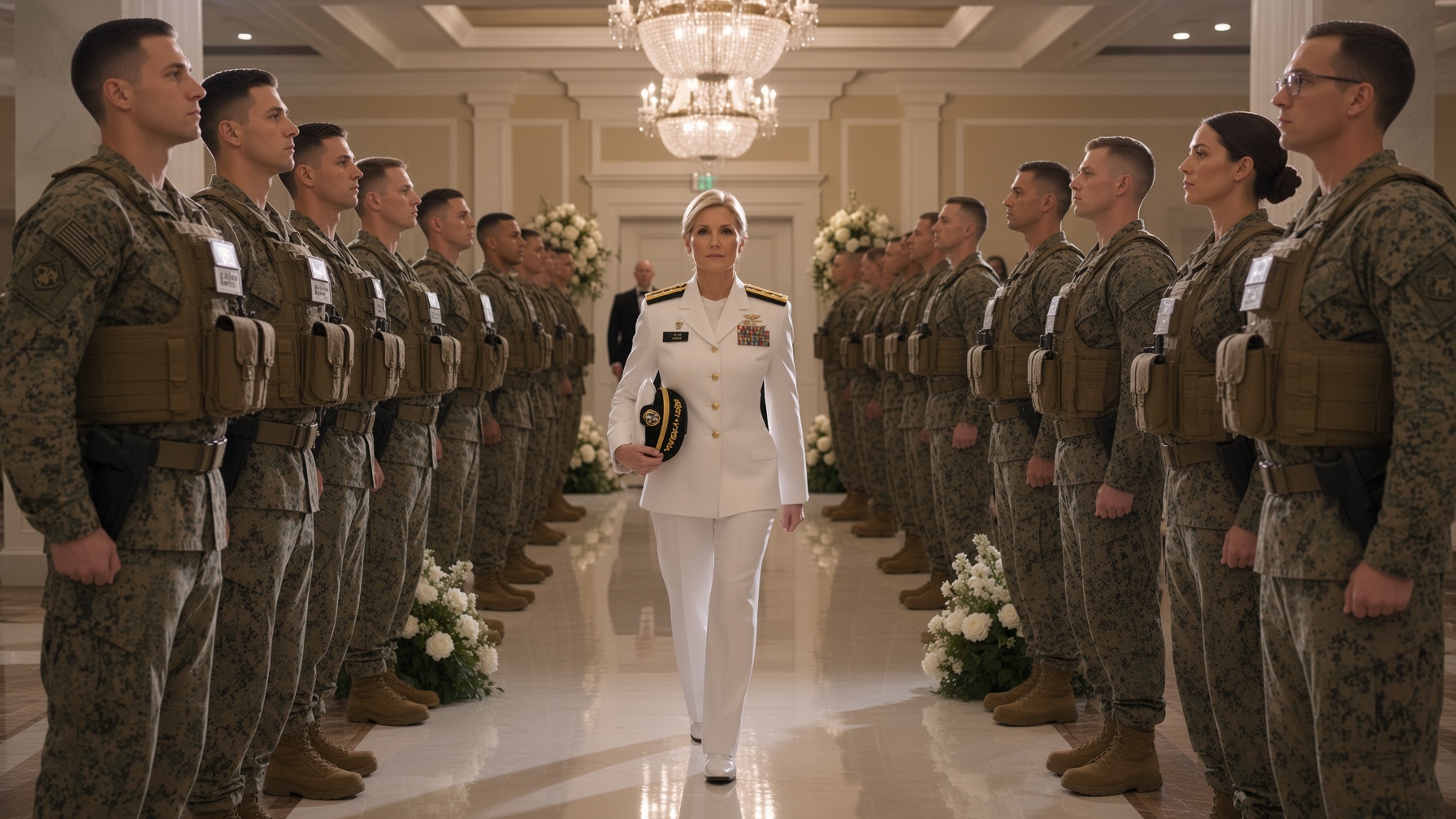
“Admiral on deck!”
The effect was immediate.
Every active-duty service member stood straight.
Retired officers rose next.
Veterans at tables across the ballroom followed automatically.
Grant stood.
Ethan stood.
Several guests who had no idea what was happening looked around and rose too.
Within seconds, almost two hundred people were standing.
The ballroom went silent.
I wanted the floor to open beneath me.
Not because I was ashamed.
Because I understood exactly what my father would think.
I turned.
He remained seated.
Mom stood beside him.
Natalie stood near the dance floor.
Her mouth was slightly open.
Dad stared at me.
For once, he had nothing to say.
Luis faced me.
“Ladies and gentlemen, forgive the interruption. Rear Admiral Evelyn Hart retires Monday after thirty-six years of service. We’re borrowing her for about twenty minutes after dessert.”
Laughter moved through the room.
“That’s all. Please continue celebrating the people who actually paid for this party.”
More laughter.
Natalie clapped.
Ethan joined her.
The room followed.
I wanted to strangle Luis.
Instead I said, “You are definitely not getting that promotion.”
He grinned.
“Worth it.”
People sat down.
The music resumed.
And then something unexpected happened.
Family members began approaching me.
Not strangers.
Family.
My cousin David came first.
“I thought you left the Navy years ago.”
I stared at him.
“What?”
He looked confused.
“Uncle Raymond said you moved into consulting.”
“When?”
“I don’t know. Ten years ago?”
My stomach tightened.
Aunt Rebecca approached next.
Her eyes moved across my uniform.
“Evelyn, honey, I had no idea.”
“No idea about what?”
“That you were an admiral.”
I looked toward Dad.
He was speaking urgently to Mom.
Aunt Rebecca continued.
“Your father always said you hated people asking about work.”
“I don’t.”
“He told us not to bother you.”
Something cold settled in my chest.
“What exactly did he tell you?”
She looked uncomfortable.
“That you wanted distance from the family.”
I stopped breathing for a second.
“What?”
“He said the Navy changed you.”
My cousin David nodded.
“He told Mom you didn’t want invitations because you were too busy.”
I remembered dozens of birthdays.
Christmas parties.
Graduations.
Family reunions I had never been invited to.
I had assumed everyone stopped asking because I missed too many.
“Did you invite me?” I asked.
Rebecca looked stunned.
“Of course.”
“When?”
“For years.”
“I never received anything.”
Her expression changed.
“We mailed things to your parents when you were deployed. Raymond said he forwarded them.”
I looked across the ballroom again.
Dad was watching now.
And suddenly I knew.
Not everything.
But enough.
I walked toward him.
Mom saw me coming.
Her face drained of color.
“Dad.”
“Not now.”
“Actually, now.”
“Evelyn.”
“What did you tell the family about me?”
He stood.
“This isn’t the place.”
“Did you tell them I didn’t want invitations?”
“People misunderstood.”
“Did you?”
He looked around.
“Lower your voice.”
My voice was already quiet.
“Did you tell Aunt Rebecca I wanted distance?”
Mom stepped in.
“Evelyn, please.”
I looked at her.
“You knew?”
She closed her eyes.
That was the answer.
I turned back to Dad.
“How long?”
He said nothing.
“How long have you been telling people I didn’t want contact?”
“Your schedule was complicated.”
“That isn’t what I asked.”
“You missed events.”
“So you stopped telling me about them?”
“You were never available.”
“You decided that for me?”
He looked furious now.
“I was protecting this family.”
“From what?”
His eyes flicked toward my uniform.
And there it was again.
Me.
He was protecting them from me.
Aunt Rebecca had followed us.
“So you never gave her my letters?”
Dad turned.
“Rebecca, stay out of this.”
My chest tightened.
“What letters?”
Everyone went silent.
Rebecca looked at me.
“The letters I sent after Annapolis.”
I stared at her.
“I never received letters from you.”
“Yes, you did.”
“No.”
“I mailed them to your parents’ house because you kept changing addresses.”
“How many?”
She looked at Dad.
“Every Christmas for years.”
My mouth went dry.
Dad walked away.
I followed.
“Stop.”
He kept moving.
“Dad.”
He entered a small hallway outside the ballroom.
I followed him.
Mom came behind us.
Natalie appeared a few seconds later.
“What’s happening?”
Dad turned.
“Nothing.”
I looked at my sister.
“Apparently Dad has been telling the family for years that I didn’t want anything to do with them.”
Natalie frowned.
“What?”
“And apparently people were sending me letters I never received.”
Mom sat slowly on a bench.
Natalie looked at her.
“Mom?”
Mom’s eyes filled.
That frightened me.
“Tell me,” I said.
Dad shook his head.
“Margaret.”
She ignored him.
“There’s a box.”
Everything stopped.
“What box?”
Mom looked at me.
“In the attic.”
Dad’s face changed.
“Enough.”
Mom continued.
“Letters. Cards. Newspaper clippings.”
I stared at her.
“For me?”
She nodded.
My father stepped between us.
“She doesn’t understand.”
Mom stood.
“I understand perfectly.”
It was the first time I had ever heard her speak to him that way.
Dad stared at her.
Mom looked at me.
“Your father started saving them when you went to Annapolis.”
“Saving them?”
Her face crumpled.
“Hiding them.”
Thirty-six years.
I could barely process the number.
“Why?”
Dad answered.
“Because you didn’t need them.”
I turned toward him.
“What?”
“You had the Navy.”
His voice was shaking now.
“You had officers praising you. Teachers praising you. Every time you came home, there was another certificate. Another promotion. Another story.”
I stared.
“You hid my mail because people were proud of me?”
“You don’t understand.”
“Then explain.”
He looked toward Natalie.
She stood frozen near the wall.
“When your sister was little,” he said, “everything became about you.”
Natalie’s eyes widened.
“That’s not true.”
Dad ignored her.
“You were the smart one. The brave one. The one leaving town. Then Annapolis. Then ships. Every year you came home with something bigger.”
I felt strangely calm.
“So?”
“So Natalie lived in your shadow.”
Natalie stepped forward.
“No, I didn’t.”
Dad snapped, “You don’t remember.”
“I remember plenty.”
He looked at me again.
“I wanted one child to have a normal life.”
There was that word.
Normal.
I had heard it my entire life.
“I didn’t stop Natalie from having anything.”
“You didn’t have to.”
“How does hiding my mail help her?”
Dad’s face twisted with frustration.
“You were always gone. She was here.”
“So you punished me for leaving.”
“I protected what was here.”
“By telling everyone I didn’t care about them?”
He didn’t answer.
That hurt more than I expected.
For years, I had believed my extended family simply stopped caring.
I remembered deployments where holidays passed quietly.
Birthdays when no family cards arrived.
Promotions nobody mentioned.
I had built an entire emotional defense around it.
I had told myself I didn’t need them.
I had told myself the Navy was enough.
Maybe part of that had been true.
But another part had been constructed by my father.
“You told me they didn’t ask about me,” I said.
Dad looked away.
“You told me Aunt Rebecca thought I was arrogant.”
Silence.
“You told me David stopped inviting me because I always said no.”
Nothing.
“You told me Grandma didn’t understand why I joined.”
Mom began crying.
I stared at him.
“Was any of it true?”
His face hardened.
“You’re making yourself the victim.”
I laughed once.
I couldn’t help it.
Natalie stared at him.
“Dad.”
He turned toward her.
“Don’t.”
“No.”
She moved closer.
“Don’t tell me not to talk.”
“Natalie.”
“You did all that because of me?”
“I did it for you.”
“I never asked you to.”
“You were a child.”
“I’m fifty-two.”
He looked stunned.
Natalie continued.
“You told me Evelyn didn’t come because she chose work.”
“She did choose work.”
“She was deployed.”
“She could have left.”
I saw Natalie’s expression change.
For the first time, she understood something I had stopped trying to explain years earlier.
“You made me angry at her,” she whispered.
Dad said nothing.
“You told me she didn’t care enough to come home.”
“She missed your graduation dinner.”
“She was in the Indian Ocean.”
“She always had an excuse.”
“That’s not an excuse.”
Natalie’s voice cracked.
“That’s her job.”
Dad looked toward the ballroom.
“We are not doing this at your wedding.”
Natalie stared at him.
“You started this thirty-six years ago.”
Nobody spoke.
Music drifted faintly through the doors.
Guests laughed somewhere beyond the hallway.
Life continued while our family quietly changed shape.
I looked at Mom.
“How much did you know?”
She wiped her face.
“Not all of it.”
“How much?”
“I knew about some cards.”
“And you let him hide them?”
Her shoulders dropped.
“I kept thinking it would stop.”
“When?”
“I don’t know.”
“That isn’t an answer.”
“I was afraid of fighting with him.”
I nodded slowly.
That answer I believed.
Mom had spent most of her life managing Dad’s moods.
Moving conversations around him.
Softening statements.
Keeping peace.
I finally understood the price.
Not just for her.
For everyone.
Dad looked at me.
“I did what I thought was best.”
I almost felt sorry for him.
Almost.
“You had thirty-six years to reconsider.”
He opened his mouth.
I raised one hand.
“No.”
He stopped.
“I’m not going to scream at you. I’m not going to ruin Natalie’s wedding. And I’m not going to stand here while you explain why lying to everyone was somehow an act of love.”
I removed my phone from my pocket.
“What are you doing?” he asked.
“Ordering a car.”
“Evelyn.”
“I’m going to the retirement gathering next door.”
His expression changed.
“So that’s it?”
“For tonight.”
“You walk away like always.”
I looked at him.
“No, Dad.”
I kept my voice steady.
“You spent thirty-six years telling everyone I walked away. Tonight I’m simply choosing where I want to stand.”
Then I turned.
Natalie followed me.
I stopped.
“This is your wedding.”
“I know.”
“Go back inside.”
“I’m coming with you.”
“No.”
She frowned.
“Why?”
“Because your husband is in there.”
That finally made her smile through tears.
“Oh.”
“Go dance with him.”
She looked at me.
“Are we okay?”
The question broke something inside me.
I stepped closer and wrapped both arms around her.
She pressed her face against my shoulder.
“Yes,” I said.
“We’re okay.”
“I’m sorry.”
“For what?”
“For believing him.”
“You were a kid.”
“I wasn’t a kid forever.”
“Neither was I.”
She pulled back.
“I should have asked.”
“So should I.”
She wiped beneath one eye carefully to protect her makeup.
“Are you leaving?”
“No.”
“Promise?”
“I promise.”
She nodded.
Then she looked toward Dad.
“I’m going to need time with him.”
“So am I.”
She inhaled.
“All right.”
I adjusted the loose edge of her veil.
“Go enjoy your wedding.”
“Yes, Admiral.”
I stared at her.
She grinned.
It was the first time my sister had ever called me that.
The Jefferson Room contained fifty-three people.
Luis had lied again.
Nobody gave a speech longer than five minutes because apparently he really had threatened them.
Daniel Mason went first.
He spoke for three.
Rachel Kim spoke for four.
Master Chief Doyle spoke for exactly two minutes and thirty seconds, then announced he was only stopping because someone had threatened to shut off the microphone.
They told stories.
Most were embarrassing.
Some were serious.
A few made me laugh hard enough that I had to wipe my eyes.
Nobody talked about medals.
Nobody talked about stars.
They talked about work.
About mistakes.
About long nights.
About the time I stayed in a maintenance office until sunrise because a twenty-three-year-old lieutenant had made an error and thought his career was finished.
About the Christmas I spent serving breakfast because half the mess staff were sick.
About the sailor whose mother died while we were deployed and the complicated effort to get him home.
Small things.
Human things.
That was what stayed with people.
Near the end, Admiral Thomas Wallace stood.
He was seventy-one and had retired six years earlier.
He looked around the room.
“Evelyn hated ceremonies when I met her.”
“I still do.”
Everyone laughed.
“She also hated compliments.”
“Still true.”
“Which is why we should continue for another forty minutes.”
More laughter.
Then his expression became serious.
“Leadership is not the rank people call you when you enter a room. Leadership is what they say when you have left it.”
The room became quiet.
Thomas looked at me.
“You built people.”
I swallowed.
“That matters.”
For the first time that evening, I couldn’t think of anything to say.
Thomas raised his glass.
“To Admiral Hart.”
Everyone followed.
I looked around the room.
Thirty-six years.
Standing in front of me.
Not in ribbons.
In faces.
“Thank you,” I said.
My voice almost failed.
“For everything.”
That was enough.
When the toast ended, I noticed someone standing near the doorway.
Natalie.
Ethan beside her.
Grant and his wife behind them.
My sister had been listening.
She smiled.
Then another figure appeared.
Mom.
Alone.
I walked toward her.
She held a room key in her palm.
“What’s that?”
“The house.”
I frowned.
She shook her head.
“Not the house key. I mean… I booked us another room tomorrow.”
“Why?”
“Your father and I are going home in the morning.”
I waited.
Mom continued.
“I’m getting the box.”
My throat tightened.
“You don’t need to.”
“Yes.”
She looked directly at me.
“You should have every letter.”
I nodded.
“Okay.”
“There may be hundreds.”
That almost knocked the air from me.
“How many?”
“I don’t know.”
She looked ashamed.
“Birthday cards. Christmas cards. Copies of articles people mailed. Notes from relatives. Invitations.”
I looked away.
Mom continued.
“There are also things from us.”
“From you?”
“Letters I wrote and didn’t mail.”
“Why?”
“Because your father said you were too busy.”
I laughed sadly.
“You believed him?”
“I wanted to.”
That was an unexpectedly honest answer.
She looked toward the room full of sailors and officers.
“I think I let your father convince me your life didn’t need us.”
I said nothing.
“He was wrong.”
“Yes.”
“So was I.”
She stepped closer.
“I’m sorry.”
I could not repair thirty-six years in a hotel hallway.
Neither could she.
But I could recognize the difference between an excuse and an apology.
“That means something,” I said.
She nodded.
“I know it isn’t enough.”
“No.”
“It’s a start?”
I looked at her.
“Yes.”
“A start.”
I returned to the wedding reception shortly after ten.
Nobody announced me.
Nobody stood.
Thank God.
The band was playing something from the eighties.
Natalie and Ethan were dancing badly and enjoying themselves.
Grant waved me toward his table.
“I owe you an apology,” he said.
“For what?”
“The announcement.”
“That was Luis.”
“I approved it.”
“I’ll blame both of you.”
“Fair.”
He smiled.
Then his expression became serious.
“Ray told me you were an administrative planner because he was ashamed?”
“Something like that.”
Grant shook his head.
“I spent thirty years wishing my father had lived long enough to see what I built.”
I didn’t know what to say.
He continued.
“Some people don’t understand what they have.”
I looked across the ballroom.
Dad sat alone.
For one moment, I saw not the man who had hurt me, but an old man who had spent decades protecting himself from something nobody else considered a threat.
My success.
My independence.
Maybe even my happiness outside the life he had planned.
I didn’t forgive him.
Not then.
But I understood something important.
His discomfort had never been proof that I had done something wrong.
That realization felt strangely freeing.
Natalie appeared beside me.
“Dance.”
“No.”
“Yes.”
“I don’t dance.”
“You commanded ships.”
“Ships don’t expect rhythm.”
She grabbed neither arm nor hand. Instead she stepped directly in front of me until I had no choice but to follow her toward the dance floor.
Ethan laughed.
“You’re in trouble, Admiral.”
Apparently everyone had discovered my title.
Natalie and I danced.
Badly.
Very badly.
I didn’t care.
Halfway through the song, she leaned closer.
“I’m glad you wore it.”
I looked at her.
“Really?”
“Yes.”
“Why?”
She smiled.
“Because apparently I needed to see you.”
That stayed with me.
Not the stars.
Not the applause.
That sentence.
Sunday afternoon, Mom arrived at my house in Norfolk carrying two large plastic storage boxes.
Dad did not come.
She placed the first box on my dining table.
I removed the lid.
The oldest envelope was yellowed.
My name was written across the front.
Midshipman Evelyn Hart.
The postmark was thirty-five years old.
Aunt Rebecca.
I opened it.
Inside was a short letter congratulating me on completing my first difficult summer at Annapolis.
At the bottom she had written:
Your grandmother tells everyone who will listen that you are going to command a ship someday.
I sat down.
My grandmother had died before I received my first command.
I had always believed she disapproved of my career.
Because Dad told me she did.
I opened another letter.
Then another.
Christmas cards.
Wedding invitations.
Birth announcements.
Graduation photographs.
Notes from cousins.
An old newspaper clipping about my first command.
Someone had circled my name in blue ink and written:
That’s our Evelyn!
I covered my mouth.
Mom sat across from me.
Neither of us spoke.
The second box was worse.
It contained letters she had written.
Some unfinished.
Some sealed but never mailed.
One was dated December 1999.
I had been deployed.
Dear Evelyn,
Christmas feels strange without you. Your father says not to make you feel guilty, so I probably won’t send this. Natalie misses you more than she admits. So do I.
I stopped reading.
For years, I had spent holidays believing nobody noticed my absence.
They had noticed.
They had simply failed to tell me.
I looked at Mom.
“Why did you keep these?”
“I don’t know.”
“Yes, you do.”
She thought about it.
“Maybe because throwing them away felt worse.”
I nodded.
We spent three hours opening mail.
Thirty-six years cannot be returned in an afternoon.
But pieces can be recovered.
Names.
Photographs.
Words.
Evidence that the story you believed about yourself was incomplete.
Around four, Mom’s phone rang.
Dad.
She looked at the screen.
Then at me.
“Do you want to talk to him?”
“No.”
She nodded.
And for once, she didn’t tell me I should.
Monday morning, I retired.
Luis had lied about that ceremony too.
There were more than one hundred people.
I decided not to fight him.
My dress whites felt different that morning.
Not heavier.
Just temporary.
When the ceremony ended, I stood for several minutes looking at the uniform I had worn for so much of my adult life.
Then I changed into a navy-blue suit.
No stars.
No ribbons.
No reason for anyone to stand when I entered a room.
It felt strange.
Luis walked beside me toward the parking lot.
“So,” he said, “what are you going to do tomorrow?”
“Sleep.”
“You wake up at five.”
“I’ll learn.”
“Impossible.”
“Commander.”
He smiled.
“Retired Admiral.”
I stopped.
He stopped too.
“Thank you.”
“For what?”
“You know.”
He pretended to think.
“The unauthorized wedding announcement?”
“Yes.”
“The forty-seven-person gathering?”
“It was fifty-three.”
“Administrative rounding.”
I laughed.
Then I became serious.
“I spent a long time believing my family didn’t care about what I did.”
Luis said nothing.
“Turns out that wasn’t exactly true.”
“No.”
“I’m still figuring out what to do with that.”
He nodded.
“That sounds like tomorrow’s problem.”
“Good answer.”
“I learned from excellent leadership.”
I rolled my eyes.
“Go back to work.”
“Yes, ma’am.”
He walked away.
I stood beside my car and looked toward the harbor.
Thirty-six years earlier, my father had tried to decide which parts of me were acceptable.
For a long time, I let his disappointment become a measurement.
Every promotion came with a thought I hated admitting.
Maybe this one will impress him.
It never did.
Because the problem had never been the size of the achievement.
The problem was that it was mine.
That afternoon, Natalie called.
“Ethan and I are at the airport.”
“How’s married life?”
“He already lost a passport.”
“Excellent start.”
“It was in his backpack.”
“Less interesting.”
She laughed.
Then she became quiet.
“Mom told me about the boxes.”
“Yeah.”
“Are you okay?”
“I will be.”
“Dad called me.”
I waited.
“What did he say?”
“That you’ve turned everyone against him.”
I almost smiled.
“Of course.”
“I told him he managed that himself.”
“That probably went well.”
“It did not.”
We both laughed.
Then Natalie said, “I need to ask you something.”
“Go ahead.”
“When we get back, will you tell me about the ribbons?”
I looked across my quiet house.
The uniform was hanging upstairs.
The boxes of letters sat on my dining-room table.
For thirty-six years, my family had treated my career like an inconvenient subject.
Now my sister was asking.
“Sure.”
“All of them?”
“That might take a while.”
“We’ll order dinner.”
“Deal.”
She paused.
“And Evelyn?”
“Yes?”
“I’m proud of you.”
I closed my eyes.
People had said those words to me before.
Commanders.
Sailors.
Friends.
Strangers.
But never my sister.
“Thank you,” I said.
She didn’t hear how difficult the words were.
Maybe that was better.
After we ended the call, I carried the boxes into my office.
I placed the oldest letter on my desk beside the photograph of my first crew.
Then I sat down.
No uniform.
No title on the door.
No schedule waiting for approval.
Just me.
Later that evening, another message arrived.
Dad.
I expected anger.
Instead there were only six words.
I don’t know how to fix this.
I stared at them for a long time.
Then I typed:
Start by telling the truth.
I sent it.
He didn’t answer that night.
That was fine.
Some things could not be repaired with one conversation.
Some things might never be repaired completely.
But I no longer needed to protect him from the consequences of what he had done.
And I no longer needed to shrink myself so he could feel comfortable.
My sister’s wedding had not been ruined by my uniform.
Nobody had confused me with the bride.
Nobody had spent the evening discussing medals.
Natalie had danced, laughed, eaten cake, and left the ballroom married to the man she loved.
The only thing my uniform had disrupted was a story my father had spent thirty-six years telling.
That I had chosen the Navy because I did not care about my family.
That nobody was interested in my career.
That relatives had forgotten me.
That my absence meant rejection.
That my success embarrassed everyone.
None of it had been true.
The truth was far simpler.
I had built a life my father could not control.
He had tried to make that life smaller by controlling the way other people saw it.
For decades, I believed him.
Then one commander called a room to attention.
People stood.
Not because I demanded it.
Not because my father approved.
They stood because they knew who I was.
And for the first time in thirty-six years, my family finally did too.