For twenty-nine years, the Army had taught me how to walk into a difficult room without bringing my fear in with me.
That lesson had carried me through emergency briefings, overseas assignments, middle-of-the-night calls, and more family separations than I cared to count. I had learned to read a situation before speaking. I had learned that the person shouting loudest was not always the person in control.
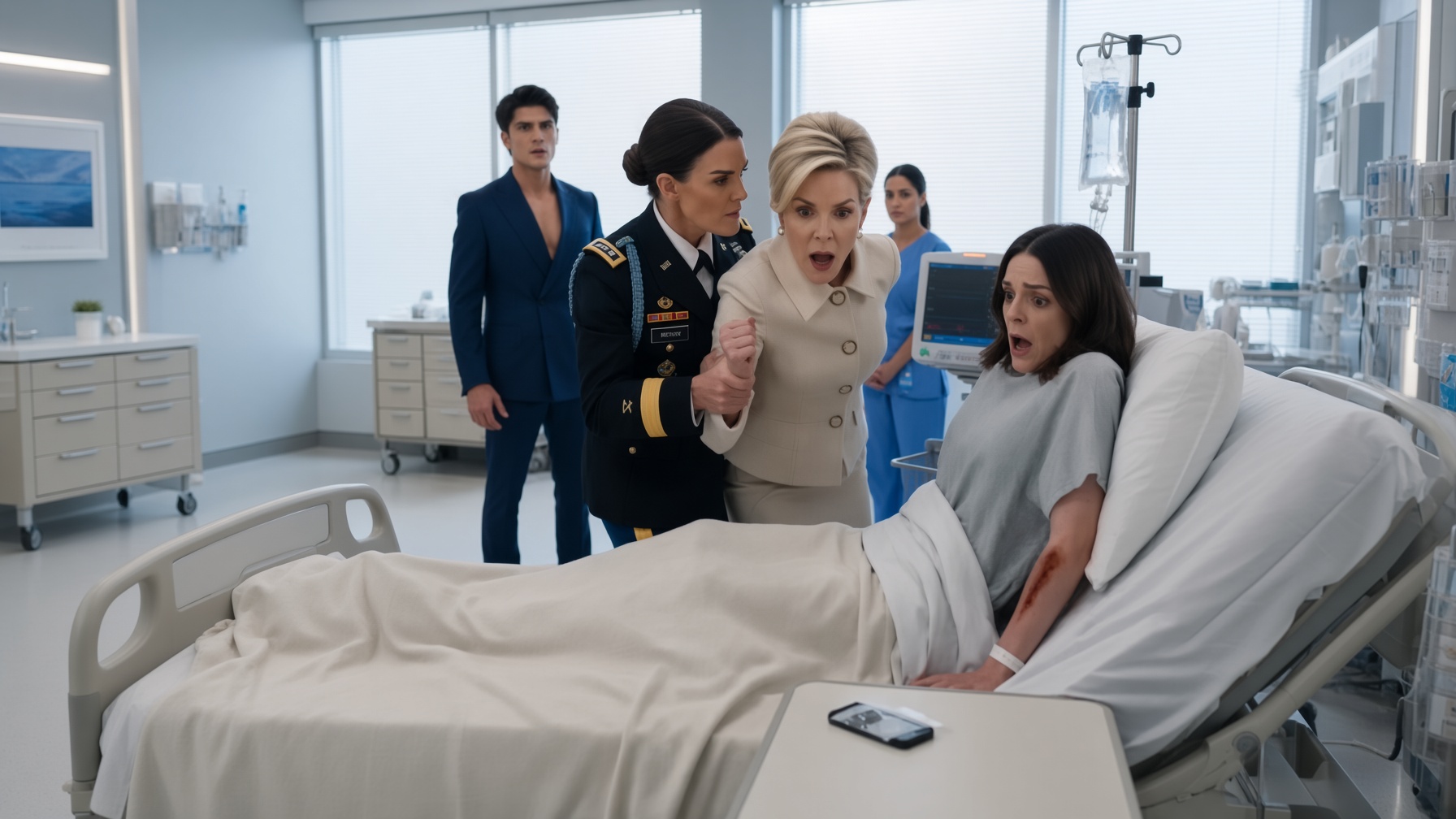
None of that training mattered when I saw my daughter in Room 614 at St. Catherine Medical Center.
I was still wearing my service uniform because I had come directly from Fort Adams. My jacket felt too tight across my shoulders, and the ribbon rack I had carefully straightened that morning suddenly seemed absurdly formal beneath the hospital’s fluorescent lights.
Natalie was curled against the raised side of the bed.
She was thirty years old, but for one terrible second, all I saw was the seven-year-old girl who used to crawl into my bed when thunderstorms rolled over our house.
One of her eyes was swollen almost shut.
A small cut crossed her lower lip.
Dark marks circled both of her upper arms.
Her hair, normally brushed smooth and tucked behind her ears, hung in uneven strands across her face.
A hospital blanket covered her from the waist down.
Her fingers had twisted so tightly into the fabric that her knuckles had gone pale.
On the plastic chair beside the bed sat the remains of her phone.
The screen was shattered.
The case had split apart.
A corner of the metal frame was bent inward.
Beside it lay a hospital gown with several dark red marks along one sleeve.
For a few seconds, I simply stood there.
Natalie saw me.
Her face changed.
Not relief exactly.
Something more painful.
Permission.
“Mom.”
Her voice barely carried across the room.
Then she whispered, “Please don’t leave me.”
I crossed the room.
I lowered the bed rail and sat beside her. I slid one arm carefully behind her shoulders and the other beneath her elbows, drawing her against the front of my uniform without putting pressure on the injuries around her ribs.
Natalie pressed her face against my jacket.
Her entire body began shaking.
I felt warm tears soak through the fabric near my collar.
“I’m here,” I said.
She made a small sound that seemed to come from somewhere deeper than crying.
“I thought you wouldn’t get here.”
“You called me.”
“I didn’t.”
I pulled back enough to see her face.
“What?”
“My phone was already gone.”
I looked toward the broken device.
“Then who called?”
“The hospital.”
I remembered the voice.
At 5:18 that afternoon, a woman from St. Catherine had called my office and asked whether I was Colonel Laura Bennett.
She had told me my daughter had been admitted.
She had not explained much more.
I had left my deputy commander with three meetings, driven through two hours of traffic in less than ninety minutes, and spent the entire trip telling myself Natalie had probably been in a car accident.
Now I knew there had been no accident.
I slid my hand across the mattress and wrapped my fingers around hers.
“What happened?”
Natalie looked toward the closed door.
Her lips trembled.
“Mom, I tried to leave.”
“Leave Grant?”
She nodded.
My son-in-law.
Grant Whitmore.
Thirty-four years old.
Private schools.
An economics degree from Georgetown.
A family business with its name on half the charitable foundations in our county.
A man who wore tailored suits even when everyone else wore jeans.
A man who had once driven three hours through a snowstorm because Natalie had forgotten her medication at our house.
A man who brought me expensive bourbon at Christmas even after I told him every year that I preferred coffee.
A man who called me Colonel even at Thanksgiving.
I had never particularly liked him.
But I had respected what I thought was his devotion to my daughter.
I was beginning to understand how expensive that mistake might have been.
“What happened when you tried to leave?” I asked.
Natalie stared down at our joined hands.
“He took my keys.”
“Grant did?”
“Yes.”
“When?”
“Friday.”
It was Monday.
My jaw tightened.
“And your phone?”
“Saturday morning.”
“What happened between Friday and today?”
Natalie swallowed.
“He said we needed time to calm down.”
“Where?”
“At the guesthouse.”
The Whitmore estate sat eighteen miles north of the city on seventy wooded acres that had belonged to Grant’s grandfather.
I had been there many times.
The main house looked more like a boutique hotel than a family home. The guesthouse stood several hundred yards away near the edge of the property.
Grant and Natalie had stayed there while renovating their downtown townhouse.
I suddenly remembered something Natalie had said three months earlier.
Grant liked the guesthouse because it was quiet.
At the time, that had sounded harmless.
Now it did not.
“He locked you inside?” I asked.
Natalie nodded.
“From the outside?”
“There’s an electronic system. You can disable the doors from the main control room.”
“How do you know?”
“He showed me once.”
Her breathing became shallow.
I lowered my voice.
“Look at me.”
She raised her eyes.
“You don’t have to tell me everything tonight.”
“I do.”
“No.”
“Yes, I do.”
The desperation in her voice stopped me.
She glanced toward the door again.
“They keep telling people things before I can explain.”
“What things?”
“That I’m unstable.”
The word came out quietly.
Too quietly.
As if she had said it many times before.
“That I get confused. That I forget things. That I have panic episodes.”
“Do you?”
“I get anxious.”
“That isn’t the same thing.”
“I know.”
“Do you forget things?”
She hesitated.
“Sometimes.”
“How often?”
“I don’t know anymore.”
That answer frightened me more than anything else she had said.
Before I could ask another question, laughter drifted from the hallway.
Natalie’s fingers tightened around mine.
The door opened.
Grant entered first.
His mother, Diane Whitmore, followed.
Behind her came Grant’s older brother, Colin.
All three stopped when they saw me.
Grant recovered first.
“Colonel Bennett.”
He glanced at my uniform.
“You got here quickly.”
“I came when I heard Natalie was injured.”
He exhaled through his nose.
“Of course.”
Diane walked farther into the room.
She was sixty-two and looked exactly as she always did.
Perfect silver-blond hair.
Pearl earrings.
Cream blouse.
Camel-colored coat.
Not one sign that her daughter-in-law had been admitted to a hospital with visible injuries.
“Laura,” she said gently. “I’m so sorry you were dragged into this.”
Dragged into this.
I looked at Natalie.
She had moved closer to the far side of the bed.
Grant noticed.
His expression hardened for half a second before smoothing again.
“What happened to my daughter?” I asked.
Diane gave Natalie a sad smile.
“She fell.”
I looked at the marks around Natalie’s arms.
“Where?”
“The guesthouse.”
“How?”
“There are stairs.”
“You have stairs that leave marks around both upper arms?”
Grant made a frustrated sound.
“Can we not do this?”
I turned toward him.
“Do what?”
“Turn everything into an interrogation.”
“My daughter is in a hospital.”
“She had an episode.”
Natalie’s face changed immediately.
“Stop saying that.”
Grant looked at her.
“I’m trying to protect you.”
“You locked me inside.”
“There,” Grant said, turning to me. “That’s what I mean.”
Natalie stared at him.
“You did.”
“No one locked you anywhere.”
“The doors wouldn’t open.”
“Because you damaged the security system.”
“I didn’t.”
“Natalie.”
His voice changed when he said her name.
Not louder.
Softer.
Almost patient.
That made it worse.
“You were confused.”
She shrank back.
I watched Grant carefully.
He was not arguing with her.
He was rewriting the conversation while it was happening.
Diane moved beside him.
“Laura, Natalie has been struggling emotionally for months.”
“According to whom?”
“Her doctor.”
“Which doctor?”
Diane’s smile thinned.
“Surely this isn’t appropriate.”
“My daughter is injured. Everything is appropriate.”
Colin leaned against the doorframe.
He was forty, broad-shouldered and permanently amused by other people.
I had disliked him since the first Thanksgiving I met him.
That afternoon, he had spent twenty minutes describing a waitress as incompetent because she had brought him the wrong wine.
Now he looked at Natalie and smiled.
“You really want to keep doing this?”
Natalie lowered her eyes.
I stood.
I did not move toward him.
I simply put myself between the bed and the door.
“Doing what?” I asked.
Colin lifted one shoulder.
“Making accusations.”
Diane sighed.
“This is becoming unnecessarily hostile.”
“No,” I said. “I’m asking simple questions.”
Grant looked at my ribbons again.
“You’re not on a base, Colonel.”
“I’m aware.”
“You don’t have authority here.”
“I didn’t say I did.”
Diane’s expression cooled.
“Our family has been part of this community for generations.”
I waited.
“We know judges. We know people in law enforcement. We support this hospital. We support several local newspapers. We have relationships with people who understand that family matters can become distorted very quickly.”
There it was.
Not quite a threat.
People like Diane rarely made direct threats.
They preferred reminders.
She glanced at my uniform.
“Your position may be important in your world, Laura. It doesn’t mean very much in ours.”
I thought she expected anger.
I gave her none.
I had spent too many years learning that silence often made arrogant people reveal more.
“I want Natalie examined by a doctor with no connection to your family,” I said.
Grant laughed once.
“You’re serious.”
“Completely.”
“She has already been examined.”
“By whom?”
“Dr. Voss.”
Natalie stopped breathing for a second.
I noticed.
“Who is Dr. Voss?” I asked.
Diane answered.
“Natalie’s physician.”
“No,” Natalie whispered.
Everyone looked at her.
She stared at her mother-in-law.
“She’s not my physician.”
Diane’s voice stayed calm.
“Sweetheart, Elaine has been overseeing your care for months.”
“I never asked her to.”
Grant ran a hand through his hair.
“Here we go again.”
Natalie’s eyes filled.
“You brought her to the house.”
“Because you were struggling.”
“You told me she was a family friend.”
“She is.”
“Then why was she giving you my information?”
Grant’s face went still.
I turned to Natalie.
“What information?”
Before she could answer, a nurse entered.
She was in her late forties with a practical expression and a badge that read MARISOL VEGA, RN.
She carried a clear evidence pouch.
Inside was Natalie’s damaged phone.
Beneath it sat a tiny black memory card.
Grant’s face changed.
Diane’s changed even faster.
The transformation lasted less than a second.
But I saw it.
Fear.
Marisol looked around the crowded room.
“Mrs. Whitmore, we found another item when we changed your bedding.”
Natalie stared at the pouch.
“Oh.”
Diane took one step forward.
“What is that?”
Marisol looked at Natalie.
“Is it yours?”
Natalie’s breathing quickened.
“Yes.”
Grant moved closer.
“What is it?”
Natalie did not answer.
Marisol turned the pouch so we could see the memory card more clearly.
Someone had scratched three letters across its plastic surface.
RUN.
The room went silent.
My eyes moved from the card to Natalie.
“You put that there?”
“Yes.”
“When?”
“Before I left.”
Grant stepped forward.
“Give me that.”
Marisol immediately moved the pouch behind her hip.
“This is hospital property pending documentation.”
“It belongs to my wife.”
Natalie’s voice came from behind me.
“No, it doesn’t.”
Grant looked at her.
Diane suddenly moved.
She reached toward the evidence pouch.
I stepped sideways and closed my hand around her forearm before her fingers reached the plastic.
Diane froze.
So did everyone else.
I released her immediately and lowered my arm.
“What are you doing?” she demanded.
“Stopping you from taking something that isn’t yours.”
Diane stared at me.
Her voice dropped.
“You should be very careful.”
I looked directly at her.
“I am.”
Colin gave an awkward laugh.
“You’re all acting like a piece of plastic is some kind of secret government file.”
I turned toward him.
“If it means nothing, why did your mother just try to take it?”
He stopped smiling.
Marisol looked increasingly uncomfortable.
“I’m taking this to hospital security.”
“Yes,” I said. “Please document exactly where it was found and everyone who was present.”
Grant scoffed.
“Oh, come on.”
Marisol looked at him.
“I was already planning to.”
She left.
The door clicked shut.
Grant stared after her.
Then his attention returned to Natalie.
His face no longer looked polished.
It looked angry.
He stepped toward the bed.
“You have no idea what you’ve started.”
I moved in front of him.
“You will not speak to her like that.”
Grant stopped.
His jaw worked.
“You think wearing that uniform makes you untouchable?”
“No.”
I glanced back at my daughter.
“It reminds me to keep my word.”
Grant looked confused.
“What word?”
“The one I gave her the day she was born.”
Natalie covered her mouth with one hand.
Diane rolled her eyes.
“This is melodramatic.”
I faced her.
“Then leave.”
“This is our family.”
“Natalie is my family.”
“She is Grant’s wife.”
“She is still my daughter.”
Colin straightened from the doorway.
“Nobody is keeping her here.”
Natalie looked at him.
“You did.”
Colin’s expression changed.
“What?”
“You stood outside the guesthouse.”
He laughed.
“I was checking on you.”
“You told me the gate wouldn’t open.”
“Because you weren’t supposed to drive in your condition.”
“What condition?”
He looked at Grant.
That was his mistake.
For one second, no one spoke.
Then Grant said, “Her emotional state.”
Natalie flinched.
Not dramatically.
Just a quick tightening through her shoulders.
But I saw it.
She had heard those words many times.
Probably in that exact tone.
I pressed the call button beside the bed.
A nurse answered.
“I need hospital security in Room 614.”
Diane stared at me.
“That’s ridiculous.”
“I disagree.”
“You’re embarrassing yourself.”
“Then you should have no problem leaving.”
Hospital security arrived four minutes later.
Grant protested.
Diane demanded a supervisor.
Colin tried to make jokes.
None of it mattered.
Natalie was an adult patient and had requested they leave.
Security escorted all three into the hallway.
Grant turned before the door closed.
“This isn’t finished.”
Natalie looked away.
I watched him until the latch caught.
Only then did I sit again.
Natalie stared at the blanket.
“I’m sorry.”
“For what?”
“For all of this.”
“You didn’t create this.”
“I should have told you earlier.”
“Probably.”
She looked up, surprised.
I gave her a tired smile.
“I’m not going to lie to you because you’re upset.”
A tiny sound escaped her that was almost a laugh.
Then she started crying again.
“I was embarrassed.”
“Why?”
“Because everyone liked him.”
“I didn’t.”
That produced a real, brief laugh.
“You never liked anybody I dated.”
“I liked Marcus.”
“You called Marcus a walking guitar case.”
“He was a musician who owned no furniture.”
“He had a couch.”
“It was inflatable.”
Natalie wiped her face.
For three seconds, she looked like herself again.
Then her expression faded.
“Grant wasn’t like this in the beginning.”
“I know.”
“He used to bring me coffee at work.”
“I remember.”
“He remembered everything. What I ate. What time my meetings ended. Which coworkers annoyed me.”
“Attention can feel like care.”
She looked at me.
I continued gently.
“Sometimes it is care. Sometimes it becomes something else.”
Natalie nodded.
“At first, I thought I was lucky.”
She told me the rules had arrived gradually.
Grant did not call them rules.
He called them conveniences.
He suggested she share her location because their schedules were complicated.
He combined their phone plan because his company received a better rate.
He encouraged her to stop driving downtown because parking upset her.
He offered to manage household accounts because finances were stressful.
When she complained about a friend he disliked, Grant explained that healthy marriages required boundaries.
When she went to dinner with that friend anyway, Grant stayed awake until two in the morning, calmly explaining every way her decision had disrespected their relationship.
“He never shouted then,” Natalie said.
“What did he do?”
“He talked.”
“For how long?”
“Hours.”
“About?”
“Why everything I remembered was wrong.”
I said nothing.
“If I said he told me something, he’d ask exactly what words he used. If I couldn’t remember every word, he said I was making assumptions. If I did remember, he said I misunderstood the context.”
She stared toward the window.
“Eventually I started taking notes.”
“What happened to them?”
“He found them.”
“How?”
“I don’t know.”
“What did he say?”
“That keeping notes on my husband was unhealthy.”
She laughed bitterly.
“Then Dr. Voss agreed with him.”
I remembered the name.
“Elaine Voss.”
“Yes.”
“What kind of doctor is she?”
“Psychiatrist.”
“You were seeing a psychiatrist?”
“Not exactly.”
I waited.
“Grant’s mother invited her to dinner about eight months ago. She was charming. She asked me about work and sleep and whether I ever felt overwhelmed. A week later, Grant told me Elaine thought I should take something for anxiety.”
“Did she examine you?”
“Not formally.”
“Did she prescribe medication?”
Natalie looked ashamed.
“Yes.”
“Did you take it?”
“For a while.”
“What happened?”
“I stopped sleeping normally. I felt foggy all day. Sometimes I couldn’t remember conversations.”
My stomach tightened.
“Did you tell Dr. Voss?”
“She increased it.”
I breathed slowly through my nose.
“And Grant later used your memory problems as proof you were unstable.”
Natalie nodded.
“He would say things happened differently. Sometimes I believed him.”
I looked toward the door.
“What made you decide to leave?”
“A blue mug.”
I frowned.
“What?”
She almost smiled.
“It sounds stupid.”
“Nothing about tonight sounds stupid.”
“We had four blue mugs from our wedding registry. Grant hated them. He said they looked cheap. About a month ago, I noticed only three were left.”
I waited.
“He told me I broke one.”
“Did you?”
“I didn’t remember breaking it. But I believed him.”
She picked at a thread on the blanket.
“Last Thursday, I was looking for a serving tray in the basement storage room. The missing mug was in a box with Christmas decorations.”
I understood.
“He lied about something that didn’t matter.”
“Yes.”
“Which meant he could lie about things that did.”
Natalie nodded.
“That stupid mug made me feel like I could breathe again.”
The next morning she called an apartment complex from her office and asked about short-term leases.
She opened a new email address.
She moved some personal documents to a locker at her gym.
She planned to tell Grant she needed space after work Friday.
“I thought he would argue,” she said. “I thought he would cry. Maybe threaten divorce.”
“What happened?”
“He smiled.”
That bothered me.
“He said he understood. He said we should go to the guesthouse for the weekend and talk somewhere private.”
“And you went.”
“I know.”
“You trusted your husband to talk.”
“I should have known.”
“No. Keep going.”
They drove separately because Natalie planned to leave afterward.
When they arrived, Diane was already there.
So was Colin.
That was when Natalie knew something was wrong.
Grant asked for her car keys.
She refused.
Colin took her purse from the kitchen counter while Grant kept talking.
Natalie tried to leave.
The front door would not unlock.
“At first I thought the system was broken.”
“It wasn’t.”
“No.”
Diane told Natalie she needed rest.
Grant told her she was making dangerous choices.
Colin stood near the entrance and told everyone they should calm down.
“I kept saying I wanted to go home.”
“What happened?”
“Grant said the guesthouse was my home.”
Her eyes closed.
“When I demanded my phone, he took it from his pocket and placed it on the table.”
“He already had it?”
“Yes.”
“How?”
“I don’t know. I left it charging in the kitchen for maybe ten minutes.”
“What happened next?”
“I went for it.”
Natalie stopped.
I waited.
“Grant grabbed both my arms.”
She looked down at the dark marks.
“He squeezed until I stopped trying to get around him.”
My fingers curled against my knee.
“I told him he was hurting me.”
She swallowed.
“He said that proved how worked up I was.”
I stared at the floor for a moment.
“And the other injuries?”
Natalie’s breathing changed.
“Mom.”
“We can stop.”
“No.”
She shook her head.
“No. I need to say it once.”
So I listened.
She described how Diane had ordered her to sit down.
How Grant had blocked the hallway.
How Colin had taken her car keys upstairs.
How they spent hours telling her that she needed treatment.
How Diane said divorce would embarrass everyone and damage the Whitmore Foundation.
How Grant insisted Natalie had agreed to stay.
When Natalie tried to reach a side door Saturday morning, Colin caught up with her near the staircase.
She pulled away.
He grabbed the back of her sweater.
She lost her balance and came down hard against the bottom steps.
“That’s how my lip got cut.”
“Did anyone call for medical help?”
“No.”
“Did anyone ask if you needed it?”
“Grant brought ice.”
The simplicity of that sentence nearly broke me.
Not because it sounded kind.
Because I could imagine how Grant had probably used that ice later as evidence that he had cared for her.
“What about Sunday?”
Natalie looked toward the broken phone.
“That’s when I found the office.”
She said the guesthouse had a study Grant rarely used.
The door was normally locked.
Sunday morning, it stood slightly open.
She noticed because Grant had taken Diane to the main house for breakfast.
Colin had fallen asleep on the downstairs sofa.
Natalie had perhaps twenty minutes alone.
“I thought maybe my keys were in there.”
Inside, she found Grant’s desk.
The drawers were locked.
The computer required a password.
Nothing looked unusual.
Then she noticed one section of the bookshelf was not flush with the wall.
She pushed it.
A narrow panel opened.
Behind it was a second room.
“What kind of room?” I asked.
“Storage.”
“For what?”
“Files.”
“What files?”
Natalie looked at me.
“People.”
She described metal cabinets.
Photographs.
Printed emails.
Hospital records.
Police incident reports.
Copies of identification documents.
Some folders were labeled with names.
Others had numbers.
“At first I thought it was company work.”
“What changed your mind?”
“I recognized a face.”
“Whose?”
“A woman named Hannah Reese.”
The name sounded vaguely familiar.
Natalie saw recognition in my face.
“She disappeared about four years ago.”
I remembered a local news story.
A twenty-six-year-old accountant who had vanished after leaving work.
Her car had been found near a commuter station.
No sign of her had ever been reported publicly.
“How was she connected to the Whitmores?”
“I don’t know.”
“What was in her file?”
“Medical records. Photographs of her outside buildings. Notes about her parents.”
My skin went cold.
“There were others?”
“Yes.”
“How many?”
“At least fifteen files.”
Natalie had barely begun looking when she heard movement in the hall.
On a small table near the cabinets sat a black memory card.
No envelope.
No label.
Only the word RUN scratched into the plastic.
“I thought it was telling me what to do.”
“Maybe it was.”
“I put it inside the waistband of my leggings.”
“Did anyone see you?”
“I didn’t think so.”
But later that afternoon Grant changed.
He stopped pretending they were having a family discussion.
He demanded to know whether Natalie had entered his office.
She denied it.
He searched her purse.
Then her jacket.
Then her suitcase.
“He kept asking what I took.”
“Did he say what was missing?”
“No.”
“How did you get out?”
Natalie stared at the blanket.
“Someone opened a door.”
“What?”
“Monday morning. Around five.”
She had been sleeping on the guest room floor because Grant had taken the bed and refused to leave her alone.
She woke when she heard a faint beep.
The exterior door beside the laundry room had unlocked.
No alarm.
No footsteps.
No explanation.
Natalie walked downstairs.
Colin was asleep again.
Grant’s phone was charging in the kitchen.
She did not stop for shoes.
She ran through the laundry room and across the gravel drive.
The main gate opened before she reached it.
“That doesn’t happen automatically,” she said.
“How do you know?”
“Grant used to complain about waiting for staff to open it.”
“Someone let you out.”
“Yes.”
“Did you see anyone?”
“No.”
A delivery truck passed her on the main road twenty minutes later.
The driver took her to a convenience store.
The clerk called an ambulance.
At some point during the ambulance ride, Natalie moved the memory card from her waistband and tucked it beneath the hospital blanket.
“Why didn’t you tell anyone?”
“I didn’t know who to trust.”
Her face folded.
“I know that sounds crazy.”
“No,” I said. “It sounds like somebody spent months making sure you doubted yourself.”
Natalie closed her eyes.
“Diane told me nobody would believe me.”
“She was wrong.”
“She said families like theirs survive things.”
“Families don’t survive everything.”
“She said people disappear from stories all the time.”
That sentence remained in my mind.
Before I could ask what exactly Diane had meant, my phone vibrated.
UNKNOWN CALLER.
I almost ignored it.
Something made me answer.
“Colonel Bennett.”
A man’s voice said, “Laura.”
I went still.
Very few strangers called me by my first name.
“Who is this?”
“Do not open the card there.”
I looked at Natalie.
“Where?”
“At the hospital.”
My eyes shifted toward the glass panel in the door.
Diane stood in the hallway twenty feet away.
She was speaking to a man in a suit.
But she was watching us.
“How do you know about the card?” I asked.
“Because they are looking for it.”
“Who are you?”
The caller ignored me.
“Do not connect it to hospital Wi-Fi. Do not put it into a computer that has ever connected to the Whitmore network.”
“What’s on it?”
Silence.
“What is on that card?”
“They aren’t afraid of the recordings.”
“Then what are they afraid of?”
Another pause.
“The person who made them.”
The call ended.
I stared at the screen.
Natalie whispered, “Who was it?”
“I don’t know.”
Thirty seconds later, a hospital security officer entered.
His name was Raymond Cho.
He carried a printed document.
“Colonel Bennett?”
“Yes.”
“We have a problem.”
He placed the paper on the bedside table.
“Someone submitted an urgent access request for Mrs. Whitmore’s complete medical chart.”
I read the name at the bottom.
Dr. Elaine Voss.
Natalie saw it.
Every trace of color left her face.
“No.”
I looked at her.
“You know her.”
Natalie began shaking her head.
“No. No, she can’t see it.”
Raymond stepped closer.
“She hasn’t. Our privacy team flagged the request because she isn’t credentialed at this hospital.”
“Then why would she request it?”
“She claimed continuity of psychiatric care.”
“I never signed that,” Natalie said.
Raymond looked at her.
“She attached a consent form.”
Natalie stared at him.
“What consent form?”
He handed me the second page.
The signature looked like Natalie’s.
Almost.
But I had watched my daughter sign birthday cards, school permission slips, tax forms and wedding documents for thirty years.
The final stroke of the N leaned too far right.
“This isn’t hers.”
Natalie looked at it.
“I never signed this.”
Raymond nodded.
“That’s why we’re asking.”
I looked through the door.
Diane was still watching.
I understood something then.
The Whitmores had not come to the hospital because they were worried about Natalie.
They had come to control the next version of the story.
I asked Raymond to restrict Natalie’s chart immediately.
He agreed.
Then I asked for the hospital privacy officer.
Within twenty minutes, an administrator named Karen Liu arrived with the independent physician I had requested, Dr. Paul Mendoza.
Grant’s family was told they could not reenter the room.
Dr. Mendoza examined Natalie while I waited outside.
I did not call my chain of command.
I did not call military police.
My uniform gave me no special jurisdiction in a civilian hospital, and I had no intention of pretending otherwise.
Instead, I called the one person I trusted to understand exactly what we needed.
Rachel Kim.
Rachel had been my closest friend since college and now practiced criminal and civil litigation in the state capital.
She answered on the second ring.
“Laura?”
“I need a lawyer.”
Her voice changed immediately.
“For you?”
“For Natalie.”
“What happened?”
“I can’t explain everything on the phone.”
“Is she safe?”
“For the moment.”
“Then listen carefully. Don’t confront anyone. Don’t take that memory card home. Don’t open it. Ask hospital security to preserve it. I’m driving to you now.”
“Rachel—”
“I’m already putting on shoes.”
That was Rachel.
No speeches.
No questions she did not need yet.
Dr. Mendoza returned forty minutes later.
His expression was serious.
He asked Natalie for permission to speak in front of me.
She agreed.
He documented injuries on both upper arms, her left shoulder, lower back, lip and right ankle.
None of them, in his opinion, matched a simple fall down stairs.
He would not speculate beyond that.
I respected him for it.
Facts mattered.
Speculation could wait.
At eight forty, Rachel arrived carrying a laptop bag and wearing jeans under a raincoat.
She looked at Natalie through the glass before looking at me.
“What do we have?”
“A lot.”
“That’s never good.”
I showed her the forged medical release.
Her eyes narrowed.
“Who is Elaine Voss?”
“Psychiatrist connected to the Whitmores.”
“Connected how?”
“We’re finding out.”
Rachel walked into the room.
She did not ask Natalie to repeat everything.
She first explained what she could do.
Then she asked what Natalie wanted.
That mattered.
For most of the weekend, people had apparently told my daughter what she needed.
Rachel gave decisions back to her.
Natalie wanted the card preserved.
She wanted the hospital records protected.
She wanted to report what happened at the guesthouse.
And she did not want to go anywhere Grant could find her.
Rachel nodded.
“Then those are our priorities.”
Around ten, a city detective arrived.
Detective Wesley Harper.
He was polite.
Too polite.
He listened to Natalie’s account while making very few notes.
When she described being prevented from leaving the guesthouse, he asked whether she had physically tried every exterior door.
When she described Grant taking her phone, Harper asked whether spouses commonly shared devices.
When she described the forged medical form, he said paperwork mistakes happened.
Rachel finally leaned forward.
“Detective, are you investigating or explaining?”
Harper looked offended.
“I’m clarifying.”
“Then clarify why you haven’t asked about the electronic security logs.”
He glanced at her.
“Excuse me?”
“The guesthouse doors are controlled digitally. If my client says she was prevented from leaving, there should be logs.”
Harper closed his notebook.
“We’ll look into it.”
“Please preserve them immediately.”
“We know how to handle evidence.”
Rachel smiled without warmth.
“Wonderful.”
After he left, Natalie whispered, “He knows Colin.”
“How?” I asked.
“I’ve seen them together at fundraisers.”
Rachel looked at me.
“That doesn’t prove anything.”
“I know.”
“But it means we don’t rely on one channel.”
By midnight, she had contacted the state investigative bureau.
Because the allegations potentially involved unlawful confinement, forged medical authorization, organized privacy violations, and evidence possibly connected to older missing-person cases, the matter no longer looked like a simple domestic dispute.
The state investigator who returned her call was interested.
Very interested.
He requested that the memory card remain sealed until a forensic technician could collect it.
St. Catherine agreed.
At one in the morning, Natalie finally slept.
I sat beside the bed listening to the quiet beeping of the monitor.
Rachel slept badly in a chair.
I did not sleep at all.
At three seventeen, another message appeared on my phone.
Unknown number.
NO ONE IN THAT HOUSE WORKED ALONE.
A second message followed.
CHECK THE DOCTOR.
I showed Rachel when she woke.
“Could be genuine,” she said.
“Could be manipulation.”
“Exactly.”
“Do we respond?”
“Not yet.”
At nine the next morning, state investigator Maya Torres arrived with a digital forensic specialist.
Maya was forty-something, direct and calm.
She did not care about my rank.
I liked her immediately.
She interviewed Natalie for nearly two hours.
Unlike Detective Harper, she did not spend the entire interview challenging minor details.
She established timelines.
Names.
Locations.
Devices.
Access points.
She asked whether Natalie remembered seeing cameras inside the guesthouse.
“Yes.”
“Where?”
“Hallways. Kitchen. Outside.”
“Bedrooms?”
Natalie hesitated.
“I don’t know.”
Maya wrote something down.
Then she collected the memory card.
The forensic specialist placed it inside a secure evidence container.
Rachel asked when we might know what was on it.
“As soon as we can examine it safely.”
Maya looked at Natalie.
“But understand something. Whatever is on this card may not make your account true or false. Your statement stands on its own. The injuries matter. The door logs matter. The forged form matters.”
Natalie nodded slowly.
I could see something change in her face.
For the first time, an investigator had spoken as if the card was not the only thing keeping her believable.
At noon, Grant sent flowers.
White roses.
Natalie stared at them for ten seconds.
Then asked the nurse to remove them.
At twelve twenty, he sent an email.
Rachel read it first.
Grant wrote that he loved Natalie.
He wrote that he understood she was frightened.
He wrote that mental-health crises could distort memory.
He wrote that he would forgive everything if she came home.
Natalie began crying halfway through.
Rachel closed the laptop.
“Do you want to respond?”
“No.”
“Good.”
Two hours later, Diane sent her own message.
Natalie did not read it.
Rachel did.
Then she handed me the phone.
It contained one sentence.
Think carefully about which family you want beside you when this is over.
I gave the phone back.
“Save it.”
Rachel nodded.
That afternoon, I changed into civilian clothes for the first time since arriving.
When I returned from the hospital restroom wearing black trousers and a gray sweater, Natalie looked surprised.
“You changed.”
“Yes.”
“Why?”
“Because this isn’t an Army problem.”
She watched me.
“And I don’t want them pretending I’m threatening them with a position I’m not using.”
Natalie’s mouth curved slightly.
“That sounds like you.”
“What?”
“Making sure the rules are fair even when you’re furious.”
I sat.
“I’m extremely furious.”
“I know.”
“I’m just organized about it.”
She laughed.
That was the second time I heard her laugh.
I counted both.
Late Tuesday evening, Maya called Rachel.
The memory card contained seven folders.
The first held video files from security cameras inside the Whitmore guesthouse.
The second contained scanned documents.
The third contained audio recordings.
The fourth held spreadsheets.
The remaining three were encrypted.
The first video they reviewed had been recorded six years earlier.
It showed a woman entering the guesthouse with Diane.
The woman was Hannah Reese.
Natalie gripped the blanket.
The video did not show what happened afterward because the camera feed ended forty minutes later.
But another file contained an audio recording.
Diane’s voice could be heard telling someone to “sign the statement and go home.”
A man answered.
Grant’s father, Richard Whitmore.
He had died two years earlier.
Another voice said, “She knows too much.”
Rachel looked at Maya.
“About what?”
“We don’t know yet.”
The next files were stranger.
Private medical records.
Reports prepared on people who had filed lawsuits against Whitmore Development.
Personal information about former employees.
Photographs showing individuals entering clinics, restaurants and government buildings.
Several handwritten notes referred to “pressure points.”
Financial troubles.
Affairs.
Addiction histories.
Custody disputes.
Medical conditions.
The Whitmores had spent years collecting private information on people who could become problems.
Natalie looked sick.
“What did Grant have to do with it?”
Maya did not soften the answer.
“His name appears throughout the files.”
Natalie closed her eyes.
I moved my chair closer but did not reach toward her until she extended her hand.
Then I wrapped my fingers around hers.
Maya continued.
“The data appears to go back at least twelve years.”
“Who made the recordings?” I asked.
“We think a former security employee.”
“Name?”
“Simon Hale.”
Natalie opened her eyes.
“I know Simon.”
“How?”
“He worked at the estate.”
“When?”
“Until about a year ago.”
“Why did he leave?”
“Diane said he stole from them.”
Maya glanced at Rachel.
“We can’t find any criminal charge.”
“Where is he now?” I asked.
“No verified address.”
My unknown caller had used my first name.
I remembered a Christmas party three years earlier.
A quiet man near the driveway had checked my identification before opening the estate gate.
I had joked that anyone who recognized Army rank should know better than to call me ma’am.
He had smiled.
“Laura, then?”
Simon Hale.
I looked at Maya.
“I think he called me.”
We gave her the number.
It was unregistered.
Predictably.
Wednesday morning, Grant filed an emergency petition claiming Natalie was experiencing a psychiatric crisis and might be unable to make medical decisions.
Rachel nearly laughed when she read it.
“Fast.”
“What happens?” Natalie asked.
“We oppose it.”
“Can he win?”
“Not with the information we have.”
But the petition scared Natalie.
That was the point.
Grant had not filed it because he expected an easy victory.
He wanted to remind her that he could turn her own medical history into a weapon.
Dr. Voss submitted a supporting letter.
She described Natalie as increasingly paranoid, emotionally volatile and prone to false recollection.
Every paragraph sounded clinical.
Professional.
Reasonable.
Until St. Catherine’s legal office discovered something important.
Several appointment dates listed in Dr. Voss’s letter did not correspond to actual medical visits.
One appointment had supposedly occurred while Natalie was attending a work conference in Denver.
Another happened on a day Natalie had spent twelve hours in my house helping me paint the guest room.
A third matched the evening of a Whitmore Foundation dinner.
“She counted dinners as evaluations,” Natalie whispered.
“Looks like it,” Rachel said.
Then came something worse.
Dr. Voss had billed a Whitmore family trust for “consultations regarding Natalie Whitmore.”
Grant had not simply discussed his wife with a family friend.
His family had paid a psychiatrist to build a record about her.
Maya obtained a warrant for Dr. Voss’s office.
The emergency petition was withdrawn the same afternoon.
Grant released a statement through his attorney saying he wanted only what was best for his wife.
Natalie read the first sentence and turned off the television.
Thursday brought the first real break.
The state bureau recovered the electronic access logs from the Whitmore estate before they could be overwritten.
The records showed that the guesthouse exterior doors had been remotely disabled Friday at 8:14 p.m.
They remained restricted for thirty-six hours.
The system recorded the account used to apply the restriction.
GRANT.W.
At 5:06 Monday morning, the laundry-room door was remotely unlocked.
The main gate opened four minutes later.
Both actions came from an administrative account assigned to Simon Hale.
“But he didn’t work there anymore,” Natalie said.
Maya nodded.
“Apparently his credentials did.”
“You think he let me out?”
“Yes.”
“Why?”
“That’s what we’re trying to learn.”
The same logs showed something else.
Sunday morning at 9:32, the hidden office door had been electronically released.
Also through Simon’s credentials.
Natalie stared at Maya.
“He wanted me to find it.”
“That’s what it looks like.”
“Why me?”
Maya hesitated.
“We found a file labeled NATALIE.”
My daughter went rigid.
I felt my own heartbeat slow.
“What was in it?”
“Not enough for us to understand yet.”
“Tell me.”
Maya looked at her.
“Photographs. Copies of emails. Your workplace schedule. Notes about your mother.”
Natalie looked at me.
“Mom?”
“What notes?”
Maya opened a folder.
“One line says, ‘Mother difficult to pressure. Military command structure creates external visibility.’”
Despite everything, Rachel almost smiled.
“They had a file explaining why Laura was annoying.”
“Apparently,” Maya said.
Another note read:
KEEP DISTANCE BETWEEN N AND MOTHER. ENCOURAGE RELOCATION.
I remembered the argument two years earlier.
Grant had wanted Natalie to move to Virginia.
Natalie had called me afterward and accused me of interfering in her marriage.
I had been shocked.
Now I wondered who had convinced her of that.
“I’m sorry,” Natalie said.
“For what?”
“I thought you were judging him.”
“I was.”
That surprised her.
“I was judging him because he wanted you three states away from your job and everyone you knew.”
A sad smile crossed her face.
“You were still right.”
“I would have preferred being wrong.”
Friday afternoon, Simon Hale finally contacted Maya directly.
He requested protection before speaking.
The meeting occurred at a state bureau office.
Rachel, Natalie and I watched from another room through secure video because Simon refused to come near the hospital.
He looked older than I remembered.
Thin.
Gray around the temples.
Tired in the particular way people look when they have been glancing over their shoulders for too long.
He admitted everything.
Not the Whitmores’ actions.
His own.
For eleven years, Simon had managed physical and digital security across Whitmore properties.
At first, he believed the unusual recordkeeping protected the family from extortion and lawsuits.
Then he began seeing things that disturbed him.
Employees followed after resigning.
Doctors paid for information.
Police contacts used to obtain reports.
Journalists offered stories about business rivals.
Complaints quietly disappeared.
He started copying records.
“Why didn’t you report them?” Maya asked.
Simon stared at the table.
“Because I was being paid extremely well.”
No excuse.
No attempt to make himself heroic.
That made me believe him slightly more.
“When did that change?” Maya asked.
“Hannah Reese.”
Simon explained that Hannah had been a financial analyst at Whitmore Development.
She discovered payments routed through consulting firms that appeared to fund private information gathering.
She threatened to report it.
Diane invited her to the estate to “resolve the misunderstanding.”
Simon had been working security that night.
Hannah left several hours later.
Alive.
That mattered.
He had video of her leaving through a service gate.
The Whitmores had not made her physically disappear.
They had made her disappear socially.
Using information about an old prescription problem and a family debt, they pressured her into signing a nondisclosure agreement.
Then they arranged a new identity through an employment intermediary and paid her to relocate.
She had been living in Oregon for years.
“Why didn’t she tell her family?” Maya asked.
“She was told they would lose their house.”
The room where we watched remained silent.
Natalie covered her mouth.
The missing-person story had never been what anyone thought.
Hannah had vanished because fear had been turned into paperwork.
“Are there others?” Maya asked.
“Yes.”
“How many?”
Simon looked down.
“More than I can remember.”
He had started preserving copies after Hannah.
When Grant married Natalie, Simon noticed something familiar.
Surveillance increased.
Medical records appeared.
Notes became more personal.
“He was building a file on his own wife?” Maya asked.
“Yes.”
“Why?”
“Control.”
Simon looked toward the camera, though he could not see us.
“Grant couldn’t tolerate uncertainty. If Natalie disagreed with him, he wanted an explanation that made the disagreement her problem.”
Simon said Diane initially encouraged Grant to be patient.
Later, she helped.
Dr. Voss joined after Grant complained Natalie was becoming “difficult.”
The medications began.
So did the written observations.
I felt sick.
“Why leave the office open?” Maya asked.
“Because I knew she was planning to leave.”
“How?”
“Grant had her emails mirrored.”
Natalie whispered, “My new account.”
Rachel looked at her.
“You created it from your work laptop?”
“Yes.”
“Did you ever use home Wi-Fi?”
“Once.”
That was enough.
Simon learned about the apartment inquiry.
He also learned Grant planned to bring Natalie to the estate.
Simon understood the pattern.
He believed the family intended to create a formal record that Natalie was unstable before she could accuse Grant of coercive behavior.
So he used his old credentials.
He opened the office.
He left the memory card.
He unlocked the door.
He opened the gate.
“Why didn’t you just call police?” Maya asked.
Simon laughed without humor.
“Which police?”
That question hung in the room.
Maya did not defend anyone.
“Why not the state bureau?”
“Cowardice.”
Again, no excuse.
“I spent years telling myself I was collecting enough evidence. Really, I was waiting for somebody else to take the first risk.”
“Why Natalie?”
“Because I knew Colonel Bennett would believe her.”
I looked at the screen.
Simon continued.
“I saw them trying to separate mother and daughter. It wasn’t working well enough.”
Natalie looked at me.
Tears rolled down her cheeks.
I did not know whether to feel grateful or furious that a stranger had judged me correctly while I had missed what was happening inside my daughter’s marriage.
Probably both.
The encrypted folders on the memory card contained Simon’s full archive.
Copies existed elsewhere.
He gave investigators access.
Over the next several weeks, the story grew much larger than Natalie.
Two police officials were placed on administrative leave while their communications were reviewed.
A hospital employee was dismissed for improperly providing records unrelated to Natalie.
Dr. Voss’s medical license came under emergency review.
Several former Whitmore employees came forward.
Hannah Reese contacted her parents through investigators for the first time in years.
That reunion remained private.
I was glad.
Not every painful moment needed a camera.
Grant stopped sending flowers.
His attorney began sending letters instead.
Diane stopped pretending we were family.
Colin disappeared from social events.
Detective Harper was removed from Natalie’s case after records showed he had accepted repeated hospitality from the Whitmore Foundation while handling matters involving its employees.
None of that meant every accusation was true.
Rachel reminded us of that constantly.
Documents still had to be authenticated.
Witnesses still had to be interviewed.
People still had rights.
I appreciated those reminders.
Justice was not supposed to mean replacing one powerful family’s certainty with our own.
Natalie moved into a small furnished apartment under her maiden name.
For the first two weeks, she slept with every light on.
She kept her phone beneath the pillow.
Whenever the building’s electronic lock beeped, she stopped whatever she was doing and listened.
I stayed with her at first.
Not because she needed a guard.
Because she asked me to.
On the fifth evening, she made pasta.
Too much pasta.
Natalie had always cooked as if unexpected relatives might appear.
She stood at the stove stirring sauce while I chopped vegetables.
“Mom?”
“Yes?”
“Did you really never like Grant?”
I looked over.
“Is this important?”
“Very.”
“I disliked him moderately at first.”
She smiled.
“Then?”
“Then intensely.”
She laughed.
“Why didn’t you tell me?”
“Because you loved him.”
“That never stopped you from giving opinions.”
“True.”
I put the knife down.
“I didn’t think disliking him was evidence he was dangerous. I thought he was controlling. I told myself you were an adult.”
“You were right.”
“I was also too careful.”
She shook her head.
“No.”
“I noticed you calling less.”
“I told you work was busy.”
“I noticed you stopped visiting alone.”
“I said Grant wanted more couple time.”
“I noticed you seemed nervous when your phone rang.”
“You asked.”
“And you said everything was fine.”
Natalie leaned against the counter.
“What were you supposed to do? Break into my house?”
“No.”
“Then stop trying to turn hindsight into responsibility.”
I stared at her.
She raised one eyebrow.
“You taught me that.”
I smiled.
“Yes, I did.”
Three months later, Natalie returned to work part-time.
She had left marketing after marrying Grant because he convinced her his family’s schedule made her job impractical.
Now she joined a small nonprofit communications firm.
Her salary was much lower than before.
She came home delighted.
“I have my own desk.”
“You had a desk before.”
“This one has no Whitmores near it.”
“Excellent feature.”
She bought herself a used car.
Nothing impressive.
A six-year-old blue sedan with a scratch along the passenger door.
I offered to help her buy something newer.
She refused.
“I picked this one.”
That was the entire point.
She chose the apartment.
She chose the car.
She chose her therapist.
She chose when to tell friends what had happened.
She chose which reporters never received a response.
She chose not to read social-media comments.
Most importantly, she chose not to rush.
Grant’s criminal case eventually focused on the guesthouse confinement, unauthorized access to Natalie’s communications, evidence tampering and involvement in obtaining false medical documentation.
Diane faced separate charges connected to privacy violations and the larger information network.
Colin’s case centered on his role in restricting Natalie’s movement and several unrelated acts found in Simon’s archive.
Dr. Voss faced both professional discipline and criminal investigation.
Their lawyers fought everything.
Of course they did.
Some charges were reduced.
Others were combined.
Several claims connected to older incidents proved difficult because witnesses had disappeared or documents were incomplete.
Real cases were not clean.
Rachel had warned us.
Still, the Whitmores’ greatest protection was gone.
Secrecy.
For decades they had relied on every person believing they were alone.
Once those people began talking to one another, the family’s influence looked less like invincibility and more like a collection of favors that could be documented.
Nearly a year after the night at St. Catherine, Natalie and I returned to the hospital.
Not for treatment.
Marisol Vega, the nurse who had found the memory card, was receiving an employee recognition award for protecting patient privacy during what the hospital politely called “an unusually complex incident.”
Marisol looked embarrassed by the entire ceremony.
Natalie brought her flowers.
Not white roses.
Bright yellow tulips.
Afterward, we sat in the cafeteria drinking terrible coffee.
Natalie rotated the paper cup between her palms.
“Do you ever think about the card?”
“Sometimes.”
“I do too.”
“What about it?”
“That word.”
RUN.
She looked out the window.
“For months, I thought that word saved me.”
“It helped.”
“Yeah.”
She smiled faintly.
“But I don’t think it was the most important thing.”
“What was?”
She looked at me.
“Calling you.”
“You didn’t call me.”
“You know what I mean.”
I did.
She had spent months doubting her memory.
Doubting her judgment.
Doubting whether discomfort counted if another person had an explanation for it.
The memory card gave investigators evidence.
Simon gave them records.
Doctors gave them documentation.
Lawyers gave them structure.
But none of those things came first.
First, Natalie had decided that her own fear mattered.
She had decided that wanting to leave was enough reason to leave.
She had decided she did not need Grant’s permission to believe what was happening to her.
I slid my cup aside.
“I wish you had never needed me there.”
“So do I.”
“But I’m glad I came.”
Natalie smiled.
“You looked terrifying.”
“I was wearing a uniform.”
“No. It wasn’t the uniform.”
“What was it?”
“You didn’t argue with them.”
I thought about that hospital room.
Grant mocking her.
Diane mentioning judges and police contacts.
Colin smiling from the doorway.
They had expected anger.
They understood anger.
They could call anger instability.
They could call shouting aggression.
They could call confusion proof.
What they did not seem prepared for was a mother who simply listened to her daughter and refused to let anyone rewrite what she was saying.
“I wanted to argue,” I admitted.
“I know.”
“I wanted to do much more than argue.”
“I know that too.”
“But you needed somebody calm.”
“Yes.”
We sat quietly.
Outside, people crossed the parking lot carrying flowers, overnight bags and coffee.
Ambulances came and went.
Nothing about the building looked important enough to have changed our lives.
Maybe that was how most turning points looked afterward.
Ordinary.
A hospital room.
A broken phone.
A nurse doing her job.
A frightened woman deciding to speak.
Before we left, Natalie asked if I wanted to see something.
She opened her purse and removed an old blue ceramic mug.
One of the wedding mugs.
I stared at it.
“You kept one?”
“I found it when I collected my things.”
“Why?”
She ran one finger along a chip near the handle.
“Because Grant hated them.”
“That seems petty.”
“It is.”
“I approve.”
She laughed.
Then her expression softened.
“But mostly because that missing mug was the first thing that reminded me I wasn’t imagining everything.”
I nodded.
She placed it back in her purse.
We walked toward the hospital exit.
At the sliding doors, Natalie stopped.
A year earlier, she had arrived through those same doors without shoes, carrying a memory card under a blanket and wondering whether anyone would believe her.
Now she stood straight.
Healthy.
Working.
Driving her own car.
Living in an apartment she had chosen.
Still healing.
Still sometimes afraid.
But making decisions again.
She looked at me.
“Ready?”
I smiled.
“You’re driving.”
“That wasn’t what I asked.”
“I know.”
Natalie rolled her eyes.
Then she walked outside.
I followed a few steps behind.
Not because she needed me to lead.
Not because I thought I could protect her from every difficult thing that might ever happen again.
I had learned enough to know better than that.
I followed because this part belonged to her.
For nearly a year, everyone around Natalie had tried to tell her where to go, what to remember, whom to trust, and what version of herself was acceptable.
Now she chose the direction.
And for the first time in a very long while, nobody was standing in her way.