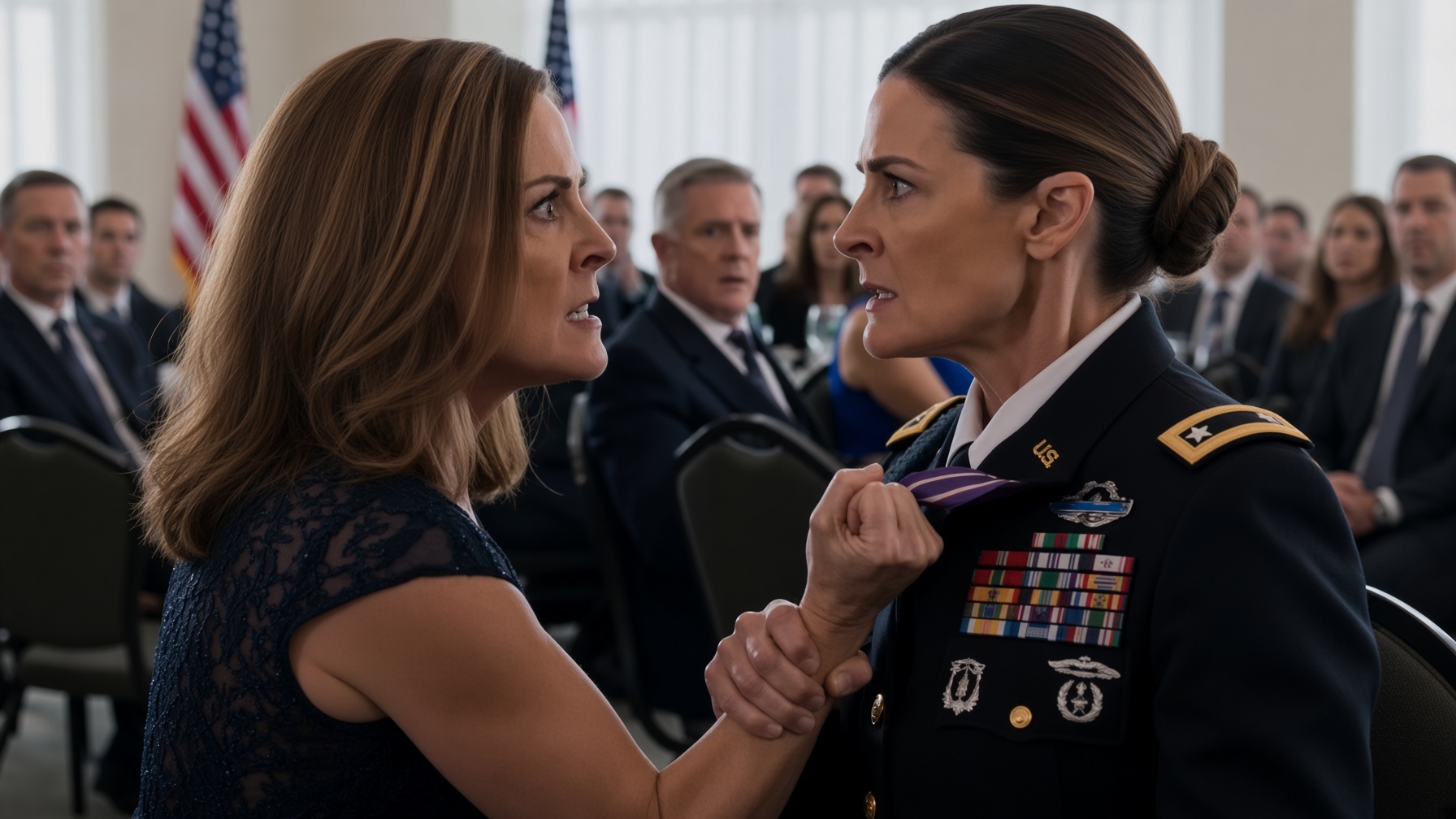
By the time my sister reached for the Purple Heart pinned above my left breast pocket, I had already survived the part of the evening I had been dreading for three weeks.
Walking through the doors had been harder than standing in front of a formation.
My name is Major Lena Whitaker. I was forty years old that spring, and I had spent more than half my life wearing an Army uniform. I knew how to brief senior officers without stumbling over my words. I knew how to make decisions when everyone around me was tired, confused, and waiting for someone else to take responsibility.
Yet walking into a banquet hall with my father and sister waiting inside made my stomach tighten in a way that military briefings rarely did.
The Washington National Guard Armory in Seattle had been prepared for an awards dinner that March evening. Round tables covered in white cloth filled the main hall. Programs sat beside water glasses. A small flag stood at the center of each table, and coffee steamed from silver dispensers along the back wall.
My dress blues felt heavier than usual.
Maybe because my family was there.
Or maybe because I knew exactly what they thought of them.
I arrived twenty minutes early because arriving early was a habit I had stopped trying to break.
Captain Joel Ramirez met me near the entrance.
He was carrying two paper cups.
“Coffee?” he asked.
“Is it good?”
“No.”
“Then definitely.”
He handed me one.
I took a careful sip and made a face.
Joel laughed.
“I warned you.”
“This tastes like somebody rinsed a coffee pot and served the water.”
“That is probably what happened.”
I looked across the room.
Several soldiers were already gathering near the stage. Most had brought spouses, parents, children, or close friends. There were little clusters everywhere—people fixing collars, taking photographs, checking seating cards, laughing too loudly because formal events made everyone slightly uncomfortable.
Joel followed my gaze.
“They here yet?”
I knew who he meant.
“My father texted ten minutes ago.”
“That sounds promising.”
“It said, ‘Parking.’”
“Very emotional man.”
I almost smiled.
Joel knew enough about my family to understand why I was nervous. He had served with me for seven years. He had seen my father at exactly one military event before this one, my promotion to major.
Dad had arrived late, stayed twenty-five minutes, then left because he had promised my sister he would help move a patio table.
Joel had never forgotten that.
Neither had I.
I glanced toward the entrance again.
“I shouldn’t care this much.”
Joel lowered his cup.
“You’re allowed to care.”
“I’m forty.”
“And?”
“I should be beyond wanting my father to approve of my career.”
Joel considered that.
“I’m forty-three. My mother still tells everyone I work in government because she can’t explain what I actually do.”
“That’s different.”
“She also calls me every Sunday and asks when I’m getting promoted to general.”
I laughed.
“There you go.”
His expression became more serious.
“Tonight isn’t about them anyway.”
“I know.”
“You say that like someone reading an instruction manual.”
“I know what tonight is about.”
“Good.”
I looked toward the stage.
A podium stood under soft overhead lights. Beside it was a table with several small presentation cases.
One of them contained my Bronze Star Medal.
That should have been the thing occupying my mind.
Instead, I was thinking about whether my sister would make a comment about my uniform.
That annoyed me more than anything.
I had worked too hard to let family insecurity follow me into that room.
The entrance doors opened.
My father walked in first.
Richard Whitaker was sixty-eight and still moved like the high school football coach he had once been, shoulders slightly forward, attention scanning whatever room he entered. He had retired from coaching five years earlier, but he still wore polo shirts from Lincoln High and still received Christmas cards from former players.
My sister followed him.
Kendra was thirty-six, stylish without appearing to work at it, wearing a dark green dress and narrow gold earrings. She managed event marketing for a large hospitality company and was very good at knowing exactly what belonged in a room.
According to Kendra, military uniforms did not.
Her husband, Eric, came behind her.
Then my mother.
Seeing Mom helped.
Elaine Whitaker spotted me and immediately smiled.
“There she is.”
She crossed the room quickly.
When she reached me, she stopped about a foot away and looked at the uniform from my shoes to my collar.
“Oh, Lena.”
There were tears in her eyes.
“Mom.”
“You look beautiful.”
“Thank you.”
She lifted both hands as if she wanted to straighten something, then stopped herself.
“Can I fix this little piece of hair?”
I bent slightly.
She carefully tucked one strand behind my ear.
Dad arrived beside her.
He looked at my uniform.
Then he looked at my face.
“Hey, kiddo.”
“Hi, Dad.”
He nodded.
“Big night.”
“That’s what they tell me.”
“Traffic was terrible.”
“Dad,” Mom said.
“What?”
“You’ve been here twelve seconds.”
“I’m making conversation.”
I smiled because that was easier than showing disappointment.
Kendra stepped forward.
“Well, Major.”
She said the word with the playful tone she used when she thought something was slightly ridiculous.
“Kendra.”
She examined me.
“That is a lot of hardware.”
“Ribbons.”
“Whatever.”
Eric gave me an apologetic smile.
“Congratulations, Lena.”
“Thanks, Eric.”
He meant it.
Eric had always been decent to me. He worked in commercial insurance and understood almost nothing about the military, but unlike Kendra, he never acted as if not understanding something made it unimportant.
Kendra pointed toward the ribbons on my chest.
“Do you have to wear all of those?”
“For dress blues, yes.”
“Does every little color mean something?”
“Yes.”
She leaned closer.
“That one?”
“Army Commendation Medal.”
“And that one?”
“Meritorious Service Medal.”
“And the striped one?”
“National Defense Service Medal.”
Kendra laughed.
“I feel like I need a guidebook.”
“There’s one in the program.”
Her smile disappeared for half a second.
Then she recovered.
“I’m joking.”
“So am I.”
Mom cleared her throat.
“We should find our table.”
Joel walked over before things became more uncomfortable.
“Mr. and Mrs. Whitaker.”
Dad recognized him.
“Ramirez.”
“Yes, sir.”
They shook hands.
Joel greeted everyone, then looked at Kendra.
“Nice seeing you again.”
“You too.”
I knew that was technically untrue. They had met once, at my promotion ceremony, and Kendra had spent half the event on her phone.
Joel turned back toward me.
“General Hayes wants award recipients near the stage in fifteen.”
“Got it.”
He left.
Dad watched him go.
“Captain?”
“Yes.”
“He works for you?”
“He’s part of my planning section.”
Dad nodded slowly.
It always surprised him when evidence of my actual job appeared in front of him.
For most of my adulthood, my father had treated the Army as a strange hobby I had refused to outgrow.
It had started when I was eighteen.
I had expected arguments when I announced I had enlisted.
Instead, Dad had laughed.
Not cruelly at first.
Just with disbelief.
“You?”
He had been standing beside the kitchen counter holding a jar of peanut butter.
“Yes.”
“You hate camping.”
“That is not the same thing.”
“You complained during that family trip because there were ants near the tent.”
“I was twelve.”
Dad had stared at me.
“You got accepted to Washington State.”
“I know.”
“You’re going to give that up?”
“I can go later.”
“Lena.”
“I already signed.”
That was when his expression changed.
“You already signed?”
“Yes.”
“Without talking to us?”
“I’m eighteen.”
“You’ve been eighteen for three months.”
Mom had been sitting at the kitchen table.
She hadn’t said anything.
Kendra was fourteen and had watched from the hallway.
Dad put the peanut butter jar down.
“This is ridiculous.”
“It isn’t ridiculous.”
“You don’t know what you’re signing up for.”
“That is why there’s training.”
That answer had made him angry.
For several weeks, we barely spoke.
I left for basic training that summer.
Dad did not come to the airport.
Mom said he had practice.
Years later, I learned he had sat in his truck outside the school for nearly an hour after practice ended because he couldn’t make himself go home.
But at eighteen, all I knew was that my father hadn’t come.
That mattered.
More than I liked admitting.
I eventually went to college while serving. Then Officer Candidate School. Then more training, more assignments, more years.
Dad gradually stopped arguing with me about leaving the military.
Instead, he acted as if it were something temporary.
“When are you going to settle down?”
“When are you going to get a normal schedule?”
“When are you going to stop volunteering for these things?”
He never asked why I stayed.
Maybe he didn’t want to know.
Kendra copied him.
She built a life that Dad understood.
College.
Marketing career.
Marriage.
House in Bellevue.
Two children.
Weekend soccer.
Kitchen renovation.
School fundraisers.
Christmas cards with matching sweaters.
I loved my niece and nephew. I respected Kendra’s work. I didn’t think her choices were smaller than mine.
But Kendra had spent years making it clear that she thought mine were.
When I missed Thanksgiving because of duty, she called me dramatic.
When I missed her daughter’s fifth birthday because I was overseas, she told Mom, “Lena always chooses the Army.”
When I returned from a long deployment thin, exhausted, and sleeping badly, Kendra asked whether I was finally ready to “do something normal.”
I never answered the way I wanted to.
That was partly training.
Mostly, it was fatigue.
People imagine military discipline means you become good at confrontation.
Sometimes it means the opposite.
You learn which arguments accomplish nothing.
So I stopped arguing with my sister.
That allowed her to believe she had won.
At the banquet, we found our table.
My family sat with two other award recipients and their guests.
One was Sergeant First Class Daniel Cho, who had brought his husband and parents.
The other was Lieutenant Colonel Melissa Grant, receiving a Meritorious Service Medal before retiring after twenty-eight years.
Kendra immediately noticed that Melissa was wearing a civilian evening dress.
She leaned toward me.
“She’s military?”
“Yes.”
“Why doesn’t she have to wear the uniform?”
“She’s not part of tonight’s official party.”
“But you are?”
“Yes.”
“So technically you could have worn a dress.”
“No.”
She looked disappointed.
“Okay.”
Eric murmured, “Kendra.”
“What?”
“You’ve asked enough questions about the uniform.”
“I’m interested.”
“You’re criticizing.”
“I’m not.”
I opened my program.
“Can we just enjoy dinner?”
Dad picked up his water glass.
“That sounds reasonable.”
The event began.
A chaplain gave an invocation.
Dinner followed.
Chicken, roasted vegetables, potatoes, and bread rolls that could have been used as construction material.
Mom whispered that the potatoes were good.
Dad said there wasn’t enough salt.
Kendra complained that there was no wine at the table.
Everything was ordinary enough that I slowly relaxed.
Then General Hayes began introducing the awards.
The first several were service awards.
Soldiers walked to the stage.
Names were read.
Families applauded.
Children leaned sideways in their chairs.
Phones appeared everywhere.
My father applauded politely.
Kendra checked her phone between awards.
I tried not to notice.
Then one of the large doors near the back opened.
A man entered with a cane.
He was tall, broad-shouldered, and moving carefully. A woman in a blue dress walked beside him.
I recognized him immediately.
Thomas Reed.
I had not seen him in person for nearly nine months.
I stood before I realized I was doing it.
Thomas spotted me.
His face changed.
He said something to the woman beside him and began making his way between the tables.
My mother looked at me.
“Who is that?”
“A friend.”
Thomas reached our table.
He stopped in front of me.
For several seconds neither of us said anything.
Then he smiled.
“Major.”
“Tom.”
“You didn’t tell me the coffee would be this bad.”
I laughed.
“You came for the coffee?”
“I crossed half the country for it.”
The woman beside him shook her head.
“Don’t listen to him.”
Thomas gestured toward her.
“Lena, this is my wife, Rebecca.”
Rebecca smiled.
“We’ve spoken on the phone.”
“Yes. It’s good to finally meet you.”
She looked at me for a moment.
Then she said softly, “Thank you.”
I never knew what to do with those words.
“You don’t need to thank me.”
“Yes,” she said. “I do.”
Thomas glanced toward my family.
I made introductions.
“This is my mother, Elaine. My father, Richard. My sister, Kendra, and her husband, Eric.”
Thomas nodded to each of them.
“Very nice to meet you.”
Dad studied him.
“You served with Lena?”
Thomas’s eyes moved back toward me.
“For a while.”
That was technically true.
He had been attached to our mission for less than three weeks.
Those three weeks had changed several lives.
Thomas had been an Army civilian intelligence specialist when our team deployed as part of an overseas security operation in late 2024.
He was smart, irritatingly funny, and completely incapable of keeping his desk organized.
We had argued about maps.
We had argued about briefings.
We had argued about whether instant coffee became acceptable if you added enough powdered creamer.
Then one afternoon everything went wrong.
I rarely talked about that day.
Not because I was forbidden.
Because describing it never seemed to make anything clearer.
There had been a damaged vehicle, confused radio traffic, people trying to find a safe route, and Thomas unable to move without help.
I had done what several others were doing.
We got everyone where they needed to go.
That was how I thought about it.
Thomas thought about it differently.
My family did not know he had been involved.
They barely knew why I had received the Purple Heart from that deployment.
I told Mom there had been an incident.
I told Dad I was fine.
I told Kendra nothing.
Thomas pointed toward an empty chair at the next table.
“Rebecca and I are over there.”
“You didn’t tell me you were coming.”
“You would have told me not to.”
“Correct.”
“That’s why.”
Rebecca smiled.
“He bought the tickets three months ago.”
“Tom.”
“What?”
“You didn’t need to do this.”
His expression changed.
“Yes, I did.”
Before I could respond, the announcer requested everyone return to their seats.
Thomas looked toward the stage.
“That’s my order.”
“Apparently.”
He started away, then stopped.
He looked at my father.
“Sir.”
Dad raised his eyebrows.
“You should be proud of her.”
Then Thomas walked back to his table.
Dad stared after him.
Kendra gave a small laugh.
“Well, that was intense.”
Mom looked at me.
“Who exactly is he?”
“Someone from the deployment.”
“The one where you were injured?”
“Yes.”
Dad shifted in his chair.
“You never said anything about him.”
“There wasn’t much to say.”
Thomas looked over from the next table.
Our eyes met.
There was, in fact, a lot to say.
The ceremony continued.
My award was near the end.
That gave me too much time to think.
I remembered receiving the call from Colonel Hayes two months earlier.
“Lena, the recommendation went through.”
I had been in my office reviewing readiness reports.
“What recommendation?”
There had been silence.
Then, “You know exactly which one.”
I leaned back in my chair.
“I thought that was finished.”
“It is now.”
“I don’t need another medal.”
“That is not how medals work.”
“I already received the Purple Heart.”
“That was for your injury.”
“I understand.”
“This is different.”
I had stared at the spreadsheet on my screen.
“I don’t want people making a big thing out of it.”
Colonel Hayes sighed.
“You pulled three people out of a disabled vehicle and coordinated the evacuation while you were injured.”
“There were six people helping.”
“And they are being recognized too.”
“That’s good.”
“Lena.”
“Yes, sir.”
“You do not have to minimize everything you do.”
I had no answer.
Maybe because I knew he was right.
My father had spent years teaching me to be humble.
The Army had reinforced it.
The combination made receiving praise almost physically uncomfortable.
At the banquet, General Hayes finally approached the podium.
“Tonight’s next award recognizes service during operations conducted on November seventeenth, 2024.”
My shoulders stiffened.
Mom moved her chair slightly.
Dad sat straighter.
Kendra put her phone down.
The hall became very quiet.
The citation began.
“For exceptionally meritorious service and acts of courage while serving as operations officer during a complex emergency response…”
The words sounded like they belonged to someone else.
They always did.
Descriptions of military actions become strangely clean after enough time.
Reports turn chaos into sequence.
Time.
Location.
Action.
Outcome.
They do not mention the smell inside a damaged vehicle.
They do not mention someone asking the same question repeatedly because they are frightened.
They do not mention how heavy a person becomes when their legs will not carry them.
They do not mention the stupid thought going through your mind while everything else is happening.
Mine had been that I had forgotten to call my mother on her birthday.
Her birthday was four days away.
For some reason, I kept thinking about it.
The citation continued.
“…despite her own injuries, Major Whitaker repeatedly returned to the disabled convoy element, assisted trapped personnel, established communication with supporting teams, and directed their movement to safety…”
I stared at a point above the podium.
Not at Thomas.
Especially not at Thomas.
“…her decisive leadership and disregard for personal risk directly contributed to the successful evacuation of all personnel…”
The applause began before the final sentence ended.
I stood.
My legs felt strangely weak.
Joel leaned across the aisle.
“Go.”
I walked toward the stage.
General Hayes was waiting.
So was Brigadier General Caroline Moore.
I stopped in front of them.
Commands were given.
I faced forward.
The medal was pinned onto my uniform.
The general spoke quietly while applause continued.
“Congratulations, Major.”
“Thank you, ma’am.”
She stepped back.
I saluted.
Then I turned toward the audience.
That was when I saw my mother crying.
Eric was clapping hard.
Dad was clapping too.
His face was difficult to read.
Kendra had both hands together, but her expression looked more confused than proud.
And Thomas was standing.
He had pushed himself upright beside his table, one hand gripping the top of his cane.
Rebecca stood beside him.
Then Daniel Cho stood.
Then Colonel Grant.
Then soldiers at another table.
Within seconds, most of the room was on its feet.
I wanted them to sit down.
I wanted to disappear.
I also wanted to remember it forever.
Both feelings could exist at the same time.
I walked back to my seat.
Mom wiped her eyes.
“Oh, Lena.”
“Please don’t start.”
“I’m not starting anything.”
“You’re crying.”
“I’m allowed.”
Dad looked at the medal.
“That was quite a citation.”
“Yes.”
“You never told us all that.”
“I told you there was an evacuation.”
“You said you were helping with an evacuation.”
“I was.”
His eyebrows pulled together.
“You left out quite a lot.”
Kendra picked up the program.
“Do they make these descriptions sound more dramatic?”
Eric turned toward her.
“Kendra.”
“What? I’m asking.”
I looked at my sister.
“No.”
She shifted.
“I didn’t mean it badly.”
“Okay.”
“It’s just formal language.”
“Yes.”
Dad continued looking at me.
“You were injured before you went back?”
I took a drink of water.
“Yes.”
“How badly?”
“Dad.”
“I’m asking.”
“I could still move.”
“That isn’t what I asked.”
My mother said quietly, “Richard.”
He looked down at his plate.
For the first time in years, I wondered whether his dismissiveness had hidden something other than contempt.
Fear, maybe.
Parents are allowed to be afraid too.
The formal ceremony ended thirty minutes later.
People began moving around the hall.
Photographs were taken near the stage.
A reception table opened in the back with coffee, small cakes, and cookies.
I posed for pictures with my unit.
Then with Mom and Dad.
Then Mom insisted Kendra and Eric join.
Dad stood on one side of me.
Mom stood on the other.
Kendra positioned herself beside Dad.
The photographer raised his camera.
“Everyone ready?”
We smiled.
Three pictures.
Then Kendra said, “Wait.”
She looked at my uniform.
“Your medal is crooked.”
“It’s fine.”
“No, it’s leaning.”
I glanced down.
It was barely noticeable.
“Kendra, leave it.”
“I’m trying to help.”
“I said it’s fine.”
She moved closer.
Her hand came toward the medal.
I stepped back.
“Don’t.”
She stopped.
Her smile tightened.
“Seriously?”
“Yes.”
“I was going to straighten it.”
“I know.”
“So?”
“So don’t.”
Around us, people were talking and moving. Nobody seemed to be paying attention yet.
Kendra lowered her hand.
“You don’t need to act like I was going to steal it.”
“I didn’t.”
“You moved away like I was doing something terrible.”
“It’s pinned correctly.”
“You literally said it was crooked.”
“No. You said it was crooked.”
Dad sighed.
“Girls.”
That word did something to me.
Girls.
As if we were twelve and sixteen again.
As if Kendra had borrowed one of my sweaters and we were arguing in the hallway.
I turned toward Dad.
“Please don’t.”
He looked surprised.
“Don’t what?”
“Reduce this to us being children.”
“No one is doing that.”
“That is exactly what you just did.”
Kendra folded her arms.
“Oh, come on.”
I could feel exhaustion rising through me.
Not anger.
Something older.
Twenty-two years of being treated like the odd one in the family.
Twenty-two years of Dad calling my career a phase.
Twenty-two years of Kendra joking about uniforms and deployments and military language.
Twenty-two years of deciding silence was easier.
“I asked you not to put your hand on the medal,” I said. “That should be enough.”
Kendra stared at me.
“It’s a piece of metal.”
The room seemed quieter.
Maybe it wasn’t.
Maybe I simply stopped hearing everything else.
I looked at her.
“What did you say?”
She shrugged.
“It’s a medal, Lena. I understand it matters to you, but you’re acting like it’s sacred.”
I heard a chair move behind me.
Then the firm knock of a cane against the floor.
Thomas had stood.
He walked toward us slowly.
Rebecca came behind him.
Kendra noticed.
Her expression changed.
Thomas stopped several feet away.
He looked at my sister.
“Ma’am.”
Kendra blinked.
“Yes?”
“That medal may look like a piece of metal to you.”
“Tom,” I said.
He glanced at me.
“Major, with respect, you have been telling me to keep quiet about this for over a year.”
“This isn’t the place.”
“I think it might be exactly the place.”
Dad looked between us.
“What happened?”
Thomas exhaled.
His right hand tightened around his cane.
“Your daughter saved my life.”
Nobody spoke.
Kendra gave a small, uncertain laugh.
“I’m sure everyone helped.”
Thomas looked at her.
“Yes. Everyone helped.”
He nodded toward me.
“But she came back for me.”
I closed my eyes for a second.
“Tom.”
“I know.”
He spoke calmly.
That made the words heavier.
“Our vehicle couldn’t move. I couldn’t put weight on one leg. Communication was unreliable. Major Whitaker had already been injured.”
Dad stared at me.
Thomas continued.
“She could have stayed with the first group moving out. Nobody would have questioned it. Instead, she came back.”
Kendra’s arms slowly dropped.
Thomas looked toward my medal.
“She helped get me out. Then she went back again for two others.”
“That’s in the citation,” Eric said quietly.
Thomas nodded.
“The citation doesn’t explain what she was like while doing it.”
I wished the floor would open.
Not because I was embarrassed by what happened.
Because the story did not belong entirely to me.
Thomas continued anyway.
“She kept talking to me because I was beginning to panic. She asked about my wife. She asked about my dog. She told me the coffee back at our base was too terrible for me to miss.”
A few people nearby had gone quiet now.
Rebecca’s eyes filled with tears.
Thomas smiled faintly.
“I thought she was insane.”
“You were complaining,” I said.
“I was in considerable discomfort.”
“You were complaining.”
He laughed.
The tension broke for half a second.
Then Thomas looked at my father.
“Sir, when I reached medical care, your daughter refused treatment until she knew everyone from our vehicle had arrived.”
“That wasn’t necessary,” I said.
“It was to me.”
Dad’s face had gone pale.
He looked at the Purple Heart.
Then at the Bronze Star.
Then at me.
“What happened to you?”
I wanted to give the same answer I had given for years.
I’m fine.
Nothing serious.
Don’t worry about it.
Instead I said, “I was injured while helping with the evacuation.”
“How?”
“Dad.”
“How?”
His voice cracked.
I had never heard that sound from him.
I lowered mine.
“There was debris when the vehicle was damaged. It caught my side and shoulder. I was lucky.”
Mom covered her mouth with one hand.
“You told me it was minor.”
“It was manageable.”
“That is not the same thing.”
“No.”
Dad looked away.
People were definitely watching now.
I hated that.
I also knew the conversation had been coming for years.
Kendra looked at Thomas.
“I didn’t know.”
He nodded.
“I figured.”
Her eyes moved toward me.
“You never told us.”
“I tried.”
She shook her head.
“No, you didn’t.”
“I did, Kendra.”
“When?”
“Every time I said deployments weren’t vacations.”
Her face tightened.
“That isn’t fair.”
“Every time I said I couldn’t simply leave duty because there was a family event.”
“That’s different.”
“Every time you told me my job was basically paperwork in a uniform.”
“I was joking.”
“Yes.”
I looked at her.
“You were always joking.”
She opened her mouth.
Nothing came out.
Dad lowered his head.
That was when I realized I did not want an apology in front of a banquet hall.
I did not want humiliation.
I did not want revenge.
I wanted a cup of coffee and ten minutes somewhere quiet.
I turned toward Thomas.
“Thank you.”
He nodded.
“You’re welcome.”
“But I need some air.”
Rebecca stepped forward.
“Of course.”
I walked away before anyone could follow.
There was a corridor beside the main hall leading toward offices and a smaller training room.
I went halfway down and stopped near a window.
Outside, Seattle was dark and wet.
Rain streaked the glass.
I removed my cap and rested it on the windowsill.
My hands were shaking.
That annoyed me.
I had gotten through the ceremony without shaking.
A voice behind me said, “You always run toward the quietest hallway.”
Joel.
I didn’t turn around.
“You followed me.”
“Yes.”
“Against your better judgment?”
“My judgment told me you were about three minutes from climbing out a window.”
“We’re on the first floor.”
“Exactly. Easy escape.”
I laughed despite myself.
He stopped several feet away.
“You okay?”
“Yes.”
“Actual answer?”
“No idea.”
“That seems more accurate.”
I looked outside.
“He shouldn’t have said all of that.”
“Thomas?”
“Yes.”
“Probably not.”
I turned.
Joel leaned against the opposite wall.
“But?”
“But your family also shouldn’t have spent two decades treating your career like a costume party.”
I stared at him.
“You heard?”
“Half the room heard.”
“Great.”
“It will be fine.”
“I don’t want people talking about it.”
“They’ll talk about dessert in ten minutes.”
“Joel.”
“Seriously. Soldiers have short attention spans around free cake.”
I smiled.
Then the smile faded.
“I don’t want my father feeling guilty.”
“That’s generous.”
“I’m not trying to punish anyone.”
“I know.”
“He didn’t understand.”
Joel considered that.
“Maybe you didn’t let him.”
That irritated me because it was true.
“I told him things.”
“You told him facts.”
“What’s the difference?”
“You said you were deployed. You said you were busy. You said you were okay.”
“I was okay.”
“Eventually.”
I looked back out the window.
Joel continued.
“I’ve known you seven years. You don’t tell people when you’re struggling. You tell them once the struggle has become a completed administrative event.”
“That sounds efficient.”
“It’s terrible communication.”
“Thank you.”
“You’re welcome.”
Footsteps came from the hall.
I expected Mom.
It was Dad.
Joel immediately straightened.
“I’m going to investigate the cake.”
“Coward.”
“Absolutely.”
He walked away.
Dad stopped near me.
For several seconds, neither of us spoke.
Rain tapped against the glass.
He looked older than he had at dinner.
Not weak.
Just older.
“I owe you an apology.”
I looked down.
“You don’t have to do this tonight.”
“Yes, I do.”
“Dad.”
“Please.”
That stopped me.
My father rarely said please.
He stepped closer but left space between us.
“I was wrong about your career.”
I said nothing.
He continued.
“Not just tonight. For years.”
“You didn’t understand it.”
“I didn’t try.”
That surprised me.
Dad stared through the window.
“When you told us you enlisted, I thought you were throwing your life away.”
“I remember.”
“I know you do.”
He rubbed his palms together.
“I’d spent eighteen years thinking I understood you. You were organized. Careful. You liked school. You had plans.”
“I still had plans.”
“I know that now.”
He gave a short, embarrassed laugh.
“I thought the Army was something you were doing because you wanted to prove I couldn’t tell you what to do.”
“Some of it probably was.”
He looked at me.
“Really?”
“I was eighteen.”
That made him laugh properly.
“Fair.”
Then his face became serious again.
“I kept waiting for you to quit.”
“I noticed.”
“When you didn’t, I started thinking maybe if I didn’t encourage it, you’d eventually come home.”
“I was home.”
He closed his eyes briefly.
“I know.”
Those two words hurt more than an argument would have.
He turned toward me.
“I thought if I treated it like it wasn’t permanent, I wouldn’t have to think about what could happen to you.”
There it was.
Fear.
The thing neither of us had named.
“When you deployed the first time,” he said, “your mother watched the news every night. I stopped watching completely.”
“I didn’t know that.”
“Of course you didn’t. I acted like an idiot.”
“Dad.”
“I did.”
He shoved his hands into his pockets.
“Then you kept going. Promotion after promotion. More responsibility. More deployments. Every time I thought about saying I was proud of you, it felt like I was approving of you going away again.”
I looked at him for a long moment.
“You could have been proud and scared.”
“I know that now.”
“You could have said both.”
“Yes.”
“You made me think you were embarrassed by me.”
His face changed immediately.
“Lena.”
“That’s what I thought.”
“No.”
“I know that now too.”
He looked down.
“I was never embarrassed.”
“You laughed at my uniform once.”
His head came up.
“When?”
“My commissioning ceremony.”
He stared at me.
“I said you looked like a hotel manager.”
“Yes.”
“I thought I was being funny.”
“I know.”
“I’m sorry.”
“It was a long time ago.”
“That doesn’t make it better.”
We stood quietly.
Then he asked, “Were you scared?”
I knew exactly what he meant.
“That day?”
“Yes.”
I considered lying.
“No.”
His eyebrows rose.
Then I sighed.
“Yes. Of course I was.”
He nodded slowly.
“But you went back.”
“People needed help.”
“Thomas needed help.”
“Yes.”
“Why?”
I almost laughed.
“What do you mean?”
“Why did you go back after you were injured?”
“Because he was still there.”
Dad stared at me.
As if the answer was too simple.
Maybe it was.
Then he said something I had waited twenty-two years to hear.
“I’m proud of you.”
My throat tightened.
I looked toward the window.
“Don’t make this weird.”
He laughed.
“I’m your father. Making things weird is part of the job.”
I smiled.
Then Dad raised one hand, paused, and asked, “Can I put my arm around your shoulders?”
The question almost made me laugh again.
“Yes.”
He stepped beside me and rested his arm carefully across my upper back, avoiding the medals.
For several seconds we stood there looking out at the rain.
I was forty years old.
And some part of me was eighteen again.
Only this time my father had shown up.
When we returned to the hall, Mom was waiting near the doorway.
She looked at Dad.
Then me.
Neither of us said anything.
Mom studied our faces and seemed to understand enough.
“Your coffee is cold,” she told me.
“That may improve it.”
“I doubt it.”
Kendra was sitting at our table.
Eric stood nearby speaking with Thomas.
Rebecca had gone to get dessert.
Kendra looked up when I approached.
“Can we talk?”
I wanted to say no.
Instead I nodded.
We moved to the edge of the room near an empty table.
For once, my sister did not begin with a joke.
She looked down at her hands.
“I really didn’t know.”
“I know.”
“I thought you exaggerated things.”
“I know that too.”
Her eyes lifted.
“I sound terrible.”
“You’re not terrible.”
“I told you the medal was just metal.”
“Yes.”
“That was terrible.”
“It wasn’t your best moment.”
She gave a weak laugh.
Then her eyes watered.
“I’m not trying to make you comfort me.”
“Good.”
She actually laughed at that.
“I deserved that.”
I waited.
She took a breath.
“I think I’ve been angry with you for a long time.”
That surprised me.
“Why?”
“You left.”
“I enlisted.”
“When I was fourteen.”
I stared at her.
“You were angry because I moved out?”
“You didn’t just move out. You became this completely different person.”
“I was still your sister.”
“Not to me.”
“Kendra.”
“I know it sounds stupid.”
She shook her head.
“You were the person who helped me with homework. You drove me to school when I missed the bus. You covered for me when Dad found the dent in the garage door.”
“You caused that dent.”
“I know.”
“You blamed a trash bin.”
“It was a convincing trash bin.”
Despite myself, I smiled.
Kendra continued.
“Then suddenly you were gone. When you came back from training, you had all these stories and friends and words I didn’t understand.”
“I didn’t realize that bothered you.”
“I didn’t realize it either.”
She looked around the room.
“Everyone here knows a version of you that I don’t.”
That sentence landed harder than I expected.
She gestured slightly toward Joel, Thomas, and the other soldiers.
“They know what you do. They know where you’ve been. They know why those ribbons matter.”
“You could have asked.”
“I should have.”
“Yes.”
“I think making jokes was easier than admitting I didn’t know my own sister anymore.”
I studied her face.
Kendra had always been good at appearing certain.
Maybe too good.
“You could have told me you missed me.”
“I was fourteen.”
“You’re thirty-six now.”
“That part I have less excuse for.”
We both smiled.
Then she pointed carefully toward my chest without moving closer.
“Can you tell me what that one means?”
I followed her finger.
“The Purple Heart?”
She nodded.
I looked at the medal.
“It recognizes being injured during service under specific circumstances.”
She swallowed.
“And you received it after the incident with Thomas?”
“Yes.”
“I’m sorry I reached for it.”
“Thank you.”
“I wasn’t trying to disrespect you.”
“I know.”
“But I did.”
“Yes.”
She nodded.
No excuses.
That mattered.
I looked toward Thomas.
He was telling Eric something and using both hands to demonstrate the size of what appeared to be a terrible sandwich.
Thomas loved telling stories about food.
Kendra followed my gaze.
“Is he okay now?”
“Mostly.”
“The cane?”
“Long distances.”
“Does he blame you?”
“For what?”
“I don’t know.”
“No.”
“He clearly thinks you’re incredible.”
“That is because Tom has poor judgment.”
From across the room, Thomas shouted, “I heard that.”
Kendra laughed.
So did I.
The room relaxed.
Not completely.
But enough.
Later, General Moore asked our family to join a smaller group near the stage for photographs.
Dad surprised me by asking questions.
Real questions.
He asked Joel what my section handled.
He asked Colonel Hayes how long we had worked together.
He asked Daniel Cho about his upcoming assignment.
He listened to the answers.
At one point I saw him reading the small guide in the program that explained ribbons and badges.
He caught me watching.
“What?”
“Nothing.”
“I’m learning.”
“I can see that.”
“You could have explained this stuff.”
“You never asked.”
He nodded.
“That is apparently a theme tonight.”
Mom collected an unreasonable number of photographs.
One with the medal.
One without my cap.
One with the cap.
One with Dad.
One with Kendra.
One with Thomas and Rebecca.
Then she wanted one with “everyone.”
“Mom, that’s fifteen people.”
“So?”
“You don’t know half of them.”
“I know them now.”
There was no arguing with her.
We took the picture.
Thomas stood beside me.
He leaned slightly on his cane.
Afterward, while everyone scattered toward coffee and dessert, he stayed.
“You mad at me?” he asked.
“Yes.”
“How mad?”
“Medium.”
“I can live with medium.”
“You shouldn’t have put my family on the spot.”
“I know.”
“Then why did you?”
He looked down at the floor.
“Because I heard your sister say it was just metal.”
“I could handle it.”
“I know you could.”
“That makes it worse.”
“Probably.”
I waited.
He sighed.
“Lena, I spent six months learning how to walk normally again.”
“I know.”
“My wife helped me put on socks.”
“I know.”
“I had nights where I woke up convinced I was still in that vehicle.”
His voice had dropped.
I said nothing.
He looked directly at me.
“And every time I remembered that day, I remembered you coming back.”
“Tom.”
“So when someone called that medal just a piece of metal, I couldn’t sit there.”
“You literally stood up with a cane to make a speech.”
“Yes.”
“That was very dramatic.”
“I practiced.”
“You did not.”
He smiled.
Then his expression softened.
“You act like what you did belonged to everybody except you.”
“Several people were there.”
“Yes.”
“Several people helped.”
“Yes.”
“I didn’t do it alone.”
“I have never said you did.”
“Then why make me the hero?”
“I didn’t.”
He paused.
“I told the truth.”
That silenced me.
Thomas nodded toward the Bronze Star.
“You don’t have to make yourself smaller so everyone else feels comfortable.”
Joel had said something similar months before.
Colonel Hayes too.
Apparently, I had become predictable.
Thomas glanced toward my family.
“Your dad looks different.”
“He apologized.”
“That good?”
“Yes.”
“Your sister?”
“Also.”
“Then maybe I’m only medium annoying.”
“Still medium.”
“I’ll accept that.”
Rebecca returned carrying two slices of cake.
“Are you two arguing?”
“Yes,” we said together.
She handed Thomas a plate.
“Then everything is normal.”
By ten o’clock, the room was nearly empty.
Soldiers collected garment bags and programs.
Staff removed coffee dispensers.
Someone was already folding tablecloths at the far end of the hall.
I stood near the entrance with my family.
Eric had gone to bring their car around.
Mom kept examining my medal as if it might disappear.
Dad held three programs because Mom wanted extras.
Kendra had her coat over one arm.
“We’re doing brunch Sunday,” Mom said.
Dad groaned.
“You just decided that.”
“Yes.”
“At what time?”
“Ten.”
“I have golf.”
“You can golf later.”
“It’s a tee time.”
Mom looked at him.
Dad sighed.
“Brunch sounds wonderful.”
Kendra smiled.
Then Mom looked at me.
“You’re coming.”
I hesitated.
The old answer formed immediately.
I have work.
I might be called in.
I’ll see.
Then I remembered I actually had Sunday morning free.
“Yes.”
Mom blinked.
“Yes?”
“Yes.”
“Ten?”
“Ten.”
“At our house?”
“Yes, Mom.”
She smiled.
Kendra looked at me.
“I’ll bring cinnamon rolls.”
“The good ones?”
“Obviously.”
Dad pointed toward me.
“You still like those maple ones?”
I stared at him.
“From Henderson’s Bakery?”
“Yes.”
“You remember that?”
He frowned.
“I am your father.”
I laughed.
“Yeah. I like them.”
“Then I’ll get some.”
A car horn sounded outside.
Eric.
Kendra began putting on her coat.
Then she stopped.
She looked at the medals one more time.
“I want to ask something.”
I raised an eyebrow.
“Careful.”
She smiled.
“The Bronze Star. Does it stay on the uniform?”
“No. I’ll have the medal set and the ribbon.”
“And where do you keep the actual medal?”
“Usually in a case.”
“Do you display them?”
“Some people do.”
“Do you?”
“Mostly they’re in a box.”
Her face showed genuine horror.
“You keep these in a box?”
“Yes.”
“Lena.”
“What?”
“You got mad at me for calling it metal, but you put it in a box.”
“That is completely different.”
“How?”
“Because it’s my box.”
Dad laughed so loudly that people near the door turned.
Kendra shook her head.
“I’m buying you a display case.”
“No.”
“Yes.”
“No.”
“Birthday.”
“Kendra.”
“You can’t stop me.”
“I outrank you.”
“You have been trying that argument for twenty years.”
“It should work eventually.”
She smiled.
Then she left with Eric.
Mom and Dad followed a few minutes later.
Dad paused at the doorway.
“Sunday.”
“I’ll be there.”
He nodded.
Then, awkwardly, he lifted his hand in a salute.
It was terrible.
Elbow wrong.
Fingers loose.
Everything about it technically incorrect.
I stared at him.
“Absolutely not.”
He laughed.
“What?”
“Never do that again.”
“I thought it was respectful.”
“It was upsetting.”
Mom pulled his sleeve.
“Come on, Richard.”
He laughed all the way into the parking lot.
I watched them leave.
For the first time in years, I did not feel relieved when a family gathering ended.
That was new.
Joel came up beside me.
“You survived.”
“Barely.”
“Your father’s salute was tragic.”
“You saw that?”
“Everyone saw that.”
“I’m going to have to move.”
“Probably.”
We walked back into the hall.
My cap was still on a chair.
The program with my name printed inside was beside it.
I picked both up.
Joel began helping a staff member move empty chairs.
I joined him.
“You were just awarded a Bronze Star,” he said. “You don’t need to stack chairs.”
“They still need stacking.”
“That may be the most Lena Whitaker sentence ever spoken.”
We worked for fifteen minutes.
Nothing ceremonial about it.
Just chairs scraping over a polished floor.
Paper cups going into trash bags.
Someone searching for a missing phone.
A sergeant trying to convince his six-year-old to put on a jacket.
It was exactly the kind of ending I wanted.
The next morning, I woke at 6:12 without an alarm.
My apartment was silent.
For several seconds I forgot why my uniform jacket was hanging from the bedroom door.
Then I saw the medal.
The Bronze Star was still pinned there.
I sat on the edge of the bed.
Morning light came through the blinds.
My phone had twenty-seven messages.
Most were from people at the ceremony.
There were photographs.
Congratulations.
A message from Thomas.
YOU’RE STILL MAD AT ME, AREN’T YOU?
I answered.
MEDIUM.
His reply came immediately.
I CAN WORK WITH THAT.
Then I noticed another message.
Dad.
Sent at 5:47 a.m.
I opened it.
There was no long speech.
No attempt to repeat our conversation.
Just a photograph.
It showed the family bookshelf in his den.
Dad had cleared an entire shelf.
The framed football photographs were gone.
The coaching plaques had been moved.
Under the picture he had written:
Your mother says Kendra is buying the display case. I made room.
I stared at the message for a long time.
Then I laughed.
I typed back:
You don’t need an entire shelf.
He responded:
Too late.
A second message followed.
Also I researched the ribbons.
I wrote:
That sounds dangerous.
He replied:
Apparently you have quite a few.
I looked at the uniform hanging beside my bedroom door.
For years, I had thought my family needed one dramatic explanation to understand me.
The perfect speech.
The perfect story.
Something that would force them to see what service had meant.
But families rarely change because of one speech.
They change through small corrections.
One question asked instead of a joke.
One apology without an excuse.
One Sunday brunch attended instead of postponed.
One father clearing a shelf.
I showered, made coffee, and spent the morning doing laundry.
Around noon, Mom called.
“Your father bought the maple rolls.”
“Already?”
“He bought two dozen.”
“Why?”
“He panicked.”
“About brunch?”
“About being a good father.”
I leaned against the kitchen counter.
“He doesn’t have to panic.”
“I told him that.”
“What did he say?”
“He bought more rolls.”
I laughed.
Mom grew quiet.
“Lena?”
“Yeah?”
“I’m sorry too.”
“For what?”
“For letting him set the tone.”
I stared at the mug in my hand.
“You always supported me.”
“I did privately.”
“That mattered.”
“But sometimes I should have said things out loud.”
I didn’t answer immediately.
She continued.
“When your sister made jokes, I told you to ignore her because I wanted everyone to get along.”
“I remember.”
“I should have told her to stop.”
“Mom.”
“I’m learning too.”
I smiled.
“Apparently that is a theme.”
She didn’t understand the reference, but she laughed anyway.
Sunday morning, I drove to my parents’ house.
Dad opened the door before I knocked.
“You’re early.”
“It’s 9:52.”
“That is early.”
“For you.”
“For civilians.”
“There it is.”
He smiled.
The maple rolls were on the kitchen counter.
Kendra was already there with Eric and the kids.
My niece Sophie ran toward me.
“Aunt Lena!”
She stopped directly in front of me because several years ago I had taught the children that they did not have to jump on people to show excitement.
“You got a medal!”
“Apparently your mother has been talking.”
“Grandpa showed us pictures.”
I glanced at Dad.
He suddenly became interested in the coffee machine.
Sophie looked up at me.
“Can I see it?”
“I didn’t bring it.”
Her face fell.
“Next time.”
“Promise?”
“Promise.”
My nephew Mason appeared.
“Mom says you rescued somebody.”
Kendra called from the dining room.
“I said she helped people.”
Mason frowned.
“Did you rescue somebody?”
I glanced at Dad.
Then Kendra.
Then at the two children waiting for an answer.
“I worked with a team that helped people who needed us.”
Mason considered that.
“Did you have a sword?”
“No.”
“A helicopter?”
“Not personally.”
“Can you get one?”
“No.”
He walked away, deeply disappointed in my career.
Kendra came into the kitchen.
“I tried.”
“I know.”
She held up a rectangular package.
“No.”
“You haven’t opened it.”
“I know what it is.”
“You don’t.”
“It’s a display case.”
“It could be anything.”
“It is shaped exactly like a display case.”
Dad leaned toward me.
“It’s nice.”
“You’re both impossible.”
Kendra put the box on the table.
“I researched proper military medal displays.”
That stopped me.
“You did?”
“Yes.”
“For how long?”
“Three hours.”
“Why?”
“Because apparently there are seventeen thousand rules.”
“There are not.”
“There are at least six thousand.”
Dad nodded.
“She sent me links.”
I looked between them.
Something inside me softened.
“Okay.”
Kendra smiled.
“Okay you like it?”
“Okay I’ll look at it.”
“I’ll take that.”
After brunch, we opened the case.
It was simple.
Dark wood.
Glass front.
No giant engraved plaque.
No dramatic wording.
Exactly the kind I would have chosen if I had ever bothered.
Kendra watched my face.
“I can exchange it.”
“No.”
“You like it?”
“Yes.”
She smiled.
“Good.”
Dad brought out the box where I had kept several medals and insignia through the years.
I had forgotten I had given it to Mom when I moved apartments.
He placed it on the table.
“Can you explain these?”
I looked at him.
“All of them?”
“If you have time.”
I checked the clock.
I had nowhere else to be.
So I sat down.
Dad sat across from me.
Mom brought coffee.
Kendra sat beside him.
The kids wandered in and out.
I began with the first medal I had ever received.
Nothing impressive.
Nothing dramatic.
An Army Achievement Medal from early in my career.
Dad held the case carefully.
“What did you get it for?”
“Mostly doing my job well.”
“That’s it?”
“That’s actually how many awards work.”
He nodded.
“What about this one?”
I explained.
Then another.
Some had stories.
Some did not.
One reminded me of a commander I had disliked at first and later respected.
Another reminded me of three months spent working twelve-hour days in a building with broken air conditioning.
Kendra laughed at that.
“This is much less glamorous than I imagined.”
“Almost everything is.”
Eventually we reached the Purple Heart.
Nobody joked.
Dad looked at it but did not lift the case.
“You don’t have to explain this one.”
“I know.”
He waited.
After a moment, I began talking anyway.
Not about every detail.
Not about the parts that belonged to Thomas or anyone else.
Just enough.
Where we had been.
What happened.
What I remembered.
What frightened me.
How long recovery took.
Why I had minimized it afterward.
Mom cried quietly.
Dad listened.
Kendra listened.
Nobody interrupted.
When I finished, Mason walked into the room holding a toy truck.
He looked at all of us.
“Why is Grandma crying?”
Mom wiped her cheeks.
“Because I’m happy.”
Mason stared at her.
“That doesn’t make sense.”
“You’ll understand when you’re older.”
“I’m eight.”
“Much older.”
He accepted that and left.
We laughed.
The heaviness disappeared.
That was important too.
I did not want to become a story my family whispered about.
I wanted to remain Lena.
The person who brought potato salad to cookouts.
The aunt who was terrible at Minecraft.
The daughter who forgot to return storage containers.
The sister who still knew exactly which childhood stories embarrassed Kendra most.
My service mattered.
So did everything else.
A month later, the medal case appeared on my parents’ shelf.
Not mine.
Dad insisted.
“You have plenty of medals at your place,” he said.
“I don’t.”
“You should.”
“I’m not turning my apartment into a museum.”
“Then we’ll keep this one.”
So the Bronze Star sat beside Dad’s coaching plaque and Mom’s framed photograph of all of us at the Oregon coast.
That arrangement felt right.
Dad started asking about my work more often.
Not constantly.
He did not suddenly become an expert.
Sometimes his questions were terrible.
“Are you commanding the whole state now?”
“No, Dad.”
“But you’re a major.”
“There are many people above me.”
“How many?”
“Enough.”
He attended another unit event that summer.
He wore a suit.
He arrived thirty minutes early.
He asked Joel three questions about organizational structure and understood none of the answers.
Joel loved him for trying.
Kendra changed too.
Slowly.
She still joked because joking was part of who she was.
But the jokes stopped being dismissive.
When I had to miss a family dinner because of duty, she texted:
We’ll save you dessert. Don’t let the Army steal the good pie.
That felt different.
She also started asking before explaining my job to other people.
At a neighborhood cookout, I heard someone ask what I did.
Kendra said, “She’s a major in the National Guard.”
The neighbor asked, “What does that mean exactly?”
Old Kendra would have invented something.
New Kendra called across the patio.
“Lena, what do you actually do?”
I laughed.
“Progress.”
She raised her drink.
“I’m learning.”
Thomas continued sending me irritating messages.
Mostly photographs of coffee.
Sometimes bad jokes.
He returned to limited work that year and visited Seattle again in June.
We had lunch.
No uniforms.
No ceremony.
Just sandwiches.
At one point he asked, “How’s the family?”
“Better.”
“Good.”
“My sister bought a medal display.”
He looked delighted.
“Excellent.”
“My father cleared a shelf.”
“Even better.”
“You realize this has encouraged them.”
“You’re welcome.”
“I didn’t thank you.”
“You will.”
“I will not.”
He smiled.
We ate in silence for a minute.
Then Thomas said, “You know what I remember most?”
I expected him to mention the evacuation.
Instead he said, “You arguing with me about putting ketchup on eggs.”
I stared at him.
“That is because ketchup does not belong on eggs.”
“It does.”
“You almost lost my respect that morning.”
“I think we survived.”
I smiled.
“Yes.”
We had.
That was the part medals never captured.
Life continued.
Messy.
Ordinary.
Full of coffee, bad food, family arguments, grocery lists, and missed phone calls.
The Bronze Star did not change who I was.
Neither did the Purple Heart.
They represented moments.
Important ones.
But moments.
For years, my family had made the mistake of believing my uniform was separate from me.
Then, for a while, I made the opposite mistake.
I wondered whether understanding the medals meant they finally understood everything.
They didn’t.
Nobody completely understands another person.
Dad still did not know what most military acronyms meant.
Kendra still thought morning physical training sounded unreasonable.
Mom still worried whenever I traveled.
I still avoided talking about difficult things until someone cornered me.
We remained ourselves.
We simply became more willing to ask questions.
That autumn, I was at my parents’ house for dinner when Sophie wandered into the den.
She stopped beside the shelf.
“Aunt Lena?”
“Yes?”
She pointed toward the display case.
“Is that the medal from the picture?”
“Yes.”
“The one Grandpa says you got for being brave?”
I looked across the room.
Dad was carrying plates from the kitchen.
He heard her.
For once, he looked embarrassed.
“I may have simplified the explanation,” he said.
I looked back at Sophie.
“Brave is a complicated word.”
She frowned.
“What does that mean?”
I thought about Thomas.
About that damaged vehicle.
About fear.
About twenty-two years of service.
About my father standing in a rainy hallway and admitting he had been wrong.
About Kendra apologizing without asking me to make her feel better.
About myself finally saying what had hurt instead of pretending nothing did.
“It means you can be scared and still do what needs to be done.”
Sophie thought about that.
“Were you scared?”
“Yes.”
“And you still helped?”
“Yes.”
She nodded.
“Then Grandpa was right.”
Dad smiled.
I looked at him.
He looked back at me.
Neither of us needed to say anything.
Sophie ran off toward the kitchen.
Dad placed the plates on the table.
“You know,” he said, “I’m getting pretty good at explaining military awards.”
“You told an eight-year-old I was brave.”
“That seems accurate.”
“You once called my dress uniform a hotel manager outfit.”
He winced.
“Are you ever going to stop bringing that up?”
“No.”
“I apologized.”
“And I accepted.”
“Then why does it keep returning?”
“Because I’m your daughter.”
He laughed.
“Fair enough.”
He started back toward the kitchen.
Then he turned.
“Lena.”
“Yeah?”
His eyes moved briefly toward the medal case.
Then back to me.
“I’m glad you didn’t quit.”
There were dozens of possible answers.
Something funny.
Something guarded.
Something designed to make the moment smaller.
For once, I chose none of them.
“Me too, Dad.”
He nodded.
Then he went to get dinner.
I stayed beside the shelf for a moment.
The medals caught the warm light from the lamp.
The Bronze Star.
The Purple Heart.
Years ago, I would have stared at them and seen duty, paperwork, memories, people, long flights, bad coffee, and complicated days I rarely discussed.
Now I saw something else too.
Not proof that my family had finally understood my career.
Something simpler.
Proof that we had finally learned how to talk about it.
That evening at the armory, my sister had reached toward a medal thinking she was straightening something crooked.
She had no idea what it represented.
Neither did my father.
For years, I had blamed them for not understanding while doing very little to help them understand.
Then Thomas stood up.
He said the thing I never would have said for myself.
After that came the harder part.
Not medals.
Not applause.
Not ceremonies.
Conversation.
Apologies.
Questions.
Listening.
Changing habits that had existed for decades.
Those things took longer.
They mattered more.
When dinner was ready, Mom called from the kitchen.
“Lena, are you coming?”
“Yes.”
I looked at the shelf one last time.
Then I walked away from the medals and joined my family at the table.
Dad had saved the chair beside him.
Kendra was arguing with Eric about whether he had bought the wrong salad dressing.
Sophie was trying to convince Mason to trade dinner rolls.
Mom was telling everyone to sit down before the food got cold.
Nothing about the scene was impressive.
Nothing deserved a citation.
Nobody was standing.
Nobody was applauding.
It was simply my family having dinner.
And after everything it had taken to get us there, that felt like more than enough.