By the time I reached Coronado, I had already driven through three counties, finished two coffees, ignored four calls from my mother, and nearly convinced myself twice to turn around.
I kept driving.
Six hours earlier, I had left my apartment in Phoenix before sunrise with one overnight bag, a navy-blue dress hanging behind the passenger seat, and my brother’s invitation tucked into the center console.
Luke had mailed it three months earlier.
He could have texted me the details. That would have been easier.
Instead, he sent an actual envelope.
Inside was the official information for his Navy ceremony and a note written on a torn sheet from a legal pad.
Maya,
Come.
Not for Mom. Not for Dad.
For me.
I kept that note.
I told myself I kept it because Luke’s handwriting was terrible and someday I could make fun of him for it.
The truth was simpler.
My brother had asked me to be there.
In our family, being asked directly mattered.
Most invitations came through my mother and carried invisible conditions.
Wear something appropriate.
Do not bring up work.
Please don’t upset your father.
Try to be normal around the relatives.
And, when I was younger, the sentence I heard most often:
This day isn’t about you, Maya.
Luke’s ceremony was different.
He had asked.
So I went.
The morning sky above Southern California was clear when I crossed onto Coronado. I had expected the island to feel dramatic after spending years hearing Luke talk about training there.
Instead, there were bicycles, coffee shops, joggers, families, tourists, and people trying to find parking.
Normal life moved only a few streets away from one of the hardest military training environments in the country.
I pulled into the designated visitor parking area and sat behind the steering wheel for a minute.
My reflection in the rearview mirror looked more tired than nervous.
I had changed at a rest stop twenty miles outside San Diego because I had known that if I arrived in jeans, my mother would stare at them all day as if denim were evidence in a criminal case.
The navy dress reached just below my knees.
I wore low beige heels because the invitation mentioned walking.
My dark hair was pinned away from my face.
Simple earrings.
No necklace.
I had learned early that if my mother was determined to criticize me, it was best not to give her too many options.
I opened the center console.
Luke’s note was still there.
Come.
For me.
“All right,” I whispered.
Then I got out.
Families were moving toward the ceremony area in small groups.
Parents looked proud.
Children carried miniature flags.
A grandmother near the entrance kept telling anyone who would listen that her grandson had always been determined, even at six years old.
I smiled at that.
Luke had not been determined at six.
At six, he had quit soccer after two practices because the socks bothered him.
He had cried the first time our father tried to teach him to ride a bicycle.
He once hid in the pantry for forty minutes because our mother told him he needed to perform a piano piece for our grandparents.
People liked to turn achievement into destiny after it happened.
They forgot the ordinary years before it.
Luke had become disciplined.
He had built that version of himself.
I knew because I had watched it happen.
At the security checkpoint, I gave my name.
The young sailor working the guest list found it immediately.
“Maya Bennett?”
“Yes.”
He checked something.
“Family seating, Row One. Congratulations to your brother.”
“Thank you.”
He handed me a small visitor badge.
That should have settled everything.
It did not.
Nothing in my family was ever settled simply because someone had written it down.
I followed signs toward the seating area.
I saw my mother before she saw me.
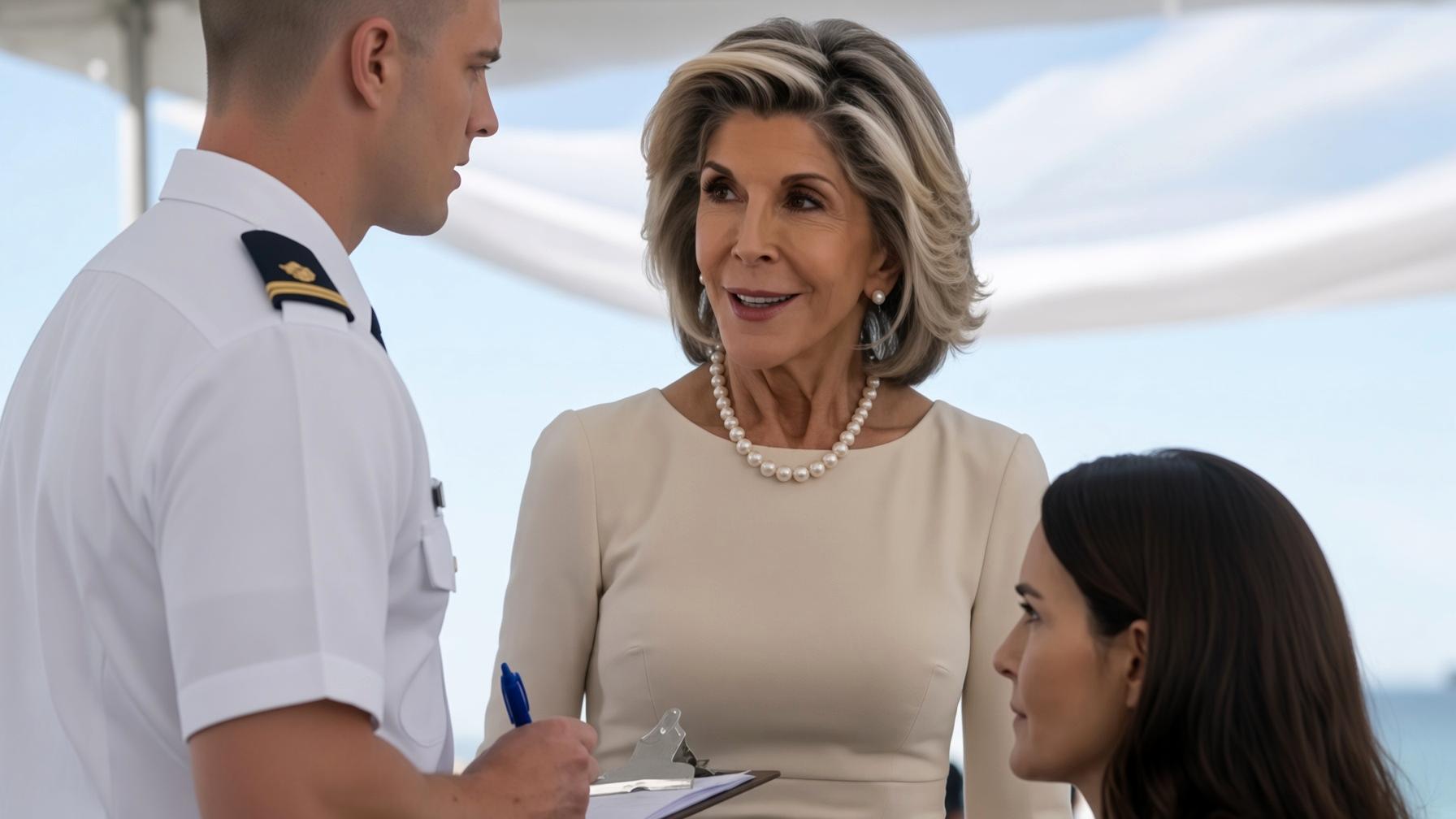
Judith Bennett sat in the front row in a pale blue dress with a matching jacket despite the warm weather.
Her pearl necklace was centered perfectly against her collarbone.
My father, Robert, sat beside her wearing the dark suit he used for weddings, funerals, and occasions where he believed photographs might be taken.
My cousin Clarissa was on his other side.
That surprised me.
Clarissa was my mother’s sister’s daughter, which made her family, certainly.
But Luke had never been close to her.
Then again, my mother liked Clarissa.
Clarissa worked in corporate communications, lived in Scottsdale, married young, owned a large house, and posted professional family portraits every Christmas.
She was everything my mother could describe without apologizing.
Clarissa noticed me first.
Her eyes moved toward me and immediately away again.
There it was.
Confirmation.
They knew I was coming.
My mother simply had not wanted me to know they knew.
I walked toward them.
Dad saw me next.
His expression tightened.
“Maya.”
“Hi, Dad.”
He stood halfway, then apparently reconsidered and sat again.
My mother looked over.
For one second, surprise appeared on her face.
Then irritation replaced it.
“You came.”
“Luke invited me.”
“I know.”
That admission was interesting.
I looked at the empty chair beside her.
My name was printed on a small card attached to the seat.
MAYA BENNETT — SISTER.
I sat.
My mother’s eyes dropped toward the card.
Then toward me.
“You drove all this way?”
“Yes.”
“You could have told us.”
“I did.”
“When?”
“Tuesday.”
My father cleared his throat.
“She sent a message.”
Mom looked at him.
“You didn’t mention it.”
Dad became very interested in adjusting his cuff.
I almost smiled.
That was my parents’ marriage in one small exchange.
My mother controlled information.
My father survived by forgetting he had received it.
Clarissa leaned forward.
“Hi, Maya.”
“Hi, Clarissa.”
“You look good.”
“So do you.”
She did.
She always did.
For nearly a minute, the four of us sat watching other families take their seats.
My mother finally said, “I hope today can stay pleasant.”
I turned toward her.
“I was planning on it.”
“This means a lot to Luke.”
“I know.”
“He’s worked incredibly hard.”
“I know.”
“So maybe we can put family problems aside for a few hours.”
I studied her.
“What problems was I planning to bring?”
She lowered her voice.
“You know exactly what I mean.”
Actually, I did not.
That was one of my mother’s most effective habits.
She accused without naming the accusation.
That forced the other person to search backward through every possible mistake.
When I was seventeen, that strategy could ruin an entire weekend.
At thirty-four, it mostly made me tired.
“I’m here to watch my brother,” I said.
“Good.”
She faced forward.
I thought we were finished.
Then she noticed the seating card again.
Something about it seemed to bother her.
Maybe it was the word sister.
Maybe it was the simple fact that Luke had arranged for me to sit in the same row as them.
My mother had spent years reorganizing the family in ways that made my place less certain.
There was Robert and Judith Bennett.
Their successful son, Luke.
Their delightful niece, Clarissa, practically another daughter.
Then somewhere outside the neat arrangement was me.
Maya.
The difficult one.
The one who left.
The one who never appreciated enough.
The one who could not stay in a relationship.
The one who changed careers.
The one who embarrassed her parents.
Some families inherit jewelry.
Mine inherited descriptions.
Once someone received one, it followed them for years.
I was twenty-one when my mother first called me disappointing.
Not to my face.
That came later.
At twenty-one, I heard her say it to my aunt Susan in the laundry room while I was home from college.
“She had so much potential,” Mom said.
Aunt Susan asked, “What happened?”
My mother sighed.
“That’s what Robert and I keep asking.”
I stood in the hallway holding a basket of towels.
I was studying biomedical engineering at Arizona State.
I had a 3.8 GPA.
I worked twenty hours a week.
Nothing had happened.
But I had changed my major from pre-law without consulting my parents.
That was enough.
Two years later, I became more disappointing when I turned down a job at the insurance firm where my father had spent most of his career.
“It’s stable,” he told me.
“It has nothing to do with what I studied.”
“They have management positions.”
“I don’t want a management position there.”
My mother stared at me across their kitchen.
“You always think you know better.”
I took an entry-level engineering job instead.
The pay was lower than the corporate role Dad had arranged.
For years, that became part of the story.
Maya threw away a great opportunity.
Then I moved to California for a medical-device company.
The story changed.
Maya abandoned the family.
Then the company was acquired, and my division was eliminated.
I spent four months unemployed.
My mother finally had proof.
Maya could never keep anything stable.
She neglected to mention that I received severance, found contract work almost immediately, and accepted a better position before the year ended.
Facts had never been particularly useful to my mother once she had a narrative she preferred.
Luke knew that better than anyone.
He was six years younger than me.
Growing up, he had been protected by the simple fact that our mother expected him to succeed.
Expectation can be its own kind of prison, but it looks prettier from the outside.
When Luke received a B in chemistry, Mom hired a tutor.
When I received a B in chemistry six years earlier, she asked whether I had become lazy.
When Luke changed his major twice, Dad told relatives he was “finding his direction.”
When I changed mine once, I became evidence that women my age lacked commitment.
It would have been easy to resent him.
For a while, I did.
Then Luke turned twenty-two and called me at two in the morning.
“I think I’m miserable,” he said.
I sat up in bed.
“Where are you?”
“My apartment.”
“Are you safe?”
“Yes.”
“What happened?”
“I don’t want to go to law school.”
That was the plan my parents had announced for him.
Not Luke.
My parents.
He had taken the LSAT.
He had been accepted by two respectable schools.
Dad had already started talking about which type of law Luke should practice.
“What do you want to do?” I asked.
There was a long silence.
Then he said, “You’re going to think I’m insane.”
“Probably.”
“I want to join the Navy.”
I stared at the dark ceiling.
Luke had never mentioned the Navy.
Not once.
“Okay.”
“And eventually I want to try for special warfare.”
I sat up straighter.
“Okay.”
“You can say something besides okay.”
“How long have you been thinking about this?”
“Two years.”
“Then this isn’t random.”
“No.”
“Have you researched it?”
“Yes.”
“Have you spoken to anyone who actually served?”
“Yes.”
“Do you understand that wanting it and qualifying for it are very different things?”
“Yes.”
“Then why would I think you’re insane?”
He went quiet.
Finally he said, “Because Mom will.”
I knew immediately why he had called me.
Not for permission.
For practice.
He needed to tell the family something they would hate, and I was the only person in the family who had survived doing that repeatedly.
Mom cried when he told them.
Dad did not speak to him for two days.
Then, as soon as it became clear Luke was serious, something remarkable happened.
My parents rewrote their own reaction.
Within six months, my mother was telling people that Luke’s military ambition showed the discipline he had always possessed.
Dad bought books about naval history.
They became proud before Luke had even completed basic requirements.
I never reminded them how hard they had tried to stop him.
Luke remembered.
That was enough.
Over the next few years, our relationship improved in quiet ways.
He called from airports.
I mailed things he forgot.
When he was frustrated, he complained to me because I was the one person who did not turn every struggle into a motivational speech.
When he failed an early screening benchmark, he called me.
“I blew it.”
“No, you didn’t.”
“I needed that score.”
“So improve it.”
“What if I can’t?”
“Then you’ll know after you try again.”
Mom would have said she always knew he could do anything.
Dad would have told him Bennetts did not quit.
Luke did not need either sentence.
He needed permission to be uncertain without becoming a disappointment.
I understood that.
Years later, when his training became real, so did the difficulty.
He rarely gave details.
I did not ask for things he could not discuss.
Sometimes he only texted:
Still alive.
I answered:
Inspiring.
Other times he called so exhausted he barely formed complete sentences.
Once, after an injury delayed him, he called from San Diego and said nothing for nearly a minute.
I waited.
Finally he whispered, “I don’t know if I can start over.”
I was living in Phoenix by then.
My job involved designing monitoring systems for hospital equipment. It was technical, demanding, and almost impossible to explain at Thanksgiving without watching my relatives’ eyes glaze over.
I had flexible remote days.
So I drove west that Friday.
Luke had expected advice.
Instead, I showed up with groceries and made him go outside for breakfast.
“You drove six hours for eggs?” he asked.
“And coffee.”
“You’re ridiculous.”
“You called.”
He stared into his mug.
“Mom thinks I’m already back in full training.”
“Why?”
“Because I didn’t tell her about the setback.”
“Why not?”
“You know why.”
I did.
In my family, vulnerability became biography.
If Luke admitted he struggled, my mother would worry publicly and then repeat the story forever.
If I admitted I struggled, she would use it as confirmation.
So Luke and I became selective.
I visited twice more during his recovery.
I never told my parents.
Neither did he.
When he returned to training, he sent me one line.
Back in.
Months later:
Still in.
Then:
Don’t book anything yet, but keep October open.
That message eventually became the invitation.
Three months before his ceremony, something else happened.
My father had a retirement dinner in Phoenix.
I almost skipped it.
Luke convinced me to go.
“You’ll regret it if you don’t.”
“You sound like a greeting card.”
“I’m becoming emotionally mature.”
“Terrifying.”
I went.
That dinner was the first time I heard the full version of the story my mother had been telling about me.
A former colleague of Dad’s sat beside me.
Halfway through dinner, he asked, “So are you working again?”
I looked at him.
“Again?”
He immediately looked uncomfortable.
“I thought—Judith said you’d been between things for a while.”
“I’ve been with the same company for four years.”
“Oh.”
“What did she say I was doing?”
He laughed nervously.
“I probably misunderstood.”
I knew he had not.
Later, a family friend asked whether I had “settled down somewhere permanent yet.”
Another asked whether I had considered moving back in with my parents while I got “everything sorted.”
By dessert, I understood.
My mother had taken four months of unemployment from eight years earlier, my move from California to Arizona, one broken engagement, and my refusal to discuss my salary and turned it into a picture of a woman who had never fully launched.
Then she had repeated it long enough that people believed her.
I confronted her in the restaurant parking lot.
“What are you telling people about me?”
She froze.
“What?”
“Dad’s friend thinks I’m unemployed.”
“I never said you were unemployed.”
“What did you say?”
“I said you’ve had an unconventional career.”
“For four years I’ve managed a twelve-person engineering team.”
“You know nobody understands exactly what you do.”
“That doesn’t mean you get to invent something easier.”
Her face hardened.
“This is exactly why conversations with you are impossible.”
Dad stood nearby pretending to check something in the trunk.
“Mom.”
“No. You come to your father’s retirement dinner and suddenly everything needs to be about correcting me.”
“I’m asking why people think I’m struggling.”
“Maybe because you are.”
The sentence was so casual that it took me a moment to process.
“I’m not.”
“You’re thirty-four, unmarried, living alone, constantly working—”
“Those are not the same thing as struggling.”
“Maybe not to you.”
There it was.
The family definition.
Success was not achievement.
Success was compliance.
Luke called the next morning.
“I heard.”
“Of course you did.”
“She called me.”
“What did she say?”
“That you caused a scene.”
“I spoke to her in a parking lot.”
“Very theatrical.”
I laughed despite myself.
Luke’s voice became serious.
“She talks about you differently when you’re not there.”
“I’ve realized.”
“I should’ve said something.”
“You don’t need to manage her.”
“I’m not talking about managing her.”
He paused.
“I mean I should have corrected it.”
That mattered.
Still, I said, “Focus on training.”
“Maya.”
“Seriously.”
“You always do that.”
“Do what?”
“Tell everyone to leave you alone because you can handle it.”
“I can.”
“That doesn’t mean people should.”
I had no answer.
Three weeks later, his invitation arrived.
Now, sitting beside my mother under the California sun, I wondered whether inviting me had been Luke’s first attempt to correct something.
The ceremony area continued filling.
My mother checked her watch twice.
Then she leaned toward Dad and whispered something.
Dad frowned.
She whispered again.
He shook his head.
I looked straight ahead.
A few seconds later, Mom raised two fingers toward a young petty officer standing near the aisle.
He noticed.
She smiled and motioned him closer.
The young man approached politely.
“Ma’am?”
My mother lowered her voice.
Not enough.
She pointed in my direction.
“There seems to be a seating mistake.”
The petty officer looked at the cards.
“What kind of mistake?”
“She shouldn’t be in this section.”
He glanced at me.
I smiled once.
His eyes returned to Mom.
“The card has her name.”
“I understand that.”
My mother’s tone became the one she used with customer-service employees.
Pleasant.
Patient.
Certain that the other person simply lacked information.
“She is Luke’s sister, but she has not been involved in his journey the way the rest of us have.”
My face became hot.
Clarissa stared down at her program.
Dad murmured, “Judith.”
Mom ignored him.
“This front area is for immediate supportive family.”
The petty officer looked uncomfortable.
“She is immediate family, ma’am.”
“Biologically, yes.”
I almost laughed because sometimes a sentence becomes so offensive that it circles back toward absurdity.
Mom continued.
“She’s really the disappointing sister. Luke would want people who actually supported him sitting here.”
Clarissa finally looked at me.
Her expression had changed.
Not agreement.
Embarrassment.
The petty officer shifted the clipboard from one arm to the other.
“I’d need to check the guest assignments.”
Mom smiled.
“Thank you.”
She turned toward me.
There was no triumph in her face.
That would have required admitting she was doing something cruel.
Instead, she looked satisfied in the way people do when they believe they have corrected an administrative error.
This was how she had always done it.
She rarely told me to leave.
She made staying uncomfortable enough that leaving felt like my own decision.
At birthdays.
At holidays.
At family vacations.
She would make one comment.
Then another.
Eventually, I would say I had work.
Or a headache.
Or a long drive.
Then later she told people, Maya never stays.
This time I remained seated.
I placed the ceremony program across my knees.
Mom looked at me.
“Aren’t you going to let him verify it?”
“He can verify whatever he needs.”
“I’m trying to save you embarrassment.”
“I’m not embarrassed.”
Her mouth tightened.
“You should think about Luke.”
“I am.”
“Maya.”
I faced her.
“I’m sitting in the chair with my name on it.”
The petty officer seemed desperate to disappear.
“I’ll check with someone,” he said.
Before he could leave, a voice came from behind us.
“No need.”
I recognized it immediately.
Luke.
I turned.
My brother was walking toward the row with a senior enlisted man beside him.
Luke looked different in uniform.
Not like someone transformed.
Like someone concentrated.
The restless movements he had as a teenager were gone.
His shoulders were level.
His expression was controlled.
But I knew him.
I saw the anger immediately.
Mom saw it too.
She stood.
“Luke! Honey, we were just—”
“What are you doing?”
Mom’s smile weakened.
“There was some confusion about seating.”
Luke looked at the petty officer.
“Was there?”
The young man glanced between them.
“Sir, I was asked to confirm the guest placement.”
Luke looked down at my chair.
Then at Mom.
“I put Maya there.”
Silence.
My father slowly removed his sunglasses.
Mom laughed softly.
“Well, obviously you submitted the family names. I just wasn’t sure you understood who had actually arrived.”
Luke stared at her.
“I knew she was coming.”
“You did?”
“I asked her.”
“I know you invited her, but—”
“I asked her to sit here.”
The senior man beside Luke said nothing.
He did not need to.
His presence made my mother suddenly aware that this was no longer a private family conversation.
She straightened her jacket.
“I was only trying to make sure the people closest to you were represented.”
“They are.”
Luke pointed toward my seat.
“That’s why she’s sitting there.”
I had never seen my mother lose control of a room so quickly.
Not because Luke raised his voice.
He did not.
Because he refused the premise.
He did not debate whether I had been supportive enough.
He simply treated my presence as obvious.
Mom tried once more.
“I’m your mother. I think I know who supported you through this.”
Luke looked at her for a long second.
Then he said, “Actually, you don’t.”
My father stood.
“Luke, today isn’t the time.”
My brother looked at him.
“You’re right.”
Then he looked at me.
“You staying?”
I nodded.
“Yes.”
“Good.”
For a second, his expression softened.
Then he turned toward the petty officer.
“She’s exactly where I assigned her.”
“Yes, sir.”
The petty officer walked away with visible relief.
Luke and the senior man continued toward the front staging area.
Mom sat.
Nobody spoke.
I could hear conversations around us again.
Some people nearby had clearly listened.
I stared at the program in my lap.
My hands were shaking slightly now.
Not before.
Now.
Clarissa whispered, “I’m sorry.”
Mom snapped, “For what?”
Clarissa became quiet.
I looked at her.
“You don’t have to apologize.”
She gave me a miserable look.
“I knew she didn’t want you here.”
There it was.
Another truth.
Mom turned.
“Clarissa.”
“What?”
“I never said that.”
“You told Aunt Susan Maya would probably make Luke’s day awkward if she came.”
My mother’s face changed.
Dad whispered, “Enough.”
Clarissa looked at him.
“No, Uncle Robert. This is ridiculous.”
I stared at her.
Clarissa and I had never been close.
Not enemies.
Just cousins who existed comfortably at opposite edges of the same family.
She took a breath.
“She asked me to come because she thought Maya wouldn’t.”
Mom looked furious.
“I invited you because Luke likes you.”
Clarissa shook her head.
“Luke hasn’t texted me in eleven months.”
I almost laughed.
Dad closed his eyes.
“This is not happening here.”
Mom faced forward.
“Fine.”
And for the first time that morning, she had nothing else to say.
The ceremony began shortly afterward.
Whatever family argument had been forming had to stop.
Names were called.
Families applauded.
Speakers talked about perseverance, discipline, teamwork, and responsibility.
I listened carefully.
I watched Luke.
It struck me that my mother would probably remember the ceremony as evidence of what she had given him.
The schools.
The sports.
The opportunities.
The encouragement.
She would not be entirely wrong.
Parents can help shape someone and still misunderstand them.
That was part of what made all of this difficult.
My mother was not cruel every day.
My father was not weak every hour.
We had family vacations where we laughed until someone spilled a drink.
Mom stayed awake with me when I had the flu in high school.
Dad taught me how to change a tire.
When my college scholarship came through, they took me out for steak.
Bad families would be easier to leave if every memory were bad.
Ours was complicated by good ones.
Luke’s name was called.
We stood with everyone else.
Mom cheered first.
Dad applauded harder than I had seen him applaud anything.
I did too.
For those seconds, we were simply his family.
When Luke returned to his place, his eyes moved toward our row.
He found me.
I smiled.
He gave the smallest nod.
Afterward, families moved toward a reception area.
Luke disappeared briefly with his class.
My mother immediately turned toward me.
“What you did was completely unnecessary.”
I stared at her.
“What did I do?”
“You sat there while Luke embarrassed me.”
Clarissa muttered, “Oh my God.”
Mom looked at her.
“You stay out of this.”
Clarissa shook her head and walked several yards away.
Dad stepped between us.
“Can we please get through one day?”
I looked at him.
“I have done nothing.”
“You could have moved.”
“There was nowhere I was supposed to move to.”
“Your mother thought—”
“I know what she thought.”
Mom crossed her arms.
“You knew I was trying to protect the atmosphere.”
“From me?”
“I didn’t say that.”
“You called me disappointing to a stranger.”
Her eyes darted toward nearby families.
“Keep your voice down.”
I almost smiled.
Of course.
The problem was never the insult.
The problem was someone hearing my response.
Dad said, “She shouldn’t have said it that way.”
Mom looked at him.
“Excuse me?”
He immediately softened.
“I mean the wording.”
I laughed.
“I’m going to get water.”
“Maya,” Dad said.
I kept walking.
My legs felt strangely light.
I bought a bottle of water and stood near a shaded area away from them.
A few minutes later, someone said my name.
“Ms. Bennett?”
I turned.
It was the senior man who had approached with Luke earlier.
He appeared to be in his late forties.
Close-cropped hair.
Calm expression.
“Yes?”
“I’m Senior Chief Daniel Keller.”
I nodded.
“Nice to meet you.”
“You too. Luke talks about you.”
That surprised me.
“Hopefully selectively.”
One corner of his mouth moved.
“He gives you credit for getting him through his recovery period.”
I looked away briefly.
“He got himself through it.”
“That’s what people usually say when they helped.”
“I drove. I bought groceries.”
“You also apparently prevented him from doing something very stupid.”
I knew exactly what he meant.
During the lowest part of his recovery, Luke had considered quitting immediately because he was ashamed of falling behind.
I convinced him to wait forty-eight hours before making the call.
Not because I knew whether he should stay.
Because I knew exhausted people sometimes confuse immediate relief with long-term decisions.
“He was frustrated,” I said.
Keller nodded.
“He was.”
I took a drink of water.
“I didn’t know he told anyone.”
“He didn’t at first.”
“Sounds like Luke.”
Senior Chief Keller looked toward the reception area.
“When candidates struggle, you learn pretty quickly who they call.”
I said nothing.
“He called you.”
That sentence landed harder than I expected.
Keller continued.
“Your brother had to do the work. Nobody can do that part for someone else. But having one person outside the pipeline who doesn’t panic every time things go wrong matters.”
I swallowed.
“Thank you.”
He nodded once.
Then he walked away.
I stood there staring at the bottle.
“You didn’t tell us.”
My mother’s voice came from behind me.
I turned.
She and Dad were several feet away.
Apparently they had heard enough.
Mom looked offended.
Not moved.
Offended.
“Tell you what?”
“That you came here during his injury.”
I stared at her.
“Luke didn’t want you to know.”
Her face tightened.
“Why?”
I said nothing.
“You drove from Arizona?”
“Yes.”
“How many times?”
“Three.”
Dad looked stunned.
“You came three times?”
“Yes.”
Mom shook her head.
“I don’t understand.”
Luke’s voice answered from behind them.
“That’s because I didn’t tell you.”
He had changed positions in the crowd without any of us noticing.
Now he stood several feet away.
Mom turned toward him.
“Why would you hide something like that from us?”
Luke glanced at me.
I could see him deciding.
I shook my head slightly.
He ignored me.
“Because when I told you I got hurt, you called Aunt Susan before I had even finished explaining what happened.”
Mom blinked.
“I needed support.”
“You told her I might be done.”
“I was worried.”
“Then Aunt Susan called Clarissa. Clarissa messaged me saying she was praying for my future.”
Clarissa, now standing behind Dad, looked mortified.
Luke continued.
“I hadn’t even gotten the medical assessment yet.”
Mom said, “That was concern.”
“It was pressure.”
Her mouth opened.
Luke raised one hand.
“And Maya didn’t do that.”
Mom looked toward me.
“Maya didn’t tell anyone,” Luke said. “She showed up, bought me food, made sure I got out of my apartment, and let me be angry without turning it into a family announcement.”
Dad looked at me.
“Why didn’t you tell us?”
The question irritated me more than it should have.
“Because it wasn’t about me.”
Mom laughed sharply.
“Well, apparently now it is.”
Luke stared at her.
“No. You made it about Maya when you tried to remove her from my row.”
“I was trying to keep today positive.”
“She was positive.”
“You don’t understand what it’s been like for your father and me.”
Luke’s expression changed.
“What has been like?”
“Watching your sister make one difficult choice after another.”
I almost interrupted.
Luke spoke first.
“What choices?”
Mom looked surprised.
“You know.”
“No. Explain.”
“Maya left California.”
“After her division closed.”
Mom paused.
“She ended an engagement.”
I said quietly, “Evan ended it.”
Mom waved that away.
“The relationship ended.”
Luke stared at her.
“That’s your evidence?”
“She refuses help.”
“I’ve never heard her ask for money.”
“That isn’t the point.”
“Then what is?”
Mom’s face became red.
“You are not going to stand here and rewrite our entire family because you had a difficult training year.”
Nobody answered.
She looked toward Dad.
“Robert?”
Dad appeared exhausted.
He looked at me.
Then Luke.
Then his wife.
For most of my life, my father had survived conflict by identifying the person most likely to forgive him and asking that person to surrender.
Usually, that was me.
I watched him prepare to do it again.
“Maya,” he said, “maybe we should all talk later.”
There it was.
I almost agreed.
Then I remembered the seat.
The card.
My mother telling a stranger that I was not supportive enough to belong beside my own family.
“No.”
Dad frowned.
“No?”
“We always talk later.”
Mom crossed her arms.
“Because decent people don’t create scenes in public.”
I looked at her.
“You created the scene when you called security.”
“He wasn’t security.”
“Fine. You called over a sailor and asked him to remove me.”
“I asked him to verify seating.”
“After telling him I wasn’t supportive family.”
Mom looked away.
Luke said quietly, “You owe her an apology.”
Mom’s head snapped toward him.
“Do not tell me what I owe anyone.”
“Then I will.”
He turned toward me.
“Maya, I’m sorry.”
I frowned.
“For what?”
“For letting this go on.”
Mom whispered, “Unbelievable.”
Luke continued.
“I knew how she talked about you.”
I stared at him.
“You told me not to worry about it.”
“I know.”
“I should have anyway.”
My eyes started burning.
I hated that.
Crying in front of my mother always made me feel twelve.
I looked away toward the water.
Luke kept talking.
“I let it be easy because I was the good one.”
Mom said, “That is not how we speak about our children.”
Clarissa made a small sound that was almost a laugh.
Luke ignored her.
“I benefited from you being the difficult one,” he said.
“That isn’t your fault.”
“Maybe not when we were kids.”
His voice became quieter.
“But I’m not a kid.”
I looked at him.
For a moment, everyone else disappeared.
It was just my brother.
The boy who had hidden in the pantry before piano recitals.
The twenty-two-year-old who called me because he was afraid to disappoint our parents.
The man standing in uniform after years of building a life they had once tried to prevent.
I said, “Today is supposed to be yours.”
“It still is.”
He smiled faintly.
“And I get to decide who belongs in it.”
I swallowed.
Mom looked furious.
“Do you have any idea how much we sacrificed for you?”
Luke’s expression lost the smile.
“This isn’t about whether you were good parents every day.”
“It sounds like it.”
“No. It’s about what you just did to Maya.”
Mom looked toward me.
Her eyes were bright now.
“You think I wanted any of this?”
I answered carefully.
“What did you want?”
“I wanted you to be happy.”
“I am happy.”
“You live alone.”
“So?”
“You work constantly.”
“I like my work.”
“You never let anyone take care of you.”
“That doesn’t mean I’m unhappy.”
“You barely visit.”
I stared at her.
Every accusation was a result presented as a cause.
“Do you know why I barely visit?”
She did not answer.
“Because I spend every visit defending my life.”
“That is dramatic.”
“Last Christmas you asked whether I had considered freezing my eggs before I had even taken off my coat.”
Clarissa covered her mouth.
Dad looked at the ground.
Mom said, “I was concerned.”
“You introduced me to a neighbor by saying, ‘This is Maya, our independent one.’”
“What is wrong with that?”
“You said it like a diagnosis.”
Luke looked toward Dad.
Dad finally spoke.
“She does have a point.”
Mom stared at him.
He cleared his throat.
“I’m not saying everything she’s saying is fair.”
Of course not.
“But maybe we’ve allowed certain assumptions.”
Mom’s voice became cold.
“We?”
Dad looked miserable.
“Yes. We.”
It was the first time I had heard him include himself without immediately retreating.
He continued.
“I knew she was working.”
I looked at him.
Mom did too.
Dad rubbed his forehead.
“At my retirement dinner, when Alan asked about Maya being unemployed, I knew Judith had probably given him the wrong impression.”
My mother’s face changed.
“You never said that.”
“I should have.”
“Robert.”
“I should have corrected him.”
My throat tightened again.
Dad looked at me.
“I didn’t.”
“No.”
“I’m sorry.”
The words were awkward.
Unpracticed.
But they were real.
Mom shook her head.
“This is absurd. Suddenly I’m responsible for everyone misunderstanding everyone else.”
“No,” I said.
“You’re responsible for what you say.”
She stared at me.
For once, I did not look away.
A group of families passed nearby laughing.
Someone called Luke’s name from across the reception space.
He raised a finger to indicate he would come over shortly.
Then he said, “There’s one more thing.”
I looked at him suspiciously.
“What?”
He smiled.
“I need you for a photo.”
Mom exhaled.
“Fine. Let’s please just take the family pictures.”
Luke shook his head.
“Not that one.”
Mom frowned.
Luke turned to me.
“Come on.”
He led me toward a smaller group near the ceremony backdrop.
Senior Chief Keller was there, along with two other men from Luke’s class and their families.
A photographer adjusted positions.
I whispered, “What is this?”
Luke whispered back, “People who got us through.”
I stopped.
“What?”
“Each of us gets a picture with the person outside the team who mattered most during training.”
My eyes widened.
“You did not.”
“I did.”
“Luke.”
“You drove twelve hours round trip because I was depressed about a shoulder.”
“You were not depressed about a shoulder.”
“I was extremely dramatic about a shoulder.”
“You’re still dramatic.”
“Stand there.”
He moved beside me.
The photographer raised the camera.
I looked back toward my parents.
My father stood very still.
Clarissa was crying.
My mother looked as if someone had rearranged a room while she was still standing inside it.
This was the moment everything changed.
Not because Luke had chosen me for a photograph.
Not because an instructor knew my name.
Because the family story had finally collided with evidence my mother could not edit.
For years, she had told people I was distant.
But Luke had called me.
She said I was unreliable.
But I had driven across the desert when he needed someone.
She described me as unsuccessful.
Yet I had spent years quietly building a career she did not understand well enough to explain.
She called me selfish.
But my brother knew what I had done when nobody was watching.
The photographer said, “Ready?”
Luke looked at me.
“You okay?”
I smiled.
“Yes.”
The camera clicked.
Afterward, Luke wrapped both arms around me and leaned his chin briefly above my shoulder.
I laughed.
“You’re ruining your tough-guy image.”
“I’ve suffered enough.”
When he stepped back, his eyes were wet.
Mine probably were too.
“Thank you,” he said.
“You don’t owe me.”
“I know.”
That made it better.
Our parents approached slowly.
Mom looked at Luke.
“You chose Maya?”
Luke nodded.
“Yes.”
She looked at me.
For several seconds, I expected another argument.
Instead she said, “I didn’t know.”
I took a breath.
“That has been the problem.”
Mom’s eyes narrowed slightly.
Not anger exactly.
Defense.
“You could have told me.”
I almost answered sharply.
Then I realized something.
That sentence had controlled me for years.
You could have told me.
As if I were responsible for providing evidence against every assumption she made.
As if I owed her constant reports proving I was doing well.
I did not.
“I could have,” I said. “But you could have asked.”
She looked down.
Nobody spoke.
Then Luke was called away again.
Dad went with him.
Clarissa followed.
Mom and I remained near the edge of the gathering.
For once, she looked uncertain.
It made her seem older.
“You think I’m a terrible mother,” she said.
I sighed.
“No.”
“You certainly sound like you do.”
“I think you love us.”
She looked at me.
“I do.”
“I also think you confuse loving us with managing how we look.”
Her face tightened.
“That’s unfair.”
“Maybe.”
I was tired of arguing every sentence until nobody remembered the original point.
So I continued.
“When Luke wanted to join the Navy, you were terrified.”
“Of course I was.”
“But once he succeeded, you started telling the story like you had always known this was his path.”
Mom stared toward him.
“I became proud.”
“That’s fine.”
I paused.
“But you do the opposite with me.”
“What does that mean?”
“When something difficult happens to me, you turn it into proof that you were right to worry.”
She did not respond.
“When something good happens, you treat it like an exception.”
“I don’t.”
“You do.”
Her lips pressed together.
I said, “Do you know my actual job title?”
The question surprised her.
“Of course.”
“What is it?”
She hesitated.
“You’re an engineer.”
“What kind?”
“You work with hospitals.”
“That’s what I did four years ago.”
Her face changed.
I nodded.
“I’m a director now.”
“You never told me that.”
“Yes, I did.”
“When?”
“The day I got promoted.”
She looked genuinely confused.
“I don’t remember.”
“I know.”
That hurt more than anger would have.
I had called her from the parking garage outside my office.
I remembered exactly where I stood.
She had listened for about thirty seconds before asking whether the promotion meant I would have to work even more.
That had been the entire conversation.
“I oversee clinical-systems engineering for the Southwest region,” I said.
Mom stared at me.
“For how many hospitals?”
“Twenty-seven.”
Her eyebrows rose.
I almost laughed.
It was such a normal reaction.
A mother learning something about her daughter.
Years late.
“That sounds important.”
“It is to me.”
She nodded slowly.
I waited.
Then she asked, “Are you happy doing it?”
The question was simple.
I could not remember the last time she had asked it without attaching a recommendation.
“Yes.”
She looked at me.
“I didn’t know.”
“I know.”
We stood quietly.
I did not mistake that moment for reconciliation.
People do not unlearn decades in five minutes beside a military ceremony.
But for the first time, my mother seemed to understand that there were large parts of my life she had replaced with assumptions.
That afternoon, we ate lunch at a restaurant on Orange Avenue.
Luke picked it because he wanted a hamburger and refused to attend what Mom called “a proper celebration lunch.”
There were eight of us.
Luke.
Mom.
Dad.
Me.
Clarissa.
Two of Luke’s friends.
And Senior Chief Keller, who joined us for only twenty minutes before returning to base.
My mother tried to order champagne.
Luke ordered a soda.
Dad gave a toast.
It was too long.
We made fun of him.
For a little while, we behaved like a normal family.
Then Clarissa ruined the peace in the best possible way.
She looked across the table at me.
“So, twenty-seven hospitals?”
Mom closed her eyes.
“Clarissa.”
“What? I’m interested.”
I smiled.
“Yes.”
Clarissa shook her head.
“Aunt Judith told my mom you did some kind of equipment support.”
“I used to.”
“What do you do now?”
I explained.
Not the simplified version.
The real version.
My team evaluated clinical technology systems, safety integrations, data reliability, and equipment deployment across hospital networks.
Clarissa listened.
Luke looked smug.
Dad looked surprised.
Mom barely spoke.
When I finished, Clarissa said, “That sounds incredibly stressful.”
“It can be.”
“Do you like managing people?”
“Some days.”
Luke said, “She’s bossy. It helps.”
I threw a napkin toward him.
He laughed.
Dad smiled.
Mom stared at the table.
Then she said quietly, “Why did we never celebrate your promotion?”
Everyone stopped.
I looked at her.
“You were busy.”
“That isn’t an answer.”
“No.”
She looked embarrassed.
“I mean, why didn’t we?”
I could have punished her then.
There were plenty of answers available.
Because you forgot.
Because you changed the subject.
Because Luke had an event that week.
Because my accomplishments were never easy for you to display.
Instead, I said, “I don’t know.”
She nodded.
We moved on.
That evening, after most of the family had gone back to their hotels, Luke and I walked near the beach.
He had changed into casual clothes.
We carried coffee from a small shop and walked slowly because both of us were exhausted.
The Pacific looked almost silver under the fading light.
“You staying tonight?” he asked.
“Yes.”
“Where?”
“Hotel near the bridge.”
“Mom thought you were driving back.”
“I’m not doing six hours after today.”
“Good.”
For a few minutes, we listened to the water.
Then I said, “You set me up.”
Luke smiled.
“With the photo?”
“With all of it.”
“No.”
“You knew Senior Chief Keller would come over.”
“I thought he might.”
“You knew Mom didn’t understand how involved I’d been.”
“Yes.”
“Luke.”
He stopped walking.
“What?”
“Did you invite me because you wanted to teach her a lesson?”
His expression became serious.
“No.”
I believed him immediately.
“I invited you because you’re my sister.”
He looked toward the ocean.
“The rest happened because Mom couldn’t leave a chair alone.”
I laughed.
“That is fair.”
We started walking again.
After a while, he said, “I was angry when I heard what she said at Dad’s retirement.”
“I know.”
“I almost called her.”
“Why didn’t you?”
“You told me not to.”
“I probably shouldn’t have.”
He shrugged.
“I also realized I’ve spent years letting her use me as the comparison.”
I looked at him.
He continued.
“Every time she said I was disciplined, part of it was because you were supposedly impulsive. Every time I was responsible, it was because you were supposedly difficult.”
“That wasn’t your doing.”
“I know.”
He smiled slightly.
“But I enjoyed being the easy one.”
“You were never easy.”
“Excuse me?”
“You cried over soccer socks.”
“I was six.”
“You hid in a pantry.”
“I was under pressure.”
I laughed so hard I had to stop walking.
Luke laughed too.
Then his expression softened.
“I missed you.”
I looked at him.
“We talk.”
“Not like before.”
He was right.
Over the last few years, our calls had become centered around his training.
I had been careful not to burden him with family problems.
He had been careful not to ask too many questions because he knew I would deflect them.
“I’m sorry,” I said.
“Don’t.”
“See? Now you’re doing it.”
He smiled.
“Fine. Apology accepted.”
We walked back toward the hotel area.
At the corner, Luke said, “Can I ask you something?”
“Sure.”
“Why did you stay in that chair?”
I thought about it.
At twenty-five, I would have left.
At thirty, I probably would have moved several rows back, told myself I was avoiding drama, and spent the drive home furious.
But that morning had felt different.
“I finally realized leaving never made her kinder.”
Luke nodded.
“So I stayed.”
“Good.”
“Very insightful.”
“I trained for years to achieve this wisdom.”
“Clearly.”
The next morning, I expected breakfast with Luke.
Instead, when I entered the hotel restaurant, my father was waiting alone.
I almost turned around.
He saw me.
“Maya.”
“Where’s everyone?”
“Your mother is upstairs.”
“Luke?”
“Already gone.”
I sat across from him.
Dad stirred his coffee even though he never used sugar or cream.
A nervous habit.
“What’s going on?”
He looked at me.
“I wanted to apologize properly.”
I waited.
He exhaled.
“I spent too many years trying to keep peace.”
“Yes.”
The direct answer surprised him.
I was tired of making everyone comfortable.
He nodded.
“And peace usually meant asking you to let something go.”
“Yes.”
“Because you would.”
I looked down at my coffee.
That was the part I had not expected him to understand.
He continued.
“Your mother would argue for three days. You’d get angry, go quiet, and eventually move on.”
“I didn’t move on.”
Dad looked at me.
“I know that now.”
For years, my silence had been mistaken for resilience.
The family thought I recovered quickly because I stopped discussing things.
In reality, I simply learned nobody wanted to hear the same problem twice.
Dad said, “I was proud of you.”
I looked at him.
“I am proud of you.”
“I know.”
“But I didn’t say it enough.”
“No.”
He nodded.
“I didn’t understand your work either.”
“That makes two of you.”
A small smile appeared.
“I looked it up last night.”
I laughed.
“Of course you did.”
“I still don’t entirely understand it.”
“You don’t need to.”
“I understand enough to know I should’ve asked more questions.”
That was probably the closest my father would ever come to a dramatic emotional speech.
It was enough.
Before we left, he said, “Your mother wants to talk.”
I groaned.
Dad smiled.
“You don’t have to.”
That surprised me more than everything else.
For years, he had been the one saying:
Just call your mother.
Just apologize.
Just let it go.
Now he was telling me I had a choice.
“Thank you.”
He nodded.
I went upstairs.
I did not call Mom.
Not that morning.
I drove back to Phoenix alone.
The six-hour drive felt shorter.
Somewhere outside Yuma, my phone rang through the car speakers.
Mom.
I let it ring.
Ten minutes later, she sent a message.
I am sorry for yesterday. I was embarrassed and reacted badly.
I read it at a gas station.
It was not a perfect apology.
She had not named what she did.
She had centered embarrassment.
Still, it was more than I expected.
I answered:
I need some time. I’ll call when I’m ready.
Three dots appeared.
Then disappeared.
A minute later:
Okay.
That one word meant more than the apology.
My mother did not like waiting on anyone else’s terms.
Yet she waited.
For twelve days.
On the thirteenth, I called.
The conversation lasted twenty-eight minutes.
We did not fix our family.
We did something harder.
We established rules.
“If you don’t understand my work,” I told her, “ask me.”
“All right.”
“Don’t describe my life to relatives in ways you haven’t checked with me.”
She became defensive.
“I don’t gossip.”
“Mom.”
A pause.
“Fine.”
“If you’re worried about me, tell me. Don’t tell Aunt Susan first.”
Another pause.
“Fine.”
“And don’t ever try to remove me from a family event again.”
Her voice became quieter.
“I shouldn’t have done that.”
“No.”
“I’m sorry.”
This time, she did not explain why.
I felt something inside me loosen.
“Thank you.”
Then Mom said, “I have conditions too.”
I almost laughed.
“Of course you do.”
“If I ask about your life, don’t immediately assume I’m criticizing.”
That was fair.
“I’ll try.”
“And answer the phone occasionally.”
“I answer your calls.”
“You let four go to voicemail on the way to Coronado.”
“I was driving.”
“You have Bluetooth.”
I smiled despite myself.
“Anything else?”
“Yes.”
“Go ahead.”
“I want to understand your job.”
That caught me off guard.
“Why?”
“Because apparently my daughter is responsible for technology in twenty-seven hospitals and I’ve been telling people she fixes machines.”
I laughed.
“I do not fix machines.”
“I know that now.”
She attended one of my company’s community presentations two months later.
I did not invite her.
She asked.
She sat in the back row with Dad.
Afterward, she introduced herself to one of my coworkers.
“I’m Maya’s mother.”
That was all.
No explanation.
No summary of my personal life.
No joke about how independent I was.
Just my mother.
I almost cried in the parking lot.
Luke called me that evening.
“How was the parental inspection?”
“Surprisingly normal.”
“Are you sure it was Mom?”
“She wore pearls.”
“Definitely Mom.”
Over the next year, our family changed slowly.
Not completely.
Mom still made comments.
I still reacted too quickly sometimes.
Dad still tried to disappear whenever voices rose.
Clarissa became an unexpected ally and started correcting Aunt Susan whenever she repeated old stories.
At Thanksgiving, Aunt Susan asked whether I was “still doing contract work.”
Clarissa answered before I could.
“She manages engineering across twenty-seven hospitals.”
I nearly choked on my water.
Mom said, “Actually, the number is twenty-nine now.”
I stared at her.
She looked pleased with herself.
Later, in the kitchen, I said, “You remembered.”
“Of course I remembered.”
I raised an eyebrow.
She sighed.
“I wrote it down.”
That was probably the most Judith Bennett solution imaginable.
I loved her for it anyway.
Luke visited Phoenix whenever his schedule allowed.
We did not discuss much about his work.
There were things I did not need to know.
Our relationship returned to older habits.
Bad jokes.
Arguments over restaurants.
Text messages making fun of Dad’s increasingly long retirement stories.
One Sunday morning, almost eighteen months after the ceremony, Luke and I sat on my balcony drinking coffee.
He had a small framed photograph with him.
He placed it on the table.
It was the picture from Coronado.
Luke in uniform.
Me beside him.
Both of us trying not to cry.
“I already have this,” I said.
“This one has something on the back.”
I turned it over.
Luke had written:
For the person who stayed when leaving would have been easier.
I stared at the sentence.
“That’s very sentimental.”
“I know.”
“Are you ill?”
“Probably.”
I turned the photograph upright again.
“You know something?”
“What?”
“I almost didn’t come.”
He looked at me.
“To the ceremony?”
“Yes.”
“Why?”
“I knew Mom would do something.”
Luke smiled sadly.
“So did I.”
“You knew?”
“Not specifically.”
He leaned back.
“But I knew inviting you directly would bother her.”
“That’s reassuring.”
“I’m being honest.”
I looked at the photograph again.
“I thought about turning around twice.”
“What stopped you?”
“Your note.”
Luke frowned.
“What note?”
“The one you mailed with the invitation.”
He thought for a moment.
“Oh.”
I stared at him.
“Oh?”
“I barely remember writing that.”
I laughed.
“You are unbelievable.”
“What did I say?”
“Come. Not for Mom. Not for Dad. For me.”
His expression softened.
“Yeah.”
“That kept me on the road.”
He nodded.
Then he looked out across the city.
“I’m glad.”
“So am I.”
The truth was, I used to think the biggest moment of that day was when Luke appeared behind us and told the petty officer my seat was correct.
For a long time, that was the part I replayed.
My mother’s face changing.
Luke refusing to let her move me.
The sudden collapse of a story that had lasted for years.
But eventually, I understood that the most important moment had happened before Luke arrived.
It happened when I stayed seated.
For most of my life, I believed keeping peace was a form of strength.
Sometimes it was.
Sometimes leaving an argument was wiser than winning it.
Sometimes refusing to react protected me.
But there was another version of silence I had mistaken for dignity.
Disappearing.
I had become very good at disappearing.
At family dinners, I left early.
When Mom misunderstood my career, I stopped explaining it.
When Dad failed to defend me, I told him it was fine.
When relatives repeated incorrect stories, I smiled because correcting them felt embarrassing.
I had thought I was refusing drama.
In reality, I had been helping everyone preserve a version of me that was convenient.
The disappointing sister.
The unstable daughter.
The one who could never quite get her life together.
That woman had never existed.
But every time I left the chair, she became easier for everyone else to believe in.
On that bright morning in Coronado, I finally did something very small.
I stayed.
I sat beside my mother.
I folded my hands over the program.
I waited while a stranger checked a guest list that already had my name on it.
And when my mother expected shame to move me, it did not.
Years later, she and I talked about that morning again.
We were sitting in my parents’ backyard after Dad’s sixty-fifth birthday dinner.
Luke was inside arguing with Clarissa about football.
Dad had fallen asleep in a patio chair.
Mom brought out two cups of tea.
She set one near me.
“I’ve been thinking about Coronado,” she said.
“That sounds dangerous.”
She ignored the joke.
“I really thought I was protecting Luke.”
“I know.”
“That doesn’t make sense to me now.”
I looked at her.
She continued.
“I had convinced myself that you didn’t care because you weren’t around as much.”
“I know.”
“And I think I needed that to be true.”
That surprised me.
“Why?”
Mom stared into the yard.
“Because if you were staying away because of me, then I had done something wrong.”
I said nothing.
She gave a humorless smile.
“I don’t enjoy being wrong.”
“I had noticed.”
She laughed.
Then her face became serious again.
“You know what I remember most?”
“What?”
“You sitting there.”
I waited.
“You didn’t yell.”
“No.”
“You didn’t leave.”
“No.”
“You just looked at me like you were finished doing what I expected.”
I thought about that.
“That’s probably accurate.”
Mom nodded.
“I knew before Luke came over that I’d lost that argument.”
I smiled.
“You still tried.”
“Of course I did.”
“That also sounds accurate.”
She laughed again.
Then she looked toward the kitchen window.
“I’m proud of you.”
This time, I did not dismiss it.
I did not make a joke.
I let the sentence stay where it was.
“Thank you.”
She nodded.
We drank our tea.
From inside the house, Luke shouted something about a referee.
Clarissa shouted back.
Dad woke suddenly and asked what he had missed.
Mom rolled her eyes.
I smiled.
My family was still my family.
Messy.
Defensive.
Loving.
Sometimes exhausting.
Nobody had become perfect because of one ceremony.
My mother still liked controlling plans.
My father still disliked confrontation.
Luke still forgot birthdays unless his phone reminded him.
I still disappeared into work when I was upset.
But the old roles were no longer fixed.
That was enough.
The photograph from Coronado remained on a shelf in my apartment.
Visitors sometimes asked about it.
I usually kept the answer simple.
“That’s my brother’s ceremony.”
They saw Luke first.
Uniform.
Achievement.
A proud day.
That was exactly as it should be.
But when I looked at the photograph, I saw something else.
I saw the woman beside him who had driven six hours expecting to be treated as a problem.
I saw someone who had spent years being told that quiet independence was evidence of failure.
I saw the daughter who finally understood she did not need her mother to explain her correctly before she could belong.
Most of all, I remembered the little white seating card.
MAYA BENNETT — SISTER.
Two words.
No qualification.
No disappointing.
No difficult.
No independent.
No successful or unsuccessful.
No good daughter or bad daughter.
Just the truth.
I was Luke’s sister.
He wanted me there.
My name had been on the seat from the beginning.
All I had to do was stop letting someone else convince me to leave it.