By the time Sebastián Alcázar understood that his wife was truly afraid, the hospital room had become almost silent.
The machines beside Valeria’s bed continued their steady rhythm. A monitor showed the baby’s heartbeat. Another displayed Valeria’s blood pressure. Somewhere beyond the closed door, a cart rolled along the polished corridor.
Sebastián stood beside the bed with one hand still holding the edge of the white sheet.
He had pulled it back because his mother had told him Valeria was exaggerating again.
That was the phrase Rebeca always used.
Exaggerating.
Being sensitive.
Making things difficult.
Sebastián had heard those descriptions so many times during the past year that they had started sounding ordinary.
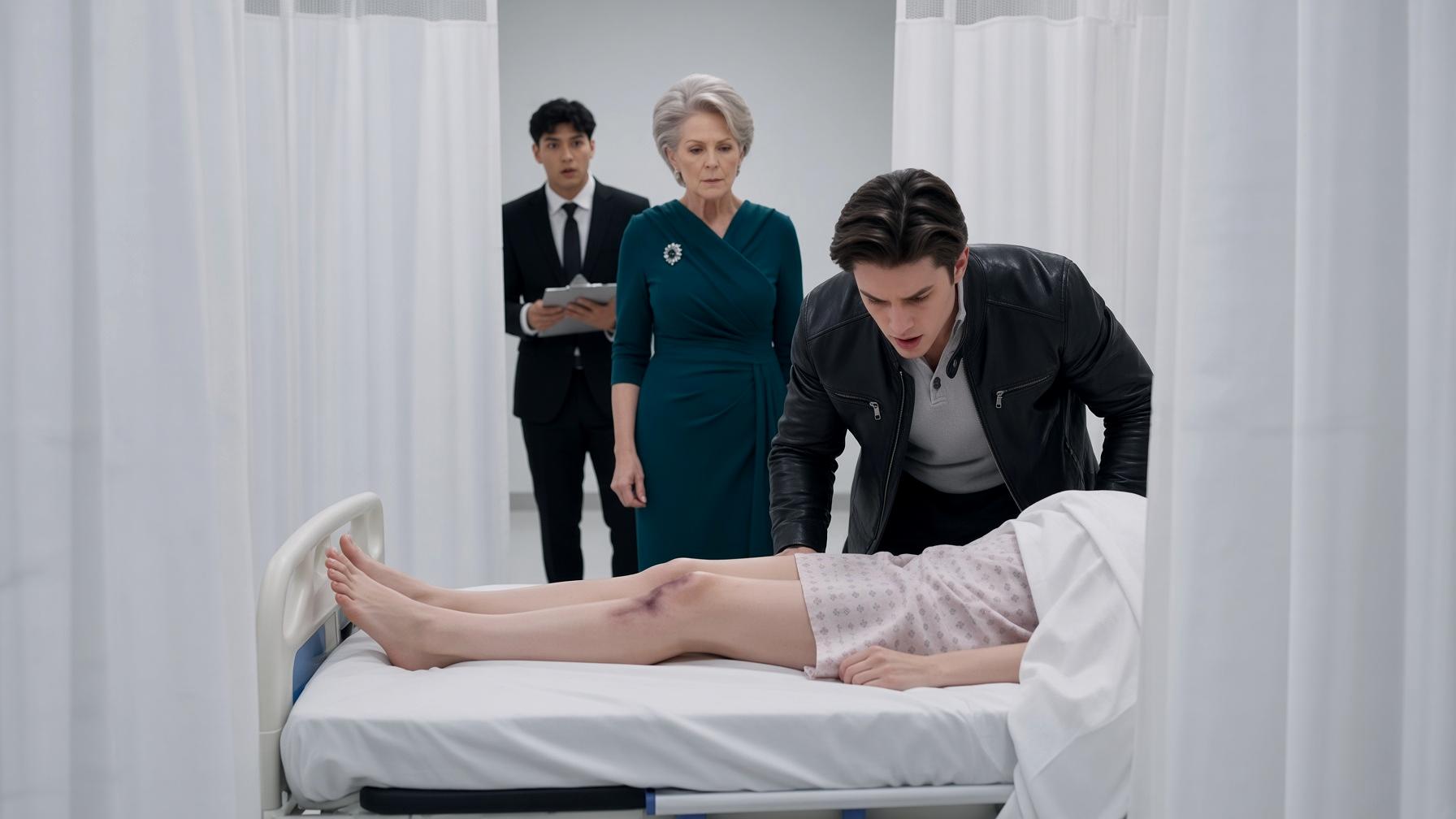
Then he saw Valeria’s legs.
Dark bruises covered them from just above her ankles to halfway up her thighs. Some were narrow marks. Others were wide patches spreading beneath her skin. Near her left knee, several bruises overlapped.
Sebastián stared without speaking.
Valeria slowly pulled the sheet back over herself.
Her face was pale with exhaustion. Strands of dark hair had escaped from the loose knot behind her head. She had been in labor for hours, yet the fear in her eyes had nothing to do with contractions.
“Don’t let them take my baby.”
Sebastián’s mouth opened.
Nothing came out.
For almost three years, he had thought he knew exactly what kind of family he belonged to.
The Alcázars argued loudly behind closed doors. They controlled everything. They cared far too much about appearances. His mother could turn a birthday lunch into a negotiation over seating arrangements.
But there had always been a line.
Or Sebastián believed there had been.
He looked again at the shape of the bruises beneath the sheet.
“Who did that?”
Valeria stared at him.
“You really don’t know?”
“I wouldn’t be asking if I knew.”
A tired laugh escaped her.
It wasn’t amused.
It sounded empty.
“You’ve been asking the wrong questions for months.”
Sebastián stepped back.
His jacket was hanging over the chair near the window. His tie had been loosened during the afternoon. He had spent most of the day moving between the hospital room, the waiting area, and phone calls connected to the family’s construction company.
Two hours earlier, he had been told there was an emergency involving one of their developments in Monterrey.
His uncle had called three times.
Octavio had texted him.
His mother had insisted he go downstairs where reception was better.
He had left Valeria alone.
Or he thought he had.
Now several documents sat on the small table near her bed.
Sebastián picked them up again.
Temporary guardianship.
Medical authorization.
A recommendation for psychiatric observation.
An agreement transferring decision-making authority regarding Valeria’s medical care.
And beneath them, a request to move her to a private psychiatric facility outside Saltillo after the delivery.
Each document carried dates from the previous week.
Before Valeria had entered the hospital.
Before anyone knew exactly when labor would begin.
Sebastián looked toward her.
“You signed these.”
Valeria closed her eyes.
He regretted the sentence immediately.
Not because it was inaccurate.
Her signature was on every page.
Because he heard himself sounding exactly like his mother.
Valeria opened her eyes again.
“That’s exactly what they want you to believe.”
Sebastián lowered the papers.
Outside the room, someone laughed softly.
He recognized his mother’s voice.
She was in the hallway.
Rebeca Alcázar could be recognized almost anywhere without being seen.
She never raised her voice unless she wanted someone to remember that she had.
At charity dinners, she wore pale colors and pearls.
At business events, she remembered every spouse’s name.
She had chaired foundations, hospital committees, church fundraisers, scholarship boards, and museum events.
People trusted Rebeca because she behaved like a woman who had never needed to lie.
Valeria had once trusted her too.
Three years earlier, when Sebastián first brought Valeria to his family’s home for Sunday lunch, Rebeca had welcomed her with flowers.
She asked questions about Valeria’s work.
Real questions.
Not the polite kind.
At the time, Valeria worked at a forensic accounting firm in Monterrey. Her job involved reviewing suspicious transactions, corporate structures, nonprofit accounts, and financial records during internal investigations.
Rebeca seemed fascinated.
“You find money people don’t want found?” she had asked.
“Sometimes.”
“And people actually pay you to do this?”
“Usually the people paying me aren’t the people hiding it.”
Rebeca had laughed.
Sebastián remembered being proud of Valeria that afternoon.
She was calm around his family.
She didn’t try too hard.
She didn’t appear impressed by their house.
She didn’t change her voice when his father mentioned a well-known governor or when his uncle began describing a hotel project worth hundreds of millions of pesos.
That was one of the reasons Sebastián had fallen in love with her.
Valeria treated him like a person before she treated him like an Alcázar.
He had not realized how rare that was.
Their courtship moved quickly.
A year after meeting, they married.
After the wedding, Valeria continued working.
At least for a while.
The first disagreements began quietly.
Rebeca suggested Valeria reduce her hours because Sebastián traveled often.
Then she suggested Valeria leave the firm because clients might consider her work a conflict with Alcázar family interests.
Valeria refused both times.
Sebastián supported her.
Mostly.
He told his mother to stop interfering, then told Valeria privately that Rebeca was “just trying to help.”
Valeria hated that sentence.
Trying to help.
It explained almost everything Sebastián failed to stop.
When Valeria became pregnant, Rebeca’s interest became constant.
Suddenly there were appointments.
Nutritionists.
Specialists.
Prenatal yoga instructors.
A decorator for the nursery.
An invitation to join Rebeca’s preferred private hospital program.
Valeria turned down most of it.
She chose her own doctor.
She chose her own hospital room.
She planned to hire help after the baby arrived, but only after she and Sebastián had spent several weeks adjusting on their own.
Rebeca called that irresponsible.
Sebastián called it a disagreement.
Valeria called it something else.
Control.
The first time she used that word, Sebastián had smiled.
“Val, my mother controls dinner reservations. That doesn’t mean she controls our lives.”
“She called my doctor.”
“She worries.”
“She asked for my medical information.”
“He wouldn’t give it to her.”
“That isn’t the point.”
“She’s excited about the baby.”
“She is acting like I’m carrying something that belongs to her.”
Sebastián had sighed and gone back to answering emails.
That conversation happened five months earlier.
Now he stood in the hospital staring at paperwork designed to remove Valeria from their child.
He wanted to believe there was another explanation.
A misunderstanding.
A legal precaution.
Anything.
“What happened while I was downstairs?” he asked.
Valeria’s jaw tightened.
“You left at one forty.”
Sebastián checked the clock instinctively.
It was nearly four thirty.
“I remember.”
“Your mother came in about ten minutes later.”
“Alone?”
“No.”
Valeria looked toward the door.
“She had Octavio with her.”
Sebastián glanced at the leather folder.
“And Dr. Salgado.”
“My mother’s doctor?”
“He isn’t your mother’s doctor. He sits on the board of her foundation.”
Sebastián stared.
“And two nurses.”
His stomach tightened.
Valeria continued.
“They locked the door.”
“Why would they lock—”
“Please don’t interrupt me.”
He stopped.
Valeria drew a slow breath.
“I had been having contractions every four minutes. I asked them where Dr. Vega was.”
Dr. Vega was the obstetrician Valeria had personally chosen.
“She had been called away for an emergency delivery on another floor,” Valeria continued. “At least that’s what they told me.”
Sebastián sat in the chair beside the bed.
“What did my mother say?”
Valeria looked directly at him.
“She said that after our son was born, he would leave with her.”
Sebastián shook his head automatically.
“No.”
“She said I needed rest somewhere else.”
“No.”
“She said everyone had noticed I wasn’t well.”
Sebastián stopped shaking his head.
Because he had heard that before.
Not from Valeria.
From Rebeca.
Your wife seems overwhelmed.
Have you noticed how often she cries?
She barely eats.
She doesn’t answer calls.
Pregnancy has been difficult for her.
Maybe she needs professional help.
Sebastián had responded the way a reasonable husband should respond.
Or the way he thought a reasonable husband should.
He encouraged Valeria to sleep more.
He suggested counseling once.
She became furious.
At the time, he thought the reaction proved his mother’s point.
Now a different possibility entered his mind.
“What did Octavio do?”
“He put those papers in front of me.”
Valeria nodded toward the table.
“He said if I signed them, everything would remain private.”
“And if you didn’t?”
“They would ask a judge to declare me unstable enough that I couldn’t make decisions for myself or the baby.”
Sebastián’s fingers tightened around the chair arm.
“That isn’t how it works.”
“I know how it works.”
“I mean, legally, they can’t just—”
“I know.”
Her voice sharpened.
“I’ve spent fifteen months collecting evidence about people who create documents to make illegal things look legal. I understand perfectly well what they were trying to do.”
That sentence confused him.
“Fifteen months?”
Valeria looked away.
Sebastián stood.
“What does that mean?”
Before she could answer, the door handle moved.
The door opened.
Rebeca entered first.
She looked exactly as she had earlier that morning.
Ivory suit.
Pearl earrings.
Hair neatly arranged.
No sign that her daughter-in-law’s accusation had anything to do with her.
Octavio followed carrying another folder.
Dr. Salgado came behind him.
Rebeca smiled.
“So, has she finished convincing you with her little performance?”
Sebastián turned slowly.
Rebeca’s smile faded when she saw the documents on the table.
Then she noticed the sheet had been disturbed.
Her eyes moved toward Valeria’s legs.
For the first time, something changed in Rebeca’s expression.
It lasted less than a second.
Not guilt.
Calculation.
Sebastián noticed.
“Mom.”
Rebeca looked at him.
“Tell me this isn’t what it looks like.”
She removed her handbag from her shoulder and placed it on the chair.
“What does it look like?”
“You tell me.”
“Sebastián, you’re exhausted.”
“That isn’t an answer.”
Octavio stepped forward.
“Maybe we should all remain calm.”
Sebastián turned toward him.
“You stay out of this.”
Octavio froze.
Sebastián had never spoken to him that way.
They had grown up together.
Their fathers were brothers.
Octavio had handled legal matters for the family for more than a decade.
He was the person Sebastián called when contracts became complicated.
The person who helped them buy their home.
The person who had drafted Valeria and Sebastián’s prenuptial agreement.
The thought landed heavily.
“You prepared those documents.”
Octavio looked toward Rebeca before answering.
“I prepared a contingency plan.”
“For what?”
“For the safety of the child.”
“Our child isn’t even born.”
“Which is exactly why we had to act before emotions made things more difficult.”
Sebastián stared at him.
Then at his mother.
Rebeca finally spoke.
“It is exactly what this family needs.”
Valeria closed her eyes.
Sebastián heard the words clearly.
No misunderstanding.
No alternate explanation.
His mother was not denying anything.
“What did you do to her?”
Rebeca’s mouth tightened.
“No one did anything to her.”
Sebastián pulled the sheet back again.
“Then explain this.”
Dr. Salgado shifted near the door.
Rebeca didn’t look at the bruises.
“She became agitated.”
“Agitated?”
“She behaved unpredictably.”
“She’s in labor.”
“That isn’t an excuse for irrational behavior.”
Sebastián looked at Valeria.
She was watching all of them silently.
“What happened to her legs?”
Dr. Salgado answered.
“She struck them repeatedly against the bed.”
“Why?”
No one answered.
“Why?”
Octavio cleared his throat.
“She resisted.”
Sebastián stared at him.
“Resisted what?”
Octavio looked down.
Sebastián’s voice lowered.
“What did she resist?”
Rebeca stepped between them.
“This is not useful.”
“Move.”
“Sebastián.”
“Move away from him.”
Rebeca did.
Not because she was frightened.
Because she was beginning to understand that her usual authority was failing.
Octavio placed the folder on the table.
“Sebastián, what matters now is what happens next.”
He removed a pen.
“Your wife is physically and emotionally exhausted. We can deal with every disagreement later.”
He opened the folder.
“Sign the authorization. After the delivery, the baby can be cared for properly while Valeria receives an evaluation.”
Sebastián looked down at the signature line.
His name had already been printed beneath it.
He laughed once.
A strange, quiet sound.
“You prepared mine too.”
“Of course.”
“How long ago?”
Octavio didn’t answer.
Sebastián picked up the page.
“How long ago?”
“Eight days.”
Valeria stared at the ceiling.
Sebastián looked at his mother.
“Eight days ago?”
Rebeca remained calm.
“We needed options.”
“You planned to take my child away from my wife eight days ago?”
“We planned to protect your son.”
“My son from what?”
“From a woman who has spent months behaving as though everyone around her is an enemy.”
Sebastián turned toward Valeria.
She was watching Rebeca now.
Something about her expression bothered him.
She looked exhausted.
But not surprised.
Not even afraid anymore.
She looked like someone waiting.
For what?
Rebeca continued.
“She stopped attending family events.”
“I was pregnant and tired,” Valeria said.
“She accused my staff of entering your house.”
“Because they did.”
“She changed locks.”
“Because your assistant had a key Sebastián never gave her.”
Sebastián’s head turned.
“What?”
Valeria looked at him.
“I told you.”
He remembered.
Four months earlier.
Valeria had complained that someone moved documents in his office.
Sebastián told her the housekeeper probably cleaned the desk.
Valeria changed the alarm code.
Rebeca called it paranoid.
“She recorded conversations,” Rebeca said.
Sebastián looked at his mother.
“How do you know?”
Silence.
That question mattered.
Rebeca realized it too late.
Sebastián repeated it.
“How do you know she recorded conversations?”
Rebeca’s posture stiffened.
“I assumed.”
“No.”
Sebastián stepped closer.
“You said it like you knew.”
Valeria moved one hand beneath her pillow.
No one noticed except Sebastián.
He looked toward her.
Her fingers closed around something.
A small remote.
She pressed it once.
A tiny green light appeared.
Then disappeared.
Octavio’s phone vibrated.
He looked down.
His face changed immediately.
Rebeca noticed.
“What?”
Octavio didn’t answer.
“What is it?”
She took the phone from him.
Six words were visible on the screen.
The District Attorney’s Office already has the files.
For the first time that afternoon, Rebeca Alcázar lost control of her face.
Her eyes widened.
Octavio reached for the phone.
She pulled it away.
“What files?”
Valeria answered from the bed.
“All of them.”
Rebeca turned.
Valeria looked tired, but her voice was steady.
“The recordings. The transfers. The contracts. The messages.”
Octavio stared at her.
“What did you do?”
Valeria smiled faintly.
“My old job.”
Sebastián felt as though the room had shifted around him.
“What recordings?”
Valeria looked at him.
“The ones I started collecting after someone tried to access my firm’s archived case files.”
Rebeca said nothing.
Valeria continued.
“Fifteen months ago, I received a notification that an old client archive had been opened using credentials connected to a computer at Fundación Alcázar.”
Sebastián looked toward his mother.
Rebeca’s expression hardened.
“I thought it was a mistake,” Valeria said. “So I checked.”
“You had no authority to investigate my foundation,” Rebeca said.
“I didn’t investigate your foundation.”
Valeria paused.
“I investigated whoever was investigating me.”
Octavio began pacing.
“This is absurd.”
“No,” Valeria said. “It became absurd when I found payments from the foundation to a medical consulting company that barely existed.”
Dr. Salgado’s face tightened.
Sebastián noticed.
Valeria noticed him noticing.
“The company belongs to Dr. Salgado’s brother-in-law.”
Sebastián turned toward the doctor.
“That’s not relevant,” Dr. Salgado said.
“It became relevant when the same company started receiving monthly transfers after my pregnancy was announced.”
Rebeca interrupted.
“You have no idea what those payments were for.”
“I do.”
“No, you think you do.”
“They were marked as wellness assessments.”
Rebeca’s jaw tightened.
Valeria looked at Sebastián.
“Do you remember the charity dinner in November?”
He nodded.
“You got angry because I left early.”
“You said you felt sick.”
“I did.”
Valeria looked at Rebeca.
“Your mother told three people that I had suffered an emotional episode.”
Rebeca folded her arms.
“You were crying in a restroom.”
“My father had just called to tell me my aunt was having surgery.”
Sebastián remembered the evening.
He had been irritated.
Rebeca had whispered to him afterward.
She isn’t managing stress well.
At the time, it seemed like concern.
Now each memory sounded different.
Valeria continued.
“Two weeks later, Dr. Salgado entered a note into a private medical system saying I had displayed signs of severe emotional instability.”
Dr. Salgado stepped forward.
“That was an informal observation.”
“You had never examined me.”
“I had met you.”
“At a fundraiser.”
“You were visibly upset.”
“I spilled coffee on my dress.”
A pause followed.
Sebastián covered his mouth.
He suddenly felt sick.
“How much of this did you know?” he asked his mother.
Rebeca looked at him.
“Enough to know we had a responsibility.”
“To whom?”
“To you.”
“No.”
“To your child.”
“No.”
“To this family.”
There it was.
The answer Rebeca always reached eventually.
Family.
A word she used to justify almost anything.
Sebastián walked toward the window.
San Pedro spread beyond the glass beneath a hazy afternoon sky.
Cars moved along the avenue far below.
Everything outside continued normally.
He wished the world would stop long enough for him to understand what was happening.
Behind him, Valeria inhaled sharply as another contraction began.
The monitor changed rhythm.
Sebastián turned immediately.
Valeria gripped the side rail with both hands.
Her eyes closed.
The contraction lasted less than a minute.
When it passed, her shoulders lowered.
Sebastián moved toward the bed but stopped before reaching her.
He wasn’t sure whether she wanted him near her.
That realization hurt more than he expected.
“Are you okay?”
“No.”
The answer was quiet.
Simple.
He nodded.
A nurse entered.
Not one of the nurses Valeria had described.
This woman was older, wearing glasses and carrying a tablet.
“Mrs. Alcázar, Dr. Vega is returning.”
She glanced around.
“Why are there so many visitors?”
“No one visits her without my permission,” Sebastián said.
Valeria looked at him.
He corrected himself.
“Without Valeria’s permission.”
The nurse nodded.
“Understood.”
Rebeca laughed softly.
“This is becoming ridiculous.”
Sebastián faced her.
“Leave.”
Her expression changed.
“Excuse me?”
“Leave the room.”
“Sebastián—”
“Now.”
“I am your mother.”
“And she is my wife.”
Rebeca’s eyes narrowed.
“Finally.”
Everyone turned toward Valeria.
She looked at Sebastián.
“You finally remembered.”
The sentence landed quietly.
He deserved it.
Rebeca picked up her handbag.
“You are making a serious mistake.”
Sebastián opened the door.
“You can explain that to whoever is coming.”
That was when Octavio spoke.
“No one is coming.”
Valeria looked at him.
Octavio smiled, but the expression looked forced.
“You think sending files automatically makes them useful?”
Valeria said nothing.
“You worked in investigations. You know chain of custody matters. Context matters. Documentation matters.”
Valeria nodded.
“Yes.”
“Then you know recordings can be challenged.”
“Yes.”
“And financial records can be interpreted multiple ways.”
“Yes.”
Octavio seemed encouraged.
Valeria continued.
“That’s why the files went to three places.”
His smile disappeared.
“My former firm received one copy.”
Rebeca stopped near the doorway.
“The District Attorney’s Office received another.”
Octavio swallowed.
“And the third?” Sebastián asked.
Valeria looked directly at Octavio.
“The professional disciplinary board that oversees attorneys.”
Octavio’s mouth opened.
No sound came out.
Valeria shifted carefully against the pillows.
“I assumed you would focus on destroying the criminal evidence first. So I thought someone should review your professional conduct separately.”
Sebastián almost smiled.
Not because anything was funny.
Because for the first time, he saw the woman he had fallen in love with.
Not the exhausted pregnant woman his mother described.
Not someone fragile.
Valeria.
Precise.
Patient.
Always three moves ahead when she knew someone was lying.
Rebeca stepped closer to the bed.
“You think this is clever?”
Sebastián moved between them.
“No.”
Valeria answered.
“I think it was necessary.”
“You have humiliated this family.”
“I haven’t released anything publicly.”
“Yet.”
“No.”
Valeria looked at her.
“You’re the one who thinks everything is about reputation.”
Rebeca’s face tightened.
“What do you think happens now? You destroy Sebastián’s company? His inheritance? The foundation? Every employee connected to us?”
Valeria shook her head.
“I think people review the evidence.”
“And if your evidence damages innocent people?”
“Then perhaps the people responsible should have considered that earlier.”
Sebastián looked toward Octavio.
“What else is in the files?”
Octavio answered quickly.
“Nothing.”
Valeria almost laughed.
Sebastián waited.
Valeria looked at him.
“Do you want the full answer?”
“Yes.”
“You may not like it.”
“I haven’t liked anything for the last twenty minutes.”
Valeria nodded.
“Your mother has been moving money through Fundación Alcázar for at least six years.”
Sebastián stared at Rebeca.
She showed no surprise.
That frightened him.
“Moving money how?”
“Donations come in. A percentage gets distributed legitimately. Another percentage is paid to consultants, medical projects, event vendors, and shell companies.”
“My mother doesn’t manage foundation finances.”
“She signs final approvals.”
“That doesn’t mean—”
“I have copies.”
He stopped.
Valeria continued.
“Octavio structured several of the companies.”
Sebastián turned toward his cousin.
Octavio looked furious.
“Don’t.”
“Don’t what?”
“Don’t stand there judging people when you’ve benefited from the same family money your entire life.”
Sebastián stepped toward him.
“I didn’t know.”
Octavio laughed.
“That’s convenient.”
“I didn’t know.”
“You never wanted to know.”
That hurt because it was partly true.
Sebastián had never examined the family’s financial systems.
He ran the construction division.
Others handled the foundation.
Others handled legal structures.
Others handled family trusts.
He signed papers prepared by people he trusted.
Trust.
The word felt embarrassing now.
Valeria watched him.
“He’s right about one thing.”
Sebastián looked at her.
“You didn’t want to know.”
He lowered his head.
Valeria continued.
“Every time I showed you something strange, you gave me an easier explanation.”
“I didn’t know it was this.”
“I didn’t either at first.”
“Why didn’t you tell me everything?”
She stared at him for several seconds.
Then answered.
“Because I tested you.”
He looked up.
“What?”
“Six months ago, I told you your mother’s assistant had entered our house without permission.”
“I remember.”
“You told your mother.”
“Yes.”
“The next morning, the camera covering your office entrance disappeared.”
Sebastián’s face tightened.
“I thought the system malfunctioned.”
“I hadn’t told you there was a camera.”
Silence.
Valeria’s eyes filled with tears, but her voice stayed steady.
“I realized then that anything I told you might reach her.”
“I didn’t know—”
“I know.”
Her voice softened.
“That was the problem.”
He had no answer.
A knock came from the door.
This time two men in dark suits stood outside with a hospital administrator and a uniformed officer.
Rebeca’s expression changed.
One of the men introduced himself.
“Sebastián Alcázar?”
“Yes.”
“Valeria Mendoza Alcázar?”
Valeria raised one hand.
“I’m Valeria.”
The man showed identification.
“We need to speak with Mrs. Alcázar regarding evidence delivered to our office this afternoon.”
Rebeca stepped forward.
“She is in active labor.”
The investigator looked at her.
“And you are?”
“Rebeca Alcázar.”
He glanced down at a document.
His expression became more formal.
“Mrs. Rebeca Alcázar, I’ll also need you to remain available.”
Octavio reached for his phone.
The second investigator spoke.
“Mr. Octavio Alcázar, we need to speak with you as well.”
Octavio stopped.
Dr. Salgado slowly moved toward the door.
The investigator looked at him.
“Doctor, please remain.”
For the next hour, the room changed completely.
Hospital administrators reviewed access logs.
Security personnel collected copies of hallway footage.
The two nurses who had been present earlier were removed from Valeria’s care.
Dr. Vega arrived furious after discovering someone had redirected messages intended for her.
Valeria underwent another examination.
Dr. Vega documented every bruise.
She photographed Valeria’s wrists where red marks remained.
She reviewed the medication chart and discovered that an anti-anxiety medication had been ordered but not yet administered.
“I didn’t prescribe this,” she said.
Dr. Salgado claimed there had been a verbal request.
Dr. Vega asked from whom.
He stopped answering questions.
Sebastián stood near the window through most of it.
He felt useless.
Whenever someone asked Valeria a question, she answered clearly.
Times.
Names.
Statements.
Documents.
She had built the story carefully before anyone realized there was a story to build.
At six fifteen that evening, hospital staff moved Valeria to another labor room on a secured floor.
Rebeca was told she could no longer visit without authorization.
Octavio and Dr. Salgado left with investigators to provide statements.
Sebastián followed Valeria into the new room.
He remained near the door.
“Do you want me here?”
Valeria looked at him.
It took too long for her to answer.
“Yes.”
Then she added, “For the baby.”
Sebastián nodded.
He understood.
At seven forty-three, Valeria’s labor progressed quickly.
Dr. Vega returned with a new nursing team.
The world narrowed to breathing instructions, monitor tones, medical questions, and long stretches of waiting.
Sebastián stayed quiet unless someone asked him something.
When Valeria needed water, he held the cup near her.
When she wanted another pillow, he adjusted it beneath her shoulders.
When she told him to stop talking, he stopped immediately.
At nine twenty-six, their son was born.
For several seconds, Sebastián forgot everything else.
The baby cried loudly.
Valeria began crying too.
Dr. Vega smiled.
“He has opinions already.”
The nurse wrapped him in a blanket and placed him beside Valeria.
Valeria stared down at his small face.
Sebastián had imagined that moment for months.
He had pictured himself beside her, both of them laughing.
Instead he stood a few feet away, afraid to interrupt something sacred.
Valeria noticed.
“Come closer.”
He did.
“He has your eyebrows,” she whispered.
Sebastián looked at the baby.
“No one should have my eyebrows.”
Valeria laughed.
It was the first real laugh he had heard from her all day.
For a few minutes, they were simply new parents.
No Alcázar family.
No investigators.
No documents.
Just a tired woman, a stunned man, and a newborn making tiny noises between them.
They named him Mateo.
The name had been chosen months earlier.
Sebastián’s father hated it because no Alcázar heir had carried that name.
Valeria loved it because it belonged to no one in the family.
Sebastián had supported her.
One small decision where he had managed to choose their new family over the old one.
He wished he had understood sooner how important that was.
Near midnight, Valeria finally slept.
Mateo slept in the bassinet beside her bed.
Sebastián sat in the chair near the window.
His phone contained thirty-seven missed calls.
His father.
His uncle.
Board members.
Family employees.
Reporters.
Someone had already learned that investigators visited the hospital.
There was one message from Rebeca.
You have no idea what you are doing.
Sebastián read it several times.
Then deleted it.
The next message was from his father.
Call me immediately.
He did.
His father answered on the first ring.
“What has your wife done?”
Sebastián closed his eyes.
Not hello.
Not how is the baby?
Not how is Valeria?
“What did you say?”
“You heard me.”
“Mateo was born tonight.”
A pause.
His father’s voice softened slightly.
“He’s healthy?”
“Yes.”
“And Valeria?”
Sebastián looked toward the bed.
“She’s resting.”
“Good.”
Another pause.
Then:
“We need to contain this.”
Sebastián almost laughed.
“Contain what?”
“Whatever she sent.”
“You knew?”
“I knew your mother was worried.”
“That isn’t what I asked.”
“Sebastián, this is not a conversation for the phone.”
“Did you know?”
His father remained silent.
Sebastián understood.
“How much?”
“Not everything.”
“How much did you know?”
“I knew Rebeca was considering legal options.”
“To take my son?”
“To protect him if necessary.”
“You all keep using that word.”
“What word?”
“Protect.”
Sebastián looked at Valeria.
“She had to install a camera in a hospital room to protect herself from my family.”
His father sighed.
“You’re emotional.”
The phrase sounded exactly like something Rebeca would say.
Sebastián ended the call.
The next morning, Valeria woke at six thirty.
Sebastián was still in the chair.
“You didn’t sleep.”
“Neither did you much.”
She looked toward Mateo.
“He woke twice.”
“I know.”
“You heard?”
“I changed him the second time.”
Valeria looked surprised.
“Successfully?”
“Depends how you define success.”
Her mouth moved slightly.
“What happened?”
“I used three diapers.”
“For one change?”
“There were complications.”
She laughed despite herself.
The sound faded quickly.
Sebastián stood.
“Can we talk?”
Valeria looked at Mateo again.
“Yes.”
“Why didn’t you leave?”
The question had haunted him all night.
“If you knew something was wrong with my family, why stay?”
Valeria was silent for a while.
“Because at first I thought it was financial.”
“That would have been enough.”
“Yes.”
“So why?”
“I wanted proof.”
“You could have told authorities.”
“I did speak to someone informally.”
“When?”
“Four months ago.”
Sebastián sat.
“Four months?”
“They said I needed more evidence.”
“And then?”
“Then things became personal.”
She looked at him.
“Your mother began telling people I was unstable.”
“Why didn’t you leave then?”
Valeria stared at the blanket.
“Because I loved you.”
The answer hurt.
Loved.
Past tense.
Sebastián noticed.
She noticed him noticing.
“I still love parts of the life we had,” she said carefully.
“That isn’t the same thing.”
“No.”
He nodded.
Valeria continued.
“I kept thinking you would eventually see what was happening.”
“I should have.”
“Yes.”
There was no cruelty in her answer.
That made it worse.
“When I became pregnant, I thought your mother might stop.”
“Instead she got worse.”
“Yes.”
“When did you realize she wanted Mateo?”
“About three months ago.”
“How?”
“She asked an attorney about grandparents’ rights.”
“Octavio?”
“No. Another attorney.”
Sebastián frowned.
“How do you know?”
“She emailed from an account she thought wasn’t connected to her.”
He almost smiled.
“Of course you found it.”
“I wasn’t reading her email. The attorney responded to an address tied to a foundation domain I was already monitoring through public records.”
“Still.”
“She’s not as careful as she thinks.”
“Apparently none of us are.”
Valeria looked at him.
“You’re different from them.”
He wanted the sentence to comfort him.
It didn’t.
“Am I?”
“Yes.”
“Yesterday I almost believed her instead of you.”
“But you didn’t sign.”
“I asked if your signature was real.”
“You were confused.”
“I left you alone when they planned the whole thing.”
“You didn’t know.”
“There you go.”
“What?”
“Giving me the excuse I kept giving them.”
Valeria was quiet.
Sebastián rubbed his face.
“I need to stop doing that.”
“Yes.”
A knock came at the door.
The investigator from the previous evening entered with a woman carrying a laptop.
They asked Valeria whether she felt well enough for a short interview.
She agreed.
Sebastián offered to leave.
Valeria told him to stay.
The investigators played part of the hospital recording.
Sebastián had not been prepared.
The video angle came from near the ceiling.
The picture was clear.
Valeria lay in the bed.
Rebeca stood beside her.
Octavio placed papers on a tray.
Dr. Salgado spoke to the nurses.
Then Sebastián heard his mother say the words Valeria had repeated.
After the baby arrives, he comes home with me.
He saw Valeria refuse.
He saw one nurse position herself beside Valeria’s shoulder.
He saw another move near her other arm.
He watched Octavio place a pen between Valeria’s fingers.
He watched Valeria struggle.
She kicked against the bed frame.
Once.
Twice.
Again.
The metal shook.
Sebastián turned away.
“Stop.”
The investigator paused the video.
Sebastián walked toward the bathroom.
He leaned over the sink.
His reflection looked unfamiliar.
He had spent years defending people because he believed knowing them was the same as knowing what they were capable of.
He was wrong.
When he returned, Valeria was still answering questions.
The investigator asked how the recording had been transmitted.
Valeria explained that the system copied encrypted files automatically to cloud storage linked to her former employer and a private legal account.
“You planned for something like this?” Sebastián asked.
“Not exactly this.”
“What did you expect?”
Valeria thought for a moment.
“I expected your mother to say something useful.”
Sebastián glanced at the paused image.
“She did more than that.”
“Yes.”
Over the next several days, the situation moved faster than anyone expected.
The hospital placed three employees on suspension pending internal review.
Dr. Salgado temporarily lost his hospital privileges.
The two nurses retained attorneys.
Octavio stopped answering family calls.
A judge issued an emergency order blocking all guardianship documents connected to Mateo until their validity could be reviewed.
The psychiatric transfer request disappeared immediately once investigators learned it had been prepared before Valeria’s admission.
More importantly, Valeria’s medical records were corrected.
The notes describing her as emotionally unstable were flagged for investigation.
By the third day, the story reached the press.
Not because Valeria released anything.
Someone inside the Alcázar foundation leaked that authorities had requested financial records.
That was enough.
News vans appeared outside the hospital.
Sebastián arranged for Valeria and Mateo to leave through a private exit.
They returned to their home late in the afternoon.
Valeria stopped just inside the front door.
The house looked exactly the same.
White stone floors.
Large windows.
The unfinished nursery upstairs.
Flowers on the dining table that had already begun to wilt.
Yet she seemed uneasy.
Sebastián noticed.
“What?”
“Who has keys?”
He understood immediately.
“No one now.”
“When did you change the locks?”
“This morning.”
“And alarm codes?”
“Changed.”
“Staff?”
“Everyone has been told not to enter unless you approve it.”
Valeria nodded.
“Thank you.”
It was a small sentence.
Sebastián felt strangely grateful for it.
The first night home was difficult.
Mateo cried every ninety minutes.
Valeria struggled with exhaustion.
Sebastián learned that newborn clothes contained far more buttons than seemed reasonable.
At four in the morning, he stood in the kitchen warming a bottle while Mateo cried against his chest.
Valeria appeared in the doorway.
“You’re doing it wrong.”
“I know.”
“The bottle?”
“Everything.”
She walked over and showed him how to test the temperature.
Sebastián watched her.
“Did you sleep at all?”
“Twenty minutes.”
“Go back upstairs.”
“So you can use another three diapers?”
“I’ve improved.”
“Evidence?”
“I only used two last time.”
She almost smiled.
Then her expression became serious.
“My attorney is coming tomorrow.”
“I know.”
“She’s bringing separation papers.”
Sebastián’s hands stopped moving.
He had known it was possible.
Hearing it was different.
“Okay.”
Valeria studied him.
“You’re not going to argue?”
“What argument do I have?”
“We just had a baby.”
“I know.”
“You could ask me to wait.”
“I could.”
“But?”
Sebastián looked down at Mateo.
“But I spent months asking you to wait.”
Valeria’s eyes filled.
He continued.
“Wait for my mother to calm down. Wait until after the holidays. Wait until after the baby. Wait because I thought everything would become easier if you ignored it.”
He swallowed.
“I don’t get to ask for more time now.”
The next afternoon, attorney Lucía Herrera arrived.
She was in her early forties, direct, and clearly unimpressed by the Alcázar name.
She placed the separation agreement on the dining table.
Sebastián read everything.
Valeria wanted temporary exclusive use of the house.
Primary custody while Mateo was a newborn.
Supervised contact between Mateo and any member of the Alcázar family besides Sebastián unless Valeria agreed otherwise.
Financial arrangements were simple because their prenuptial agreement already separated most assets.
Sebastián signed.
Lucía looked surprised.
“That’s it?”
“That’s it.”
Valeria looked at him.
“You should have your attorney review it.”
“I did.”
“When?”
“This morning.”
“And?”
“He told me not to sign.”
Lucía raised an eyebrow.
“So naturally you ignored him?”
“Yes.”
“Why?”
Sebastián looked at Valeria.
“Because my wife shouldn’t need legal permission to feel safe in her own house.”
Valeria lowered her eyes.
He corrected himself.
“Valeria.”
Lucía collected the documents.
For the next month, Sebastián moved into an apartment near his office.
He visited Mateo every day.
At first, the visits were awkward.
Valeria remained in the room.
They spoke mostly about feeding schedules, diapers, doctor appointments, and sleep.
Gradually, normal conversation returned.
One evening, Sebastián arrived carrying groceries.
Valeria stared at the bags.
“What is that?”
“Food.”
“I can see that.”
“You said you had nothing for dinner.”
“I said I hadn’t decided.”
“You had crackers.”
“That was one time.”
“It was yesterday.”
He cooked pasta.
Badly.
Valeria ate it anyway.
Afterward, Mateo fell asleep in a small chair near the dining table.
Sebastián looked around the room.
“I miss this house.”
Valeria kept her eyes on her plate.
“You can have it if you want.”
“No.”
“It was bought mostly with your money.”
“It’s your home.”
“It was ours.”
He nodded.
“Was.”
Silence settled between them.
Then Valeria said something unexpected.
“I don’t know if I want a divorce.”
Sebastián looked at her.
She continued before he could respond.
“That isn’t a promise.”
“I know.”
“I don’t know if I can trust you.”
“I know.”
“I don’t want you to start performing some perfect-husband routine for six months.”
“I don’t know how.”
“That’s probably good.”
He smiled.
Valeria looked toward Mateo.
“I need to see what you do when your family pressures you.”
“They already are.”
“What are you doing?”
“Not answering most calls.”
“That isn’t permanent.”
“No.”
“What happens when your father says I ruined the company?”
“He already did.”
“And?”
“I told him the company’s problems are not your fault.”
“What happened?”
“He removed me from two executive committees.”
Valeria looked surprised.
“You didn’t tell me.”
“You have enough going on.”
“Sebastián.”
“What?”
“Don’t hide things because you think you’re protecting me.”
He froze.
There was that word again.
“Right.”
She nodded.
“Tell me.”
So he did.
His father had threatened to freeze distributions from the family trust.
His uncle accused Valeria of targeting them for revenge.
Several cousins stopped speaking to him.
The foundation board had launched an independent audit.
Three vendors were under investigation.
And investigators had asked Sebastián to provide financial documents from the construction company.
“I gave them everything.”
Valeria stared.
“Everything?”
“Everything they asked for.”
“Your father knows?”
“Yes.”
“And you’re still alive?”
“Barely.”
She laughed.
The investigation continued for nearly a year.
It revealed that some of Valeria’s suspicions had been correct and others had been incomplete.
The foundation had indeed paid inflated consulting contracts.
Octavio had created several companies involved in those transactions.
Dr. Salgado’s family benefited from one of them.
Rebeca had approved payments without proper disclosure.
The money involved was significant.
But the most damaging evidence was not financial.
It was the pattern of communication regarding Valeria.
Messages showed months of planning.
Rebeca described Valeria as an obstacle.
Octavio suggested building a paper trail showing emotional instability.
Dr. Salgado recommended recording informal observations in medical notes.
Several messages discussed the baby.
One from Rebeca read:
Sebastián will understand eventually. Once the child is with us, everything becomes easier.
When Sebastián read that message, he stopped visiting his mother entirely.
Rebeca continued insisting she had acted to protect her grandson.
She never apologized to Valeria.
Not directly.
Six months after Mateo’s birth, Rebeca requested a meeting through attorneys.
Valeria agreed only if Lucía attended.
The meeting took place in a conference room.
Sebastián was there too.
Rebeca entered wearing navy blue.
No pearls this time.
She looked older.
Not dramatically.
Just tired.
She sat across from Valeria.
For several seconds, no one spoke.
Then Rebeca looked at Mateo’s photograph on Valeria’s phone.
“He looks like Sebastián at that age.”
Valeria turned the phone face down.
“You asked for the meeting.”
Rebeca nodded.
“My attorneys believe we can resolve several matters.”
Lucía leaned back.
“This is not a settlement meeting.”
“I understand.”
“Then why are we here?”
Rebeca looked at Valeria.
“I wanted to speak to her.”
Valeria waited.
Rebeca folded her hands.
“I made mistakes.”
Sebastián almost laughed.
Valeria remained still.
Rebeca continued.
“I became overly concerned.”
“Concerned?”
Valeria’s voice was quiet.
“I believed you were isolating Sebastián.”
“I asked him to set boundaries.”
“You changed him.”
“No.”
Valeria shook her head.
“You lost control of him.”
Rebeca’s face tightened.
“That is not how I see it.”
“I know.”
“I believed the baby would need stability.”
“He had two parents.”
“You and Sebastián were arguing constantly.”
“Mostly about you.”
Rebeca looked at her son.
Sebastián didn’t rescue her.
For perhaps the first time in his life, he let his mother sit inside the discomfort she had created.
Rebeca turned back to Valeria.
“I should not have allowed the hospital situation to go as far as it did.”
Valeria stared at her.
“That is the closest you can get?”
“To what?”
“To saying what you did.”
Rebeca’s posture stiffened.
“I did not intend for you to be injured.”
“You intended to remove my child.”
“I intended to have him cared for safely until—”
“No.”
Valeria’s voice remained calm.
“You still won’t say it.”
Rebeca stopped.
“You decided I was easier to remove than convince. So you created a version of me that looked unstable. Then you found people willing to put that version into records.”
Lucía said nothing.
Sebastián watched his mother.
Valeria continued.
“You expected Sebastián to sign because you trained him his entire life to trust the family before anyone outside it.”
Rebeca glanced at her son.
This time Sebastián spoke.
“She’s right.”
His mother’s expression changed.
“I raised you.”
“Yes.”
“I protected you.”
“Sometimes.”
“I gave you everything.”
“That’s exactly the problem.”
Rebeca looked stunned.
Sebastián leaned forward.
“You gave me everything except the ability to question you without feeling disloyal.”
Silence filled the room.
He continued.
“You made disagreement feel like betrayal.”
“I did what every mother—”
“No.”
He shook his head.
“Don’t make this normal.”
Rebeca looked down at her hands.
It was the first time Sebastián had ever seen her without an immediate response.
The meeting ended without reconciliation.
But something important happened afterward.
Outside the building, Valeria stopped beside Sebastián.
“You were different in there.”
“Different how?”
“You didn’t explain her behavior for her.”
He looked back toward the doors.
“I’m trying to stop.”
Valeria nodded.
“That matters.”
Two months later, they started marriage counseling.
Not because Valeria had forgiven him.
Because she wanted to understand whether trust could be rebuilt.
Sebastián went without argument.
The counselor, Teresa, asked difficult questions.
Why had Sebastián dismissed Valeria’s concerns?
Why had Valeria remained silent once she began investigating?
Why did Sebastián view conflict avoidance as kindness?
Why did Valeria test him instead of confronting him directly?
Some sessions ended well.
Others ended with Valeria crying in the parking garage while Sebastián sat in the driver’s seat wondering whether saying anything would make things worse.
Once, she told him:
“I needed a husband. Not a translator for your mother.”
He never forgot it.
Another time, Sebastián said:
“You decided I would fail before giving me all the information.”
Valeria became angry.
Then admitted he had a point.
Healing, Teresa told them, was not the same as deciding who had been worse.
It was deciding whether both people were capable of becoming safer for each other.
That process took time.
At Mateo’s first birthday, Valeria and Sebastián were still legally separated.
They celebrated at Valeria’s house with a small group.
Her parents came from Guadalajara.
Lucía attended.
Dr. Vega sent flowers.
No one from the Alcázar family was invited except Sebastián.
Mateo destroyed half his birthday cake with both hands.
Sebastián took photographs.
Valeria laughed until she cried.
Later, after everyone left, they cleaned the kitchen together.
Sebastián was loading plates into the dishwasher when Valeria spoke.
“The court ruling came today.”
He stopped.
Regarding the hospital case, several civil findings had already been issued.
The criminal investigation into falsified medical documentation and financial activity remained separate.
“What did it say?”
“The guardianship documents were formally declared invalid.”
Sebastián nodded slowly.
“And the medical consent forms?”
“Invalid.”
“The psychiatric request?”
“Removed from the record.”
He exhaled.
Valeria leaned against the counter.
“I thought I’d feel something bigger.”
“What do you feel?”
“Tired.”
“That makes sense.”
“And relieved.”
“That too.”
She looked toward the living room where Mateo slept in a portable crib.
“I spent so long preparing for someone to say I imagined everything.”
Sebastián closed the dishwasher.
“I’m sorry I helped make you feel that way.”
Valeria nodded.
“I know.”
They stood there in silence.
Then she said:
“I want you to move back.”
Sebastián stared at her.
“What?”
“Not permanently.”
He almost laughed.
“Good correction.”
“I mean we try it.”
“Okay.”
“One room.”
“Separate rooms?”
“For now.”
“Okay.”
“And if your mother arrives—”
“She won’t.”
“If she does.”
“She doesn’t enter.”
Valeria nodded.
“If your father calls—”
“I don’t hide it.”
“If the company becomes a problem—”
“I tell you.”
“If I think something is wrong—”
“I listen before explaining.”
Valeria smiled faintly.
“You remembered.”
“I wrote it down.”
“You did not.”
“I absolutely did.”
“Where?”
“In my phone.”
He opened the notes app.
There was a list.
Listen first.
Don’t defend people automatically.
Don’t call fear overreaction.
Tell the truth even when trying to “protect” her.
Ask what she needs instead of deciding.
Valeria read it.
When she reached the bottom, she laughed.
The last line said:
Learn how to change Mateo with one diaper.
“That one may be unrealistic,” she said.
“I’ve improved.”
“Debatable.”
Sebastián moved back the following week.
The first months were strange.
They were married but not fully together.
They shared breakfast.
They traded night feedings.
They attended counseling.
They argued about ordinary things again.
Laundry.
Work schedules.
How much television Mateo should watch.
Where Sebastián left his shoes.
Ordinary problems became strangely comforting.
One evening, Valeria found him asleep on the sofa with a report covering his chest and Mateo sleeping beside him in a portable crib.
She stood in the doorway for a long time.
A year earlier, she had imagined leaving Monterrey completely.
Changing her phone number.
Starting over somewhere no Alcázar could easily reach.
Now she wasn’t sure what she wanted.
But uncertainty no longer felt dangerous.
It felt honest.
The legal cases eventually ended without the spectacular public collapse many reporters had predicted.
There were fines.
Professional sanctions.
Financial settlements.
Corporate resignations.
Octavio lost his position with the family companies and faced disciplinary action over the hospital documents.
Dr. Salgado’s medical conduct was formally reviewed, and he never treated Valeria again.
The hospital changed its access policies after an internal investigation.
The Alcázar foundation replaced several board members and submitted to outside auditing.
Rebeca resigned from its leadership.
She avoided public appearances for months.
She remained convinced, at least publicly, that she had been misunderstood.
Sebastián stopped waiting for an apology.
That became one of the hardest lessons.
Some people did not change simply because the truth became undeniable.
Sometimes they changed the story instead.
Nearly two years after Mateo’s birth, Sebastián received a handwritten letter from his mother.
He read it alone.
Then he gave it to Valeria.
Not because she asked.
Because he no longer wanted hidden channels between his old family and the life they were rebuilding.
Rebeca wrote that she missed him.
She missed Mateo.
She believed mistakes had been made on all sides.
She hoped enough time had passed for forgiveness.
Valeria finished reading.
“All sides.”
“I noticed.”
“What are you going to do?”
Sebastián looked toward the backyard.
Mateo was outside with Valeria’s father, trying unsuccessfully to kick a red ball.
“I’m going to write back.”
“What will you say?”
“That forgiveness isn’t access.”
Valeria looked at him.
“That sounds like Teresa.”
“I pay a lot of money to steal her best sentences.”
Valeria smiled.
Sebastián wrote the letter that evening.
He told Rebeca he hoped she was healthy.
He said he remained open to a future conversation if she could acknowledge what happened without minimizing it.
He also explained that she would not meet Mateo until both parents agreed it was safe.
He mailed the letter himself.
Rebeca did not respond.
For six months, nothing happened.
Then, one Sunday morning, Valeria received a card.
No excuses.
No legal language.
No accusation.
Just a short handwritten message from Rebeca.
I was wrong.
I believed protecting my family gave me the right to control it.
It did not.
I am sorry for what I did to you.
Valeria read it twice.
Then placed it in a drawer.
Sebastián didn’t ask what she planned to do.
Months later, Valeria agreed to one supervised meeting.
It took place in Teresa’s office.
Rebeca looked nervous for the first time Valeria had ever seen.
She apologized again.
This time without adding anything after it.
No “but.”
No explanation.
No reference to family reputation.
Valeria did not forgive her immediately.
She thanked her for saying it.
That was all.
It was enough for one day.
Three years after the hospital night, Sebastián and Valeria returned to San Pedro for an appointment.
Not at the same hospital.
They had avoided that building since Mateo’s birth.
This time they were visiting a small pediatric clinic nearby because Mateo had developed a mild fever.
He sat between them in the waiting room wearing bright blue shoes and holding a toy truck.
At three years old, he talked constantly.
“Why is that light green?”
“I don’t know,” Sebastián said.
“Why?”
“Because I didn’t install it.”
“Who installed it?”
“Someone who knows more about lights.”
“Why?”
Valeria laughed.
“He’s your punishment.”
“My mother says I asked questions constantly.”
Valeria glanced at him.
“Good.”
Sebastián smiled.
The nurse called Mateo’s name.
He jumped down from the chair and walked toward the door.
Then he turned.
“Mamá. Papá. Come.”
They followed.
There was nothing unusual about the moment.
That was what made it important.
No cameras hidden in ceilings.
No folders waiting on tables.
No relatives making decisions outside closed doors.
Just two parents walking behind their child.
Later that evening, after Mateo was asleep, Valeria stood on the balcony of their house.
Sebastián came outside holding two cups of tea.
He placed one on the table beside her.
“You’re quiet.”
“I’m thinking.”
“Dangerous.”
She smiled.
“Do you remember what you asked me in the hospital?”
“I asked a lot of stupid questions.”
“Afterward.”
He waited.
“You asked why I stayed.”
Sebastián nodded.
“I remember.”
“I think I know the answer now.”
He looked at her.
“I stayed because I thought leaving meant they won.”
Sebastián listened.
“But I was wrong.”
She looked through the glass doors toward their home.
“I didn’t need to stay to win.”
“No.”
“I needed to make my own decisions.”
“Yes.”
“And you?”
“What about me?”
“Why did you stay?”
Sebastián thought about it.
“Because leaving would have been easier.”
Valeria raised an eyebrow.
“That’s not romantic.”
“You told me not to perform.”
“Fair.”
He continued.
“I knew I couldn’t fix what happened. I couldn’t undo the hospital. I couldn’t make you trust me by asking for trust.”
He looked toward the dark yard.
“So I stayed because I wanted to become someone you could make a decision about later.”
Valeria was quiet.
“That was almost romantic.”
“Almost?”
“Seven out of ten.”
“I’ll take it.”
She lifted the cup and drank.
After a moment, Sebastián spoke again.
“Do you regret installing that camera?”
Valeria looked at him.
“Never.”
“What if nothing had happened?”
“Then I would have had several hours of incredibly boring hospital footage.”
He smiled.
“And if you hadn’t seen it?”
“I didn’t install it because I knew something would happen.”
“Then why?”
Valeria thought about the answer.
“Because I was tired of depending on whether someone believed me.”
Sebastián lowered his eyes.
That sentence still hurt.
Probably always would.
Valeria noticed.
She moved closer until their shoulders rested side by side.
“I believe you now,” he said.
“I know.”
“I wish I had sooner.”
“So do I.”
He looked at her.
“Is that something we ever stop saying?”
“Probably not.”
He nodded.
“Okay.”
From inside the house, Mateo suddenly shouted.
“Mamá!”
Valeria closed her eyes.
“So much for sleep.”
Sebastián opened the balcony door.
“I’ve got him.”
“You said that last night.”
“And I survived.”
“Barely.”
He went upstairs.
Valeria remained outside for another minute.
Three years earlier, she had believed evidence was the only thing protecting her.
In some ways, she had been right.
The recordings mattered.
The documents mattered.
The financial records mattered.
They had stopped people with money, influence, and polished reputations from rewriting what happened inside a locked hospital room.
But evidence had not rebuilt her marriage.
It had not taught Sebastián how to listen.
It had not taught Valeria how to speak before fear turned every conversation into a test.
Those things had taken ordinary days.
Uncomfortable conversations.
Apologies that did not demand immediate forgiveness.
Boundaries that remained boundaries even when family members became angry.
And hundreds of small choices no camera would ever record.
Upstairs, Mateo laughed.
Sebastián said something she couldn’t hear.
Then Mateo laughed louder.
Valeria went inside.
She walked up the stairs and found Sebastián sitting on the floor beside Mateo’s bed.
Their son had apparently decided he needed water, another blanket, his toy truck, and an explanation for why the moon could not come inside his bedroom.
Sebastián looked toward Valeria.
“Help.”
She folded her arms.
“You’re doing great.”
“I’ve answered seven moon questions.”
“Only seven?”
Mateo sat up.
“Mamá, why does the moon follow our car?”
Sebastián pointed at him.
“See?”
Valeria laughed.
She walked into the room and sat on the other side of the bed.
“Because it’s very far away,” she explained.
Mateo frowned.
“How far?”
Sebastián groaned.
Valeria laughed again.
This was not the future either of them had imagined on their wedding day.
It was messier.
Less certain.
More carefully built.
And because of that, it finally belonged to them.