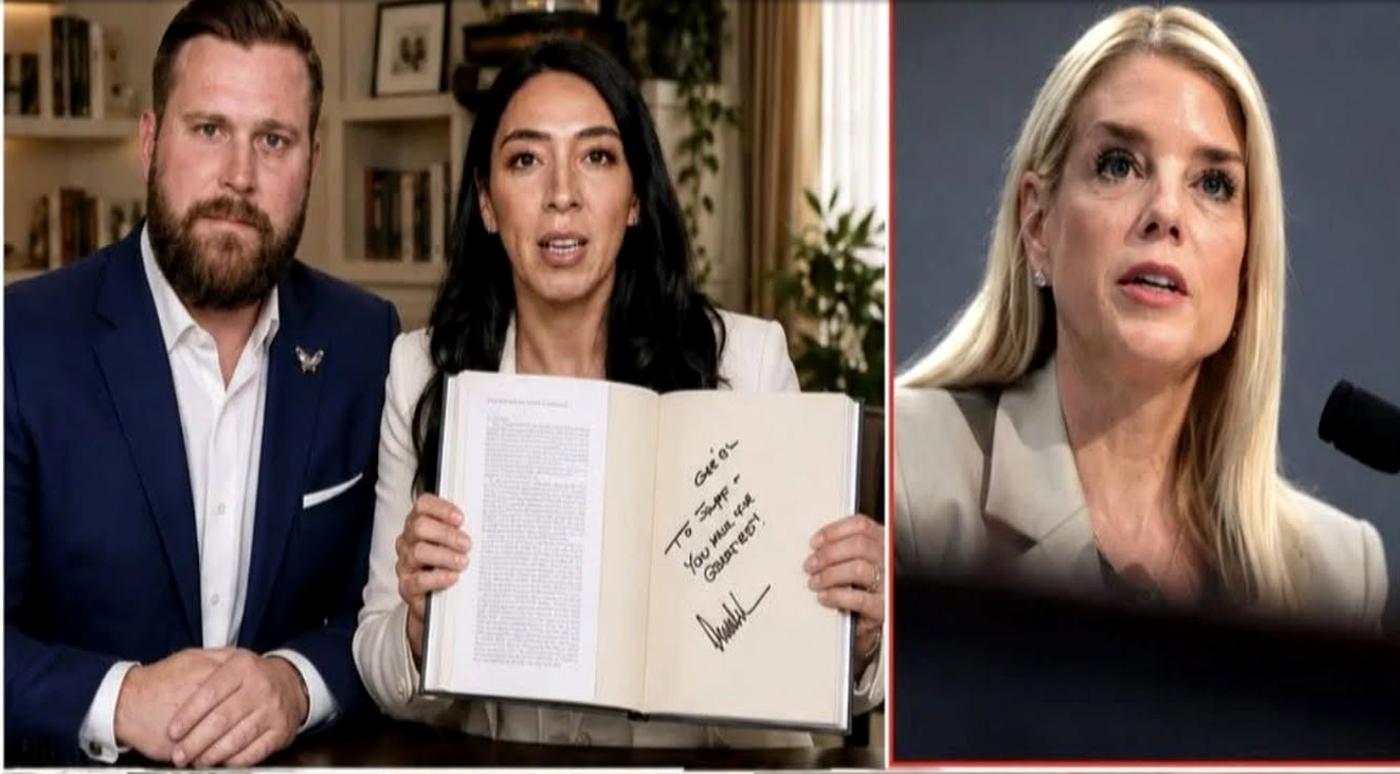
For a story that seemed destined to disappear beneath years of court filings, headlines and political arguments, Virginia Giuffre’s voice is proving remarkably difficult to silence.
The renewed attention surrounding Nobody’s Girl is bringing readers back to the testimony, allegations and experiences Giuffre documented before her death — and once again placing the people, institutions and powerful circles surrounding Jeffrey Epstein under intense public scrutiny.
The memoir was not a sudden leak.
It was a book Giuffre completed before her death and explicitly wanted published.
Knopf released Nobody’s Girl: A Memoir of Surviving Abuse and Fighting for Justice on October 21, 2025, at 400 pages.
That detail changes the meaning of the current attention.
This is not a secret manuscript suddenly escaping into the world.
It is Giuffre’s own account, preserved for publication after she was gone.
And now readers are returning to it with a question that has never really disappeared:
How much more does this memoir reveal about the world Giuffre entered as a teenager — and the powerful people she said she encountered inside it?
The emotional force of the book comes from its personal nature.
Giuffre was not simply describing Epstein through the language of investigators or lawyers.
She was recounting her own experiences.
She described being drawn into Epstein and Ghislaine Maxwell’s orbit as a teenager, the abuse she said followed, and the years she spent trying to make institutions and the public listen to her account.
The Washington Post described the memoir as the story of a woman who had spent years speaking publicly about being trafficked while underage.
That makes the book much bigger than another collection of Epstein-related documents.
It is a survivor’s narrative.
And that matters because the Epstein story is often reduced online to names, photographs, flight records and speculation.
Giuffre’s memoir pulls the focus back toward the person at the center of the experience.
What did she believe was happening when she was first approached?
What did she understand about the people around Epstein?
When did she begin to realize the scale of what was happening?
And what did it cost her to speak publicly?
Those questions cannot be answered by a contact book.
They cannot be answered by a list of famous names.
And they cannot be answered responsibly by treating every allegation as an established fact.
That distinction becomes especially important because Nobody’s Girl does discuss prominent people.
Reviews and excerpts have drawn attention to Giuffre’s descriptions of figures such as Prince Andrew and to accounts involving unnamed political figures.
Some people she previously accused denied the allegations, and those allegations were not equivalent to criminal convictions.
The memoir therefore enters a complicated evidentiary landscape.
There are statements made by Giuffre.
There are statements made by other witnesses.
There are court records.
There are denials.
There are historical investigations.
And there are questions that remain contested.
The existence of the memoir does not settle all of those disputes.
But it does preserve Giuffre’s perspective in extraordinary detail.
That may be one reason the book has continued to attract attention well after publication.
By December 2025, The Guardian reported that the memoir had sold one million copies worldwide in just two months.
Its impact also extended beyond book sales.
The memoir renewed scrutiny of Prince Andrew and intensified public pressure for greater disclosure of Epstein-related government records.
And that brings the story back to the present.
Every time new documents are released, readers inevitably return to the same questions:
Who knew what?
When did they know it?
Which relationships were social, professional or personal?
And were institutions capable of recognizing what was happening around Epstein?
Those are serious questions.
But there is another question that may be even more important.
What happens when a survivor’s own account collides with years of public narratives written by everyone else?
For decades, Giuffre’s story was repeatedly discussed by lawyers, journalists, politicians and online commentators.
Now the memoir gives readers her own narrative in a sustained form.
That does not make every detail automatically proven.
But it does make the testimony harder to reduce to a headline.
And this is perhaps where the renewed interest becomes most significant.
The Epstein story has produced an enormous archive.
The U. S.
government has released millions of pages of records, including material connected to investigations, court proceedings and witness accounts.
Yet more documents can sometimes make a story more confusing rather than less.
One file may contain an allegation.
Another may contain a denial.
Another may document a meeting.
Another may establish a timeline.
Only by examining them together can researchers begin to understand what the evidence actually supports.
Giuffre’s memoir belongs inside that larger record.
It is neither a complete legal verdict nor a simple piece of gossip.
It is a first-person account that can be compared with other evidence.
And that is exactly how it should be treated.
The danger comes when social media turns a nuanced memoir into a supposed “master list” of powerful people.
That can erase the very thing the book is trying to preserve: Giuffre’s experience.
The most important story is not necessarily who appears on a page.
It is what happened to the young woman whose life became entangled with Epstein’s world.
And what happened afterward.
She became a public accuser.
An activist.
A litigant.
A survivor whose testimony was repeatedly challenged, examined and debated.
Her decision to write Nobody’s Girl was therefore also a decision about memory.
She wanted her story to exist in her own words.
And it now does.
That may be why the “wall of silence” metaphor continues to resonate.
Not because every rumor surrounding the memoir is true.
Not because every person discussed in it has been proven guilty of anything.
But because one woman who spent years demanding to be heard left behind a permanent record of what she said happened.
The challenge now is what readers do with that record.
Do they turn it into another cycle of viral accusations?
Or do they read it carefully, compare it with documentary evidence and distinguish testimony from proof?
That choice matters.
Because the Epstein case already contains enough verified facts, disturbing testimony and institutional questions to demand serious attention.
It does not need invented revelations.
It needs careful examination of the record.
And perhaps that is the most powerful legacy of Nobody’s Girl.
The book cannot answer every unanswered question.
But it makes it much harder to pretend that the people at the center of the story were merely names in a file.
They were human beings.
They had memories.
They had fears.
They had lives before and after Epstein.
And Giuffre made sure that at least one survivor’s version of that history would remain publicly accessible.
So the question now is not simply whether Nobody’s Girl can “reopen” the Epstein story.
It already has.
The deeper question is what readers will discover when they stop searching only for shocking names and start paying attention to the testimony itself.
Because sometimes the most powerful thing a survivor leaves behind is not another revelation — but a voice that refuses to disappear.