The first thing I noticed about Grant Whitaker’s message was what it did not contain.
No apology.
No explanation.
No acknowledgment that eight years had passed since he had spoken to me like I was a stranger standing in the wrong place.
There was not even a greeting.
His name appeared across the screen of my secure phone at 3:17 on a Wednesday afternoon while I stood beside a wall-sized map in the operations room of the Texas Department of Public Safety.
**Grant Whitaker.**
For several seconds, I thought one of my staff had entered the wrong contact into the system.
Then I read the message.
**Mother wants to see you before the year ends. Christmas Day. Whitaker residence, Fort Carson. 1400 hours. Please be there.**
That was all.
Eight years of silence reduced to three short sentences.
I stared at the screen until the map behind it blurred.
“Commander?”
I looked up.
Captain Lena Brooks stood in the doorway holding a stack of reports against her chest.
Lena had worked with me for nearly five years. She could tell whether a meeting had gone badly from the way I put my pen down.
Now she looked from my face to my phone.
“What happened?”
“Nothing.”
“That is your ‘something happened’ voice.”
I placed the phone on my desk.
“We need to finish the Denton briefing.”
She did not move.
“Maya.”
Only a handful of people in the building called me by my first name.
Lena had earned the privilege after spending thirty-six hours beside me during a missing-assets investigation that involved three counties, two warehouses and an accountant who thought deleting spreadsheets meant the information no longer existed.
I leaned against the desk.
“My former husband wrote to me.”
Her eyebrows rose.
“The colonel?”
“Yes.”
“The one who hasn’t spoken to you since before the kids were born?”
“That one.”
“What does he want?”
I handed her the phone.
She read the message.
Then read it again.
“That’s it?”
“That’s it.”
“No ‘how are you?’”
“No.”
“No ‘I’ve spent eight years thinking about what I did?’”
“Apparently he was concerned about word count.”
Lena looked at me.
“You’re joking.”
“A little.”
She returned the phone.
“What does his mother want?”
“I don’t know.”
“Have you spoken to her?”
“Not since the divorce.”
“That family really committed to disappearing.”
I looked toward the windows.
Outside, December rain darkened the runway. Two department helicopters sat beyond the hangar, their rotors tied down against the weather. Technicians moved equipment beneath the covered maintenance area.
Eight years.
I had learned not to think of my old life in years anymore.
I measured it differently.
Four kindergarten registrations.
Four first lost teeth.
Four children learning to ride bicycles.
Two broken arms, both belonging to Lucas, because Lucas believed gravity was a rumor invented by nervous adults.
One hospital stay when Grace developed pneumonia at four.
Hundreds of school lunches.
Thousands of bedtime questions.
Eight Christmas mornings.
And not one call from Grant.
Lena lowered her voice.
“Are you going?”
I looked at the message again.
The sensible answer was no.
There was no reason to walk back into that family.
Margaret Whitaker had made her opinion of me clear long before Grant left.
His older brother had once called me temporary.
His aunt had spent our wedding reception asking whether my family owned any property.
Grant himself had done far worse.
The afternoon he ended our marriage, I was eleven weeks pregnant.
I had known for nine days.
He had known for three.
He called me a liar.
Then he left before he could learn how wrong he was.
I picked up my phone.
“Yes.”
Lena stared.
“You’re going?”
“Yes.”
“Why?”
“Because I’m tired of allowing that family to tell a story in which my children never existed.”
Her expression softened.
“You’re taking them?”
“All four.”
“Maya.”
“They’re old enough.”
“Old enough for what?”
“To know where half their face came from.”
She leaned against the doorframe.
“You realize this could become ugly.”
“It became ugly eight years ago.”
“You know what I mean.”
I did.
My children knew that their father had not been part of their lives.
They knew his name.
They knew he served in the Army.
They had seen one photograph.
I kept it in a drawer, not because I wanted to hide him, but because there had never been much to explain.
When Noah was five, he found it.
“Is this Dad?”
I remember standing beside the kitchen counter with a grocery bag in one hand.
“Yes.”
“Where does he live?”
“Different places.”
“Why doesn’t he live with us?”
That question nearly brought me to my knees.
Instead, I put the groceries down.
“Your dad and I stopped being married before you were born.”
“Does he know about us?”
That had been harder.
“He knew I was expecting a baby.”
“A baby?”
“Yes.”
“But there are four of us.”
“He left before we knew there were four.”
Noah thought about that.
Then he asked the question children eventually learn to stop asking.
“Why didn’t you tell him?”
“I tried.”
That answer had to be enough.
Now Grant had invited me to Christmas.
He thought he was inviting one woman.
I wondered what his face would look like when five people arrived.
Lena said, “What are you going to tell the kids?”
“The truth.”
“All of it?”
“The version appropriate for eight-year-olds.”
“That leaves out quite a lot.”
“They don’t need adult resentment.”
“You’re better than I am.”
“No. I’ve had eight years to practice.”
She looked at me for another moment.
Then she picked up the Denton reports.
“You still have a briefing in twelve minutes.”
“I know.”
“And you’re going to act like your life didn’t just open an old file?”
“That is exactly what I’m going to do.”
She smiled slightly.
“That might be the most you sentence you’ve ever said.”
I ignored her.
But after she left, I looked at Grant’s message one more time.
Then I opened the locked drawer beside my desk.
Inside was a small envelope.
I kept four documents there.
Four certified birth certificates.
On each one, under **Father**, the same name appeared.
**Grant Alexander Whitaker.**
He had never seen them.
—
I met Grant when I was twenty-four.
Back then I was Maya Bennett, newly hired into a state investigative analyst program and convinced that if I worked hard enough, planned carefully enough and kept enough emergency cash in my savings account, life would eventually become predictable.
Grant was twenty-nine and already a captain.
We met at a barbecue hosted by a mutual friend outside San Antonio.
He arrived late.
I noticed him because everyone else noticed him.
Grant had that kind of presence.
Tall.
Broad shoulders.
Gray eyes.
A crooked smile that appeared first on the left side of his mouth.
He did not talk loudly, but people listened when he spoke.
For the first hour, I avoided him.
Men who knew exactly how impressive they were had never interested me.
Then I walked into the kitchen looking for ice and found him trying to repair the host’s broken blender with a butter knife.
“You know that’s unplugged, right?” I asked.
He looked at the cord.
Then at me.
“I was testing whether anyone would notice.”
“Of course.”
“It worked.”
“What’s wrong with it?”
“No idea.”
“Then why are you holding a butter knife?”
“It creates confidence.”
I laughed.
He smiled.
There it was.
That dimple.
My children would eventually inherit it.
I did not know that then.
He offered me a drink.
I said no.
He asked why.
“I’m driving.”
“So am I.”
“Then why did you offer me one?”
“I’m terrible at flirting.”
“You seemed very confident about the blender.”
“That was before you came in.”
We talked for almost two hours.
After that, things moved quickly.
Grant was attentive without being overwhelming.
He remembered details.
If I mentioned a book, he asked about it a week later.
If I had a difficult case, he brought dinner without asking me to explain.
When he traveled, he called whenever he could.
He made military life seem manageable.
There would be separation, he said.
Changes.
Uncertainty.
“But I’ll never disappear on you.”
Those words remained with me for years.
We married fourteen months after meeting.
His mother did not approve.
Margaret Whitaker was the widow of Major General Charles Whitaker, a man whose military photographs covered entire walls of the family home.
The Whitakers had served for generations.
Army.
Navy.
Air Force.
According to Margaret, military service was not simply a profession.
It was an inheritance.
At our rehearsal dinner, she sat beside me wearing dark green silk.
“You understand Grant’s career will always require sacrifice.”
“I do.”
“His wife must never make him choose between home and duty.”
“I wouldn’t.”
She gave me a small smile.
“I hope not.”
At the time, I believed she was nervous.
I spent the first two years of my marriage trying to earn her approval.
I remembered birthdays.
Hosted dinners.
Sent photographs when Grant was deployed.
I listened politely when she corrected my table settings.
Nothing worked.
To Margaret, I remained the daughter of a public-school principal and a respiratory therapist who had somehow wandered into a family that owned engraved silver.
Grant defended me at first.
Then less often.
Then not at all.
“Let it go,” he would say.
“She doesn’t mean anything by it.”
“She absolutely means something.”
“Maya.”
“You’re asking me to ignore it because confronting her makes you uncomfortable.”
“I’m asking you not to turn every comment into a battle.”
So I stopped.
Not because Margaret improved.
Because I loved my husband.
That was one of many decisions I later reviewed differently.
Three years into the marriage, Grant received orders for an extended overseas assignment.
Around the same time, we began trying to have a child.
It did not happen quickly.
After more than a year, both of us stopped discussing it.
Then, three weeks before Grant was scheduled to leave, I woke before dawn feeling sick.
I took a test.
Then another.
Then sat on the bathroom floor staring at two lines.
I remember laughing.
Then crying.
Then laughing again.
Grant was still asleep.
I walked into our bedroom holding the test behind my back.
“Wake up.”
He opened one eye.
“What time is it?”
“Five thirty.”
“If this house is not on fire, I am filing a complaint.”
“Grant.”
He opened both eyes.
I held out the test.
For one second, he stared without understanding.
Then he sat upright.
“No.”
“Yes.”
“No.”
“Yes.”
He got out of bed so fast he knocked his pillow onto the floor.
“You’re sure?”
“I took two.”
“You’re pregnant?”
I nodded.
He crossed the room and wrapped both arms around me.
His face pressed against my hair.
I remember every detail because it was the last morning I trusted happiness without reservation.
For three days, Grant was thrilled.
Then something changed.
I did not understand why.
He began asking questions.
When had I last seen my doctor?
Was I certain about the dates?
Could the test be wrong?
At first, I thought he was anxious.
Then his mother called me.
Her voice was cold.
“Grant tells me you are pregnant.”
“Yes.”
“What unusual timing.”
I sat at my desk.
“What does that mean?”
“He is leaving.”
“I know.”
“And suddenly you are expecting.”
“I didn’t schedule it.”
“You have wanted him to leave the Army.”
“That is not true.”
“You complained about deployments.”
“Missing my husband is not asking him to resign.”
She made a soft sound.
“Young women sometimes panic when a marriage becomes difficult.”
I felt my stomach tighten.
“What exactly are you suggesting?”
“I’m suggesting Grant should be certain before changing any plans.”
“He isn’t changing plans.”
“He mentioned requesting a delay.”
That was news to me.
I called Grant immediately.
“Did you ask to postpone?”
“It was only a question.”
“Why didn’t you tell me?”
“Because I knew you’d react like this.”
“React like what?”
“You’re already upset.”
“I’m confused.”
The conversation became our first serious argument about the pregnancy.
Three days later, Grant said something worse.
He asked whether the child was definitely his.
I stared at him across our dining table.
“What did you just ask?”
“Maya.”
“No. Say it again.”
“I’m asking because the timing—”
“The timing of what?”
“You were traveling for work.”
“So were you.”
“You spent four days in Houston.”
“For an investigation.”
“With your team.”
“Yes.”
“Including David Cole.”
David was a married fifty-eight-year-old supervisor who had grandchildren.
I almost laughed.
Then I saw Grant’s face.
“You’re serious.”
“I’m asking.”
“You think I slept with David?”
“I don’t know what happened.”
“Nothing happened.”
He looked away.
That hurt more than the question.
Someone had planted doubt.
I knew who.
But Grant had chosen to water it.
Within two weeks, our marriage became nearly unrecognizable.
He slept in the guest room.
We spoke mostly about logistics.
His mother called daily.
Then came the doctor’s appointment.
Grant promised to attend.
The night before, he received a call.
He said he had to meet with his commanding officer.
I attended alone.
That was the appointment where my obstetrician stared at the ultrasound screen and began smiling.
“What?”
She adjusted the equipment.
“There’s more than one.”
My heart started racing.
“Twins?”
She moved the monitor slightly.
“Well…”
I looked at her.
“How many?”
She laughed softly.
“You might want to take a breath.”
There were four.
Four separate heartbeats.
Four developing babies.
The room became strangely quiet except for the machine.
I cried.
The nurse cried.
The doctor gave me several warnings about risk, specialists and monitoring.
I barely heard half of it.
I called Grant before leaving the parking garage.
No answer.
I called again.
Nothing.
Then a message appeared.
**We need to talk tonight.**
He came home at seven.
I was sitting at the kitchen table with the ultrasound photographs spread in front of me.
Grant did not sit.
“I filed.”
I looked up.
“What?”
“For divorce.”
Everything inside me went still.
“You filed for divorce?”
“Yes.”
“Without talking to me?”
“We’ve been talking for weeks.”
“No. You’ve been accusing me for weeks.”
“I can’t do this.”
“Do what?”
“This marriage.”
I stared at him.
Then looked down at the ultrasound images.
“Grant, there are—”
“I don’t want another conversation about the pregnancy.”
“You need to hear this.”
“No.”
“There are four.”
He looked at me.
I remember that clearly.
He heard me.
“What?”
“Four babies.”
His expression changed.
Then hardened again.
“That’s impossible.”
“I just came from the doctor.”
“Maya.”
“I have the ultrasound.”
He did not look at it.
Instead, he said something I would replay for years.
“I don’t know what you expect me to believe anymore.”
I stood.
“I expect you to look at the medical report.”
“I’m leaving next week.”
“Then look before you go.”
“I’ve already requested an overseas transfer extension.”
“Grant.”
“I need distance.”
“From me or from responsibility?”
His jaw tightened.
“Don’t.”
“No, you don’t get to do that. You just filed for divorce while I’m carrying four babies.”
“If they are mine—”
That sentence ended our marriage long before the legal paperwork did.
I stared at him.
Then I gathered the ultrasound images.
My hands were shaking so badly that one slid onto the floor.
He did not pick it up.
Neither did I.
I walked upstairs.
The next morning, he was gone.
Within seven days, he left the country.
Within three weeks, his number changed.
His attorney handled everything.
I sent medical records.
No response.
I sent certified notices confirming the pregnancy.
No response.
His attorney said Grant contested paternity and would address the matter after deployment.
He never did.
By the time the babies were born, the divorce was final.
I stopped asking him to come back.
—
The pregnancy was difficult.
At twenty-six weeks, I was placed on strict medical restrictions.
At twenty-nine, I was admitted to the hospital.
At thirty-two weeks and four days, Noah, Ethan, Sophia and Olivia arrived within seven minutes of one another.
Noah screamed first.
Ethan barely made a sound.
Sophia arrived with both fists raised near her face.
Olivia was the smallest.
Three pounds, four ounces.
She spent the longest time in neonatal care.
My mother moved into my apartment.
My father drove four hours every weekend.
My coworkers donated leave.
People I barely knew brought food.
Grant sent nothing.
Not a card.
Not an email.
Not one question.
On the children’s birth records, I listed him as their father.
My attorney advised me to establish paternity formally.
At the time, I refused.
“Why?” she asked.
I looked through the hospital glass at four tiny bodies surrounded by wires and monitors.
“Because I’m not dragging a man into their lives who worked this hard to stay out.”
“You may need support.”
“I have savings.”
“Maya.”
“I have a career.”
“You have four premature babies.”
“I know exactly how many babies I have.”
She became quiet.
Years later, I understood her concern better.
At twenty-six, pride and survival often feel identical.
Somehow, we managed.
The first two years were chaos.
I slept in ninety-minute pieces.
I labeled bottles by color.
Every door in the apartment had a schedule taped beside it.
At one point, my mother said my kitchen looked like a military command post.
“I learned from their father,” I said.
It was the first joke I made about Grant after the divorce.
I expected it to hurt.
Instead, it felt freeing.
The children developed personalities long before I expected.
Noah was observant.
He watched before joining anything.
At three, he could sit beside an open toy box for ten minutes deciding what he wanted.
At eight, he asked questions that made adults reconsider their own answers.
Ethan was quiet in a different way.
He loved machines.
Fans.
Vacuum cleaners.
Engines.
If something broke, he wanted the pieces.
Sophia believed rules were discussion topics.
When her kindergarten teacher said everyone had to color the sun yellow, Sophia asked where the rule was written.
Olivia was the smallest and somehow the loudest.
She sang constantly.
Songs from school.
Songs from cartoons.
Songs she invented about pancakes.
They looked enough alike that strangers always knew they were siblings.
But none of them were identical.
Noah and Ethan both had Grant’s gray eyes.
Sophia’s were darker.
Olivia’s seemed almost blue in bright light.
All four had the same dimple.
That dimple bothered me for the first year.
I would see Noah smile and suddenly remember Grant standing beside a broken blender.
Eventually, the children made the feature their own.
Grant stopped owning any part of their faces.
They were simply themselves.
My career changed too.
I returned to work when the children were six months old.
Not full-time at first.
Then more.
I moved from financial investigations into organized crime analysis.
Then interstate fraud.
Then special investigations.
I became a lieutenant at thirty-one.
Captain at thirty-three.
Commander at thirty-four.
The title surprised people who remembered the quiet analyst I had been.
It did not surprise me.
Raising four children taught me more about command than any leadership course.
You learned quickly that shouting did not create order.
Preparation did.
Consistency.
Knowing who needed encouragement and who needed space.
Knowing that four people could receive the exact same instruction and interpret it four different ways.
By the time Grant’s message arrived, I led a statewide investigative unit coordinating major financial and trafficking cases with federal and military partners.
My office had two phones.
A security clearance.
A wall of commendations I rarely looked at.
And a drawer full of school permission slips.
My life was not the one Grant had left.
That mattered more than I wanted to admit.
—
I waited until Friday evening to tell the children about Christmas.
We were eating tacos at the kitchen table.
Friday taco night had begun when they were four because I needed one dinner each week that nobody could argue about.
Even then, Sophia argued about lettuce.
“I need to tell you something,” I said.
Four heads lifted.
Noah put down his taco.
“That sounds serious.”
“It isn’t bad.”
“That’s what teachers say before announcing a test,” Sophia said.
Ethan continued eating.
Olivia asked, “Are we getting a dog?”
“No.”
She sighed.
“Then continue.”
I smiled.
“We’ve been invited somewhere for Christmas.”
“Grandma’s?” Ethan asked.
“My parents are coming with us afterward.”
“Where first?”
I took a breath.
“To meet some people from your dad’s family.”
Silence.
Even Ethan stopped chewing.
Noah looked at me.
“Dad’s family?”
“Yes.”
“Is Dad going to be there?”
“I believe so.”
Olivia’s eyes widened.
“Our actual dad?”
“You only have one.”
“You know what I mean.”
“I do.”
Sophia frowned.
“Why now?”
I looked at her.
“His mother asked me to come.”
“Grandma?”
“Your other grandmother.”
“We have two grandmas?”
“Technically, yes.”
Olivia looked offended.
“Why have we never met that one?”
There it was.
The impossible question made simple.
“Because your dad and I separated before you were born, and his family stopped speaking to me.”
Noah watched me closely.
“Do they know about us?”
“Your dad knew I was expecting babies.”
“All four?”
“He left right before I learned there were four.”
“But did you tell him after?”
“Yes.”
“And he didn’t come?”
I kept my voice calm.
“No.”
Nobody spoke.
Ethan looked down at his plate.
Sophia’s face tightened.
Olivia asked, “Did he not get the message?”
“I sent more than one.”
Noah leaned back.
“So he knows.”
“He had enough information to know.”
That distinction mattered to me.
I did not know what Grant’s attorney had actually forwarded.
I knew what I sent.
I knew he never answered.
Sophia asked, “Do we have to go?”
“No.”
That surprised them.
“No?” she repeated.
“No one is forcing you.”
“What if only some of us want to?”
“Then only some go.”
Olivia immediately said, “I want to go.”
Ethan nodded.
Sophia asked, “Will there be food?”
“It’s Christmas.”
“That’s not an answer.”
“Yes, there will be food.”
“Then maybe.”
Noah said nothing.
After dinner, while the others loaded plates into the dishwasher, he remained seated.
“Mom?”
“Yes?”
“Why do you want to go?”
I sat beside him.
“That’s a fair question.”
“Are you mad at him?”
“Sometimes.”
“Still?”
“Yes.”
He looked surprised by my honesty.
“I’m not angry every day. I don’t wake up thinking about him.”
“But you’re mad.”
“What happened hurt me.”
He nodded.
“Do you want us to make him feel bad?”
“No.”
That answer came immediately.
“Then why bring us?”
“Because you are not a secret.”
He looked at me.
“And I don’t want anyone telling a story about you that isn’t true.”
“What story?”
“That you didn’t exist.”
Noah frowned.
“We obviously exist.”
“I know.”
He thought about that.
“Will he know we’re his?”
I looked at my son’s gray eyes.
“Yes.”
“How?”
I almost smiled.
“I think he’ll figure it out.”
—
Christmas morning began at 4:52 because Olivia had decided sleep was optional on holidays.
By five fifteen, all four children were in my bedroom.
“No gifts until six,” I said without opening my eyes.
“That’s unreasonable,” Sophia replied.
“It’s the law.”
“You make laws?”
“At five in the morning, yes.”
Ethan climbed onto the foot of the bed.
“Can we make breakfast?”
“You may pour cereal.”
“Pancakes?”
“No fire or stovetop appliances without an adult.”
“I know.”
“Then why ask?”
“Possibility.”
At six, we opened the small gifts at home.
The larger family celebration would happen that night with my parents in Colorado Springs.
At seven thirty, everyone changed into clothes I had laid out the night before.
Navy winter coats.
Dark pants.
Boots.
Each child wore a small gold shield pin from my unit.
The pins had no official authority.
They were honorary gifts my team had presented at our family holiday dinner.
Noah also insisted on wearing the miniature campaign-style cap Lena had given him as a joke.
“You look like you’re conducting an inspection,” I told him.
“Maybe I am.”
Our transportation was unusual enough that I explained it twice.
My unit was participating in a joint interstate task-force briefing in Colorado that week. A National Guard flight already scheduled between Texas and Colorado had seats available under the existing coordination agreement.
We were not receiving a helicopter simply because I wanted to make an entrance.
That would have embarrassed me.
The children, however, cared only about the aircraft.
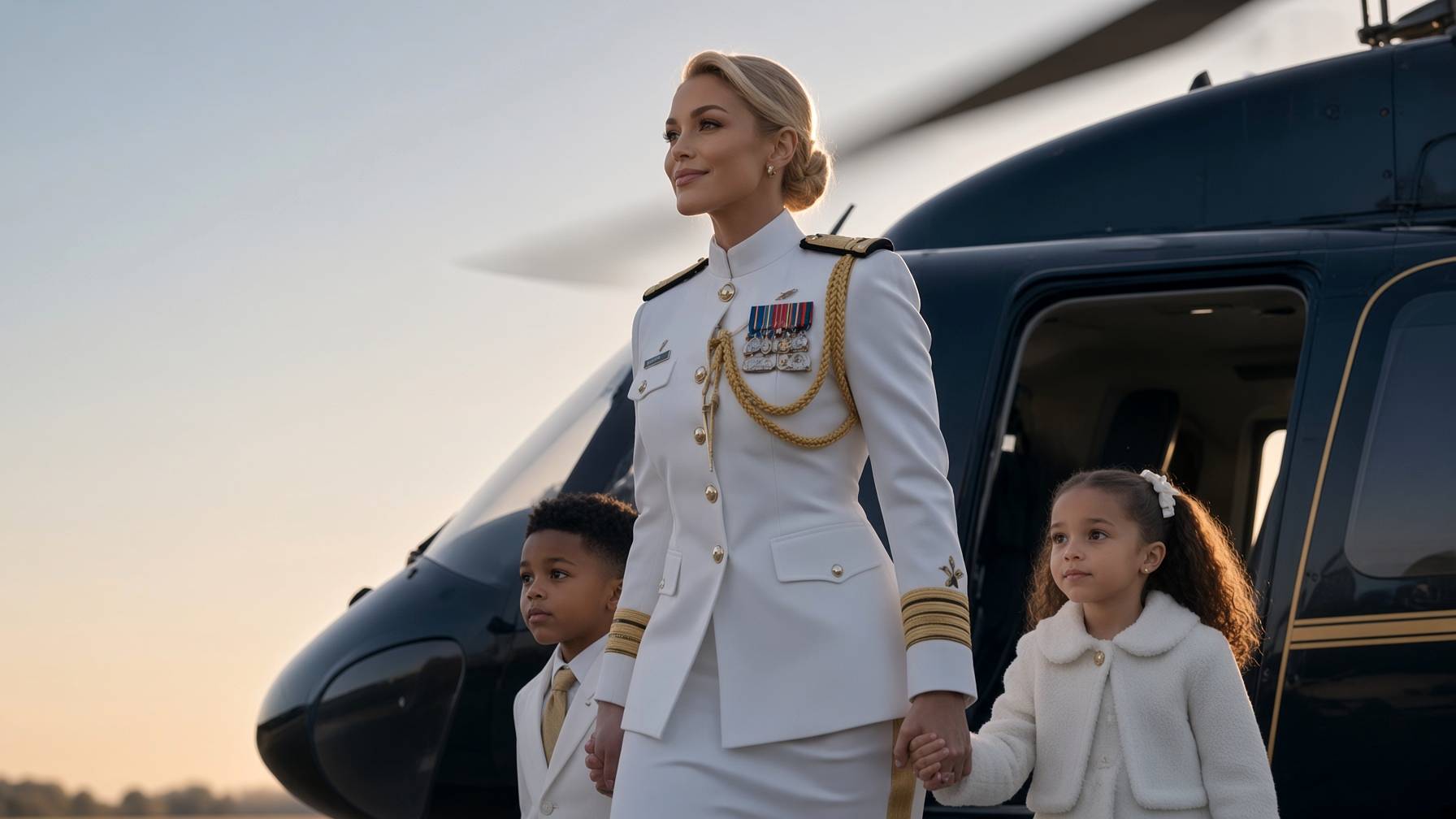
By late morning, after the fixed-wing leg and a transfer arranged through Fort Carson, we were seated inside a military helicopter for the final flight.
Olivia’s eyes were enormous.
Ethan looked like someone had handed him the keys to heaven.
“Can I see the cockpit?” he shouted through his headset.
“Later.”
“Promise?”
“No.”
“Mom.”
“I said maybe.”
“That means no.”
“It means ask the crew after we land.”
Noah sat beside me.
The Colorado landscape passed below us.
Snow covered the open areas.
Mountains rose in the distance beneath a pale sky.
He adjusted his headset.
“Are you nervous?”
I looked at him.
“Why?”
“You keep moving your wedding ring.”
I stopped.
I wore a simple ring on my right hand.
Not a wedding ring.
My grandmother’s.
Apparently I had been rotating it around my finger without noticing.
“A little.”
“Me too.”
“You can still change your mind.”
He shook his head.
“I want to see him.”
“Okay.”
“What do I call him?”
My throat tightened.
“Whatever feels comfortable.”
“Dad?”
“If you want.”
“What if I don’t?”
“That’s okay.”
“Colonel?”
I laughed.
“That might be slightly formal.”
“You call people by rank.”
“At work.”
“Is he at work?”
“Technically, we’re entering a military installation.”
“So Colonel works.”
“If you want.”
Noah nodded seriously.
Across from us, Sophia leaned toward Ethan.
“I’m calling him Grant.”
“You can’t call adults by first names,” Ethan said.
“Mom does.”
“Mom is an adult.”
“I’m almost nine.”
“That is not almost adult.”
Their argument continued until Lena, who had joined us for the Colorado task-force portion of the trip, raised one finger.
“Save some energy for the actual family drama.”
I gave her a look.
She corrected herself.
“Family gathering.”
The helicopter began descending.
My stomach tightened.
Below us, the Whitaker family residence appeared beside the parade lawn.
The house belonged to military history more than to any one family.
Grant’s father had used it during his final years of service, and Margaret had maintained close ties to the installation afterward. For large holiday gatherings, the Whitakers still used the residence through a private association arrangement connected to retired senior officers.
I had been there twice while married.
The first Christmas, Margaret corrected the way I folded napkins.
The second, Grant and I left early after she announced during dinner that military wives needed “independent interests so their husbands did not feel trapped.”
Now the lawn was white with snow.
Vehicles lined the drive.
Guests stood near the windows.
The helicopter descended.
Snow scattered beneath the rotor wash.
I looked at my children.
“Stay together.”
Four heads nodded.
The door opened.
Cold air rushed inside.
I stepped down first.
My formal dark-blue state command uniform felt suddenly too stiff across my shoulders.
I had debated wearing civilian clothes.
Lena told me not to.
“You earned the uniform.”
“I don’t need to prove anything.”
“No. But you also don’t need to shrink yourself to make old memories comfortable.”
So I wore it.
Silver insignia at my shoulders.
Nameplate.
Service ribbons.
Nothing excessive.
Nothing hidden.
Noah climbed down after me.
Then Ethan.
Sophia.
Olivia.
Once we moved away from the aircraft, the four children gathered beside me.
I looked toward the house.
The front doors opened.
Margaret Whitaker stepped outside.
She had aged.
Of course she had.
That should not have surprised me.
In my memory she was always fifty-eight, elegant and immovable.
Now she was sixty-six.
Her hair was almost entirely white.
She wore a deep burgundy dress beneath a wool coat.
A crystal glass was in one hand.
She looked first at me.
Then at the children.
Her hand opened.
The glass fell onto the stone step.
It broke into several pieces.
Noah looked up at me.
“Is that Grandma?”
The helicopter was still loud behind us, but somehow his question seemed louder.
Margaret’s face changed.
Her eyes moved from Noah to Ethan.
Then Sophia.
Then Olivia.
She covered her mouth.
More people appeared behind her.
Grant’s brother.
Two cousins.
Several retired officers I recognized.
Spouses.
Family friends.
The conversation inside the house faded.
Olivia whispered, “Everyone is staring.”
“I know.”
“Did we do something?”
“No.”
Margaret came down one step.
“Maya?”
“Hello, Margaret.”
Her eyes filled.
Not enough for tears to fall.
Just enough that I saw them.
“Who are…”
She stopped.
Because she knew.
Anyone would.
Grant’s face had been copied into four smaller versions and rearranged slightly.
The eyes.
The dimple.
Noah even stood like him, weight slightly shifted onto one leg whenever he was uncertain.
Margaret’s voice came out thin.
“How old are they?”
Noah answered before I could.
“Eight.”
She closed her eyes.
Eight.
The number did what my arrival could not.
It created a timeline.
Olivia tugged lightly at my coat sleeve.
“Are we going inside?”
Margaret opened her eyes.
“Yes.”
Then she looked at me.
“Please.”
I had never heard Margaret Whitaker say that word to me before.
We climbed the steps.
As we passed, she looked at each child.
Sophia looked directly back.
Ethan stared at the military medals displayed inside the entryway.
Olivia smiled because Olivia smiled at almost everyone.
Margaret nearly lost her composure when the dimple appeared.
Inside, the house smelled like evergreen branches, coffee and roasted meat.
Nothing had changed and everything had.
The same wide staircase.
The same portraits.
The same large Christmas tree placed near the grand hall windows.
Voices disappeared as we entered.
Then I saw Grant.
He stood beside the fireplace wearing his formal Army uniform.
For a second, eight years vanished.
He was still the man I remembered.
Then the details returned.
More silver near his temples.
Deeper lines beside his mouth.
Colonel’s insignia.
A stronger stillness in the way he stood.
Beside him was a woman in a pale gold dress.
Blond hair.
Elegant.
Probably early thirties.
Her fingers rested around his forearm.
Grant held a small velvet box.
I understood immediately.
A proposal.
Of course.
Margaret had invited me to Christmas on the day her son planned to begin another marriage.
I wondered whether she knew.
The blond woman smiled politely when she saw me.
Grant did not.
His face emptied.
“Maya?”
His eyes moved to my uniform.
Then lower.
Noah.
Grant stopped breathing.
I saw it.
His chest simply seemed to stop moving.
Then Ethan stepped beside Noah.
Grant’s eyes widened.
Sophia emerged from behind me.
Olivia followed.
Four faces.
Four children.
Four separate confirmations of the same thing he had refused to believe.
The velvet box fell from his hand.
It landed beside his polished shoe.
The woman next to him looked down.
Then at me.
Then at the children.
“Grant?”
He did not answer.
Her fingers slid away from his sleeve.
“Who are they?”
His mouth opened.
Nothing came out.
I had imagined this meeting many times.
Not deliberately.
Usually late at night.
I imagined yelling.
I imagined Grant apologizing.
I imagined ignoring him.
In every version, I knew exactly what to say.
Standing there, I felt none of the satisfaction those imaginary scenes had promised.
I felt tired.
And sad.
Mostly, I felt protective of the four children beside me.
I rested my palm lightly against Olivia’s upper back and guided her nearer.
“Merry Christmas, Grant.”
His eyes finally moved to mine.
“How…”
He stopped.
I waited.
“How old?”
Noah answered.
“Eight.”
Grant closed his eyes briefly.
The blond woman stared at him.
“Grant?”
Margaret had entered behind us.
She gripped the banister.
I looked around the room.
“I thought it was time the Whitaker family met Noah, Ethan, Sophia and Olivia.”
Grant whispered, “Four.”
“Yes.”
“You…”
His voice broke.
“You had four?”
“You received medical records.”
“I never saw…”
He stopped again.
That caught my attention.
“You never saw what?”
Before he could answer, Noah stepped away from me.
“Noah,” I said.
He looked back.
“I just want to see.”
I nodded.
He walked toward Grant.
The room remained completely silent.
Noah stopped several feet away.
He tilted his head.
Grant stared at him.
Noah studied Grant’s face with the seriousness he normally reserved for puzzles.
Then he looked toward Ethan.
Then back at Grant.
Finally, he asked:
“Did you know we looked like you?”
No one moved.
Grant’s face changed in a way I had never seen before.
Not anger.
Not embarrassment.
Something closer to being completely unprepared for the truth.
“No,” he said.
Noah frowned.
“Did you know about us?”
Grant swallowed.
“I knew your mother was pregnant.”
“With four?”
“I…”
“Noah,” I said gently.
He looked at me.
“You can ask questions. But give him time to answer.”
Noah turned back.
Grant lowered himself slowly until he was closer to Noah’s height.
He did not move his hands toward him.
He seemed afraid even to do that.
“I knew your mother told me she was expecting babies.”
Noah’s eyebrows pulled together.
“Then why didn’t you meet us?”
Grant looked at me.
I did not help him.
This answer belonged to him.
“I made a terrible decision.”
“That’s not why.”
Grant blinked.
“What?”
“That’s what Mom says when we do something wrong after she asks why. She says ‘I made a bad decision’ doesn’t explain the decision.”
A small sound came from somewhere in the room.
Someone almost laughed and stopped.
Grant looked at my son.
“You’re right.”
Noah waited.
Grant inhaled slowly.
“I believed something that wasn’t true.”
“What?”
“That your mother might not be telling me the truth.”
Noah looked at me.
I kept my expression neutral.
Then he looked back at Grant.
“About us?”
“Yes.”
“But we were inside her.”
Sophia whispered loudly from behind me, “Obviously.”
I almost closed my eyes.
Grant heard her.
For the first time, the left side of his mouth moved.
A tiny, broken version of the smile my children had inherited.
Noah was not finished.
“Did you check?”
That question changed the room.
Grant stared.
“No.”
“Why?”
“I should have.”
“That’s also not why.”
I saw Grant’s eyes fill.
He lowered his gaze.
“You ask difficult questions.”
“Mom says easy questions usually have easy answers.”
I heard Lena make a quiet coughing sound behind me.
Grant looked at me again.
“You’ve taught him well.”
“I taught all four.”
The blond woman beside the fireplace took one step backward.
“Grant, I need to understand what is happening.”
He stood.
“Elise.”
So that was her name.
She looked at him.
“Are these your children?”
He stared at the four of them.
“Yes.”
The word seemed to hurt him.
“Yes. They are.”
“You knew?”
“I knew Maya was pregnant when we divorced.”
“With four children?”
“I didn’t know there were four until…”
His eyes returned to me.
“Apparently she tried to tell me.”
I folded my arms.
“I did tell you.”
“You said it once.”
“I sent your attorney the medical report four times.”
His face changed.
“Four?”
“Yes.”
“I received one letter saying you were claiming multiple pregnancy and would address paternity later.”
“That was your attorney’s wording.”
“I never saw the medical documents.”
Margaret stepped forward.
“Grant.”
He turned.
Something passed between them.
I saw it immediately.
So did Grant.
His expression hardened.
“Mother.”
Margaret looked pale.
“What did you receive?”
She said nothing.
“Mother.”
Elise looked between them.
“What is going on?”
Grant walked toward Margaret.
“Did you handle communications from my divorce attorney while I was overseas?”
Margaret’s lips parted.
I remembered suddenly that she had.
Grant had given her limited authority to manage mail and personal administration while he was deployed.
At the time, I thought nothing of it.
“Maggie?” one of the retired officers said quietly.
Grant’s mother looked at me.
Then at the children.
Finally she said, “This should not happen in front of them.”
I almost laughed.
For eight years, everyone had worried about protecting adults from uncomfortable conversations.
“No,” I said. “No accusations in front of them. Facts are fine.”
Grant turned back to her.
“What did you know?”
Margaret lowered her voice.
“I knew Maya continued sending claims.”
“Claims?”
My temper moved for the first time.
“They were prenatal records.”
She looked at me.
“I believed—”
“No. Tell him.”
Grant stared at his mother.
“Tell me what you did.”
Margaret’s eyes filled again.
“I told your attorney not to forward every document.”
The silence afterward felt enormous.
Grant took one step backward.
“You what?”
“You were overseas.”
“That was my mail.”
“You were under tremendous pressure.”
“That was my marriage.”
“You had already filed for divorce.”
“That was my child.”
“Children,” Sophia corrected from beside me.
Everyone looked at her.
She shrugged.
“There are four.”
Margaret closed her eyes.
Grant’s voice became quieter.
“You knew?”
“I knew Maya reported a high-risk multiple pregnancy.”
“When?”
“After you left.”
“How soon?”
She did not answer.
“When?”
“Within weeks.”
Grant looked like someone had removed the floor beneath him.
“You knew for eight years.”
“No.”
“What does that mean?”
“I did not know they had been born.”
I stared at her.
“That’s not true.”
Margaret looked at me.
I stepped forward.
“I sent birth announcements by certified mail.”
Grant turned.
“You did?”
“To your last legal address and your attorney.”
Margaret said, “I never saw them.”
“Your signature is on one receipt.”
Her face went still.
I had kept it.
Of course I had.
Investigators keep records.
Abandoned wives do too.
Grant whispered, “Mother.”
She looked at him.
“I thought I was protecting you.”
“From four newborn children?”
“From a woman I believed was trying to interfere with your career.”
Elise covered her mouth.
Grant stared at his mother.
“You told me Maya stopped pursuing paternity.”
“She did.”
“After I received nothing.”
I said, “I stopped because every attempt disappeared into silence.”
Margaret’s voice sharpened.
“You could have filed in court.”
“Yes.”
“Then why didn’t you?”
I looked at her.
“Because I was twenty-six years old with four premature babies, one of whom spent weeks struggling to breathe properly. I was working when I could, sleeping when they allowed it, and trying not to fall apart. I decided I would rather raise them without him than spend years forcing a man to acknowledge children he had already rejected.”
Grant closed his eyes.
“That’s not what I—”
“It was exactly what you did.”
He looked at me.
“I didn’t know.”
“You knew enough.”
His face tightened.
I continued.
“You knew I was pregnant.”
“Yes.”
“You knew I had medical confirmation.”
“Yes.”
“You accused me of being unfaithful without evidence.”
“Yes.”
“You refused to look at the ultrasound sitting on our table.”
He said nothing.
“You filed for divorce.”
“Yes.”
“You left.”
“Yes.”
“And you made sure I could reach you only through people who already believed I was lying.”
Grant lowered his head.
“Yes.”
There was no defense.
Oddly, that made me less angry.
Elise walked toward the fireplace and picked up the velvet box.
She held it in her palm.
“Was this why you invited Maya?”
Margaret looked at her.
“No.”
“Then why?”
The question surprised me too.
Margaret looked at the children.
“I found something.”
Grant frowned.
“What?”
She moved toward a small writing desk near the windows.
From a drawer, she removed a folder.
“I was going through your father’s papers.”
General Charles Whitaker had died two years earlier.
Margaret placed the folder on the desk.
“I found correspondence.”
Grant opened it.
His face changed.
“What is this?”
I could not see.
He read silently.
Then looked at his mother.
“Dad knew?”
Margaret nodded.
My heart started beating faster.
“Knew what?”
Grant handed me the first page.
It was a printed email dated seven years earlier.
From Grant’s father.
To Margaret.
**You cannot keep this from him indefinitely. If Maya has delivered children and Grant is their father, he has both a legal and moral responsibility to know. Whatever happened in their marriage does not erase those children.**
I stared at the page.
Another email.
**I contacted Maya’s attorney independently. She confirmed four children were born. I have requested photographs.**
My breath caught.
I looked at Margaret.
“Charles knew.”
“Yes.”
“Did he see them?”
“No.”
“Why?”
“I stopped him.”
The words barely registered.
“You stopped him?”
“He was ill.”
“That was years before he died.”
“He had heart problems.”
“So?”
“He wanted to contact you. I convinced him it would reopen everything.”
Grant gripped the desk.
“Dad knew I had four children?”
“He suspected.”
“He asked you to tell me.”
“Yes.”
“And you didn’t.”
Margaret began crying.
Not loudly.
Tears simply moved down her face.
“I thought I was saving your future.”
Grant looked at the uniform on his own chest.
“My future.”
“I believed Maya wanted to use the pregnancy to keep you from deploying.”
I stared at her.
“I never asked him to stay.”
“I know that now.”
“You knew that then.”
She shook her head.
“You told me he considered delaying.”
“He considered it because he was excited.”
“I thought—”
“You decided.”
That silenced her.
“You decided what my motives were. You decided what Grant should know. You decided what his father should do. You decided my children were an inconvenience.”
“No.”
“Yes.”
“Maya.”
“No.”
My voice remained calm.
That surprised even me.
“My children are eight years old. They have never received a birthday card from this family. Never received a Christmas call. Never had anyone here ask whether they were healthy. You don’t get to describe that as protection.”
Margaret looked at the floor.
Olivia tugged my sleeve.
“Mom?”
I turned.
“Can we go somewhere else?”
Her face had changed.
Too many adults.
Too much tension.
I immediately regretted allowing the discussion to continue.
“Yes.”
Lena stepped forward.
“I’ll take them to see the helicopter display room.”
Ethan’s eyes lit up.
“There’s a helicopter room?”
“There is now.”
I almost smiled.
Noah remained beside me.
“You too.”
He hesitated.
“Can I ask one more question?”
I looked at Grant.
Grant nodded.
Noah faced him.
“If Grandma hid the letters, why didn’t you call Mom yourself?”
The room went quiet again.
Grant did not look at his mother.
He looked only at Noah.
“Because I was stubborn.”
Noah waited.
“And proud,” Grant added.
Another pause.
“And afraid that if I called, I would have to admit I might have been wrong.”
Noah considered that.
“That’s a better answer.”
Grant let out a breath that almost became a laugh.
“Yes.”
Noah nodded.
“Okay.”
Then he followed his siblings.
Before leaving the room, he turned.
“We’re going to see helicopters.”
Grant smiled faintly.
“I heard.”
“You can come later if Mom says.”
Then he disappeared through the doorway.
Grant stood motionless.
I stared after my son.
“I’m sorry,” he said.
I looked at him.
“Not here.”
His face tightened.
“Please.”
“Not in front of your entire family.”
“I don’t care who hears.”
“I do.”
Elise moved toward us.
“I think you two need privacy.”
Grant looked at her.
The ring box was still in her hand.
His face changed.
“Elise.”
She gave him a sad smile.
“You were going to ask me something today.”
He closed his eyes.
“I was.”
“I think that question can wait.”
“I’m sorry.”
“So am I.”
She placed the box on the table.
“I need some air.”
Grant reached slightly toward her, then stopped before his hand reached her sleeve.
She walked away.
I watched her go.
“She didn’t know.”
“No.”
“How long?”
“Two years.”
“Did you tell her about me?”
“Yes.”
“The pregnancy?”
He hesitated.
“I told her you claimed you were pregnant when we divorced.”
I stared.
“Claimed.”
“I know.”
“You really held onto that word.”
“I believed it.”
“That doesn’t make it less cruel.”
“No.”
He looked toward the doorway where the children had disappeared.
“Can we talk?”
I nodded toward a smaller library off the hall.
“Ten minutes.”
“Fine.”
We entered.
Grant closed the door.
For several seconds, neither of us spoke.
The library looked exactly as I remembered.
Dark wood.
Old military books.
A photograph of Grant’s father shaking hands with a president.
Grant stood beside the desk.
I remained near the window.
“You look different,” he said.
“So do you.”
“I mean…”
He gestured toward my uniform.
“I heard you stayed with DPS.”
“I did.”
“Commander.”
“Yes.”
“That’s impressive.”
“I didn’t come for a performance review.”
He nodded.
“Right.”
Silence.
Then he said, “I’m sorry.”
I looked at him.
“For what part?”
“All of it.”
“That’s convenient.”
“I don’t know where to start.”
“Start eight years ago.”
He sat on the edge of a chair.
“I was scared.”
“So was I.”
“I know.”
“No. You know now. At the time, you seemed to think pregnancy was something I had arranged against you.”
He lowered his eyes.
“My mother got into my head.”
“That explains something. It excuses nothing.”
“I know.”
“She did not force you to accuse me.”
“No.”
“She did not force you to refuse the ultrasound.”
“No.”
“She did not force you to file.”
“No.”
“She did not force you onto the plane.”
“No.”
I let the silence remain.
Grant rubbed both palms over his face.
“When you told me there were four, I thought…”
He stopped.
“What?”
“That you were saying something outrageous to stop me from leaving.”
I stared.
“You thought I invented quadruplets?”
“Yes.”
“That is almost impressive.”
“I was not thinking normally.”
“That is obvious.”
He accepted it.
“I was angry because I thought you had betrayed me.”
“I hadn’t.”
“I know.”
“Do you?”
“Yes.”
“How?”
He looked at me.
“After the divorce, I found out David Cole had been in Houston with his wife and daughter during your entire assignment.”
I blinked.
“When?”
“About six months later.”
Six months.
“You knew six months later that your accusation made no sense.”
“Yes.”
“And you still didn’t call.”
His eyes lowered.
“No.”
“Why?”
“Because by then I was ashamed.”
“That answer may be worse.”
“I know.”
“You chose eight years of silence because admitting you were wrong embarrassed you.”
“Yes.”
I walked toward the bookshelf, then turned back.
“My children asked about you.”
His face tightened.
“Noah found a photograph when he was five.”
Grant closed his eyes.
“Ethan used to think every man in camouflage might be you.”
He looked at me.
“Sophia stopped asking when she was six.”
I swallowed.
“Olivia once made a Father’s Day card for my father because she said every child needed someone to give one to.”
Grant lowered his head.
I had not intended to say those things.
Once I began, I could not stop.
“They learned to swim without you. They learned to read without you. Noah had surgery when he was four. Ethan broke his arm twice. Sophia won a district science prize. Olivia sings in the school choir.”
Grant’s eyes filled.
“You missed all of it.”
“I know.”
“No. You know the list. You don’t know what missing it means.”
“You’re right.”
That answer stopped me.
I had expected excuses.
Grant seemed finally too tired for them.
“What do you want?” I asked.
He looked up.
“What?”
“From me.”
“I don’t know.”
“You invited me.”
“My mother did.”
“You sent the message.”
“Yes.”
“Why?”
He looked toward the closed door.
“She told me she had something important to tell you.”
“She didn’t tell you what?”
“No.”
“And you expected me to appear after eight years because you wrote one message?”
A trace of shame crossed his face.
“Yes.”
“Still issuing orders.”
“I wasn’t trying to.”
“You were.”
He nodded.
“You’re right.”
I almost sighed.
“Stop agreeing with everything.”
“I’m trying not to defend the indefensible.”
“That’s at least new.”
He gave a small, sad smile.
Then he asked, “Are they happy?”
The question changed my anger.
Not erased it.
Changed it.
“Yes.”
“Healthy?”
“Yes.”
“All four?”
“Olivia has mild asthma. Otherwise healthy.”
“Do they…”
He stopped.
“Do they what?”
“Know anything about me?”
“They know your name, your job and that we divorced before they were born.”
“Do they know what happened?”
“Enough.”
“Do they hate me?”
“They don’t know you well enough to hate you.”
That hurt him.
It was supposed to be true, not cruel.
Perhaps it was both.
He looked at the floor.
“Can I know them?”
I had expected the question from the moment his message arrived.
I still did not have an easy answer.
“That isn’t entirely my decision.”
“They’re eight.”
“They have opinions.”
“I understand.”
“You don’t get to walk into their lives because guilt arrived at Christmas.”
“I know.”
“You don’t get to promise things and disappear when your assignment changes.”
“I won’t.”
“You already did.”
He closed his mouth.
“You will not call yourself their father and expect them to behave like children who grew up with you.”
“I understand.”
“You will not criticize the life I built.”
“I wouldn’t.”
“You will not use your mother as an intermediary.”
“I absolutely will not.”
“And there will be a paternity test.”
He looked surprised.
Then nodded.
“Of course.”
“Not because I doubt anything.”
“I understand.”
“Because if we move forward, there will be no uncertainty left for anyone to manipulate.”
“Agreed.”
I looked at him for several seconds.
“One meeting.”
His eyes lifted.
“What?”
“After today, if the children want it, you can meet them again.”
Hope appeared so quickly that I almost regretted giving it.
“Thank you.”
“Don’t thank me yet.”
He nodded.
“I won’t.”
“Good.”
A knock came at the door.
Lena opened it halfway.
“Sorry.”
“What happened?”
She smiled.
“Nothing bad. Ethan has convinced a warrant officer to explain rotor systems, Sophia is debating someone about whether military housing qualifies as government property, Olivia found cookies, and Noah wants you.”
I almost laughed.
“That sounds normal.”
Grant stood.
“Can I come?”
I looked at Lena.
Then at him.
“Walk behind us.”
It was not forgiveness.
It was a beginning small enough that I could control it.
—
The rest of Christmas was awkward.
There is no graceful way to introduce four previously unknown grandchildren at a holiday gathering.
Margaret tried.
She asked them what they liked at school.
Sophia told her mathematics but “only when teachers stop pretending there is one correct way to explain everything.”
Ethan asked whether General Whitaker had ever flown helicopters.
Noah studied every family photograph.
Olivia discovered that Margaret’s cook had made six kinds of cookies and temporarily forgot all family tension.
Grant remained nearby.
He did not force conversation.
That helped.
When Ethan asked about his medals, Grant explained three.
When Sophia asked why he had so many photographs in the house, he said most belonged to his father.
When Olivia asked whether he knew any Christmas songs, he admitted he knew only half the words to most of them.
Noah remained careful.
At dinner, seating became another problem.
Margaret had assigned place cards before we arrived.
Mine was positioned halfway down the table.
Grant sat near Elise.
There were no seats for four children.
Margaret began moving cards.
Sophia watched.
“Did you not know we were coming?”
Margaret froze.
I nearly choked on my water.
“No,” she admitted.
Sophia looked at me.
“Mom knew.”
“Yes,” I said.
“Dad didn’t?”
Grant answered.
“I didn’t.”
Sophia frowned.
“Your family is bad at communicating.”
Lena lowered her face behind her glass.
Grant actually laughed.
“You are not wrong.”
Dinner became easier after that.
Not easy.
Easier.
Children have a way of making adults abandon carefully constructed drama because someone needs more potatoes.
After dessert, Elise approached me in the hallway.
“Commander Bennett?”
“Maya is fine.”
She smiled weakly.
“Elise Carter.”
“I gathered.”
“I’m sorry.”
“You didn’t do anything.”
“I feel like I walked into the middle of someone else’s life.”
“You did.”
She appreciated the honesty.
“Grant told me you divorced because you wanted different lives.”
I almost smiled.
“That’s one description.”
“He said there had been a question about trust.”
“There was.”
“He never said children.”
“I know.”
She looked toward the room where Grant was showing Ethan an old photograph.
“I love him.”
“I assumed so.”
“I’m not asking for permission.”
“Good.”
“I just…”
She searched for words.
“I don’t know what to do with this.”
“You don’t have to decide today.”
She looked at me.
“Is that what you’re doing?”
“Yes.”
“Deciding nothing?”
“Deciding only what needs deciding.”
She nodded.
“That sounds difficult.”
“It becomes easier with practice.”
She smiled faintly.
Then her expression became serious.
“Did he really not know?”
“About their birth? I don’t know exactly what reached him.”
“But he knew you were pregnant.”
“Yes.”
“And he left.”
“Yes.”
Elise lowered her gaze.
“Thank you.”
“For what?”
“For not trying to tell me what that means for my relationship.”
“That relationship is yours.”
She looked at me again.
“You really aren’t here for revenge.”
“No.”
“Grant thought you might hate him.”
“I did for a while.”
“And now?”
I considered it.
“Hating someone for eight years takes too much scheduling.”
She laughed unexpectedly.
Then covered her mouth.
“Sorry.”
“It was supposed to be funny.”
“Good.”
She glanced toward the dining room.
“I think I’m going home.”
“Probably sensible.”
“What about the proposal?”
I looked at the velvet box she now held inside her purse.
“That is very much not my department.”
She nodded.
Then she left.
Grant watched her through the window.
He did not follow.
I respected that more than I expected.
—
The paternity test occurred three weeks later.
There was no surprise.
Grant was the biological father of all four children.
The report stated probabilities so high that the numbers seemed almost absurd.
Grant read it alone.
Then called me.
“I got the results.”
“So did I.”
“I know you didn’t need them.”
“No.”
“I did.”
That surprised me.
“Why?”
“Because I needed one piece of paper that nobody could reinterpret.”
I understood that more than I wanted to.
“How are the kids?”
“Doing homework.”
“Can I speak to them?”
“Which one?”
He hesitated.
“All?”
“That is not how telephones work in this house.”
A small laugh.
“Whoever wants to.”
I covered the phone.
“Grant is asking if anyone wants to talk.”
Olivia ran over first.
“I do!”
She took the phone.
“Hi, Grant.”
I raised my eyebrows.
She ignored me.
“Yes, I finished school. No, we don’t have snow. Yes, Noah said Texas gets snow sometimes but not proper snow.”
She listened.
“Okay. Bye.”
She handed the phone to Ethan.
“Ask him about helicopters.”
Ethan did.
That first call lasted forty-two minutes.
Noah never took the phone.
I did not force him.
Two weeks later, Grant flew to Texas.
Not with ceremony.
Not in uniform.
Not expecting to stay with us.
He booked a hotel.
We met at a public park near the children’s favorite science museum.
He arrived early.
So did we.
He had brought gifts.
I stopped him before he opened the trunk.
“No.”
He looked confused.
“They’re Christmas gifts.”
“Three weeks late.”
“I know.”
“No expensive gifts.”
“They’re not expensive.”
“What are they?”
“Books.”
I looked at him.
“Books?”
“And one model helicopter.”
“For Ethan.”
“Yes.”
“That seems reasonable.”
He looked relieved.
The first several visits were like that.
Careful.
Structured.
Two hours.
Then three.
A museum.
Lunch.
A soccer game.
Grant learned quickly that quadruplets did not operate as one unit.
He made that mistake exactly once.
“What do you four want to eat?”
Four answers came immediately.
He stared.
I smiled.
“Welcome.”
He learned that Noah hated ketchup.
Ethan took apart pens when bored.
Sophia read menus completely before ordering.
Olivia could not whisper.
He learned their birthdays were technically the same day but each child insisted on a separate cake.
He learned that Noah liked history.
That Ethan collected screws and bolts.
That Sophia wanted to become either a judge or veterinarian depending on the week.
That Olivia wanted to sing professionally and also own a bakery.
The children learned things too.
Grant hated olives.
He drank coffee without sugar.
He had a scar above his right eyebrow from falling out of a tree at eleven.
He liked old western movies.
He was terrible at board games requiring drawing.
They also learned that he was not a superhero.
That mattered.
Children sometimes imagine absent parents as either perfect or terrible.
Grant was neither.
He was a man who had made a devastating decision and then repeated it through silence for years.
He could also make Ethan laugh.
Help Noah with a history project.
Listen seriously to Sophia’s arguments.
Sit through Olivia singing the same song three times.
Those truths had to exist together.
Six months after Christmas, Noah finally called him Dad.
It happened accidentally.
Grant was leaving after dinner.
Noah ran into the hallway.
“Dad, wait.”
Everything stopped.
Noah stopped too.
His face turned red.
Grant turned.
Neither moved.
Noah looked at me.
I said nothing.
Grant said softly, “Yeah?”
Noah picked up a notebook from the stairs.
“You forgot this.”
Grant took it.
“Thanks.”
Noah nodded.
That was all.
After Grant left, Noah came into the kitchen.
“Mom.”
“Yes?”
“I didn’t mean to say Dad.”
“Okay.”
“Was that bad?”
“No.”
“Did you hear?”
“Yes.”
“Did he?”
“Yes.”
Noah groaned.
I smiled.
“You can call him whatever feels natural.”
“What if it changes?”
“Then it changes.”
“What if sometimes I call him Grant?”
“That’s fine.”
“What if I’m mad?”
“You still need to be respectful.”
He rolled his eyes.
“Of course.”
Then he left.
I stood alone in the kitchen and cried for three minutes.
Not because I was sad.
Not exactly.
Because eight years earlier, I had imagined moments like that and believed they would never happen.
Now that they were happening, they belonged to my children.
Not me.
That was how it should be.
—
Grant and Elise did not marry that year.
They separated for several months.
Later, they reconciled.
When Grant told me, he looked strangely nervous.
“I wanted you to know before the kids meet her again.”
“Okay.”
“That’s it?”
“What else do you want?”
“I don’t know.”
“Congratulations?”
He laughed.
“Maybe.”
“I’m not congratulating you for resuming a relationship.”
“Fair.”
“Is she good to the kids?”
“She wants to be.”
“Then we’ll see.”
Eventually, Elise became part of their lives too.
Carefully.
Without pretending she was anyone’s mother.
The children liked her.
Sophia especially liked that Elise worked as an architect and could answer detailed questions about buildings.
Margaret’s relationship with them was more difficult.
At first, she tried to compensate with gifts.
Expensive coats.
Electronics.
A family heirloom watch for Noah.
I returned the watch.
She called.
“Why?”
“He’s eight.”
“It belonged to his great-grandfather.”
“Then keep it safe until he’s older.”
“I wanted him to know he belongs to this family.”
“He already belongs.”
Silence.
“You cannot purchase eight missing years.”
“I know.”
“Do you?”
“I’m trying.”
That phrase again.
Trying.
I began to understand that sometimes trying was the only thing available.
Margaret came to Texas for their ninth birthday.
She stayed at a hotel.
I did not invite her into my house the first night.
She did not complain.
At the party, she sat beside my mother.
That combination made me nervous.
My mother later said Margaret spent twenty minutes asking what the children were like as babies.
“She cried,” Mom told me.
“I know.”
“Do you feel sorry for her?”
“Sometimes.”
“Is that difficult?”
“Yes.”
My mother nodded.
“You can feel sorry for someone and still hold them responsible.”
I looked at her.
“When did you become wise?”
“After raising you.”
“Unlikely.”
She laughed.
Life settled.
Not back to normal.
Into something new.
Grant transferred closer the following year.
He said the decision was his.
I made him repeat that.
“You are not changing your career because of guilt.”
“I’m changing an assignment because I have four children.”
“That sounds like guilt.”
“It sounds like fatherhood.”
That answer stayed with me.
He rented a house forty minutes away.
The children began spending occasional Saturdays there.
Later, one weekend each month.
The first overnight visit nearly destroyed me.
Not because I distrusted Grant.
Because I had never spent a night away from all four children simultaneously unless I was working.
At 9:30, I called Lena.
“What are you doing?”
“Watching television.”
“Want company?”
“No.”
“You sound strange.”
“The house is too quiet.”
She laughed for thirty seconds.
“This is not funny.”
“It is extremely funny.”
“I could hear the refrigerator.”
“Enjoy it.”
“I hate it.”
“You’ll adapt.”
I did.
Eventually.
Two years after that Christmas, Grant and I stood together outside Noah and Ethan’s school concert.
The boys were carrying instrument cases.
Sophia and Olivia argued near the car about whose turn it was to choose music.
Grant looked at me.
“Do you ever think about what would’ve happened if I had believed you?”
“Yes.”
“Do you think we would still be married?”
I considered lying.
Then decided against it.
“No.”
He seemed surprised.
“No?”
“No.”
“Why?”
“Because the pregnancy didn’t create the problems between us.”
He nodded slowly.
“Mother.”
“Partly.”
“And me.”
“Yes.”
“And you?”
I smiled.
“Yes.”
That surprised him.
“I was terrible at saying what I needed until I was furious.”
“That’s true.”
“Thank you.”
“Sorry.”
“No, it’s true.”
I watched Olivia argue that Christmas music should be allowed in March.
“We loved each other,” I said. “But we didn’t know how to protect the marriage from our worst habits.”
Grant nodded.
“I wish I had understood that then.”
“So do I.”
“Would you change it?”
I looked at the four children.
That question was impossible.
“If I changed anything, I might change them.”
“That’s not what I meant.”
“I know.”
He smiled.
“No. I wouldn’t trade the life I have.”
He looked down.
“I understand.”
“That doesn’t mean what happened was okay.”
“I know.”
“But I don’t live inside that day anymore.”
Grant looked at me.
For the first time, I realized he still did.
Maybe not constantly.
But part of him remained at that kitchen table eight years earlier, refusing to look at four blurry shapes on an ultrasound photograph.
I felt sorry for him.
That was new.
Not romantic.
Not forgiving everything.
Just human.
“You should stop punishing yourself eventually,” I said.
He gave me a tired smile.
“You’re telling me that?”
“Yes.”
“I don’t know how.”
“Learn.”
“You make everything sound simple.”
“No. I make instructions simple. The work is usually terrible.”
He laughed.
The children called us.
We walked toward them separately.
That felt right too.
—
Three Christmases after the helicopter landed at Fort Carson, we returned to the Whitaker residence.
This time we drove.
No uniforms.
No crowd waiting.
No broken glass.
Grant was already there with Elise.
Margaret stood at the front door.
The children ran ahead.
“Grandma!”
All four used the word now.
Margaret bent slightly as Olivia threw both arms around her waist.
Ethan immediately asked whether the old model aircraft collection was still upstairs.
Sophia wanted to know if Margaret had kept the family letters they had been discussing.
Noah carried a pie my mother had made.
I remained near the car for a moment.
Grant walked down the steps.
“You okay?”
“Yes.”
“You’re staring.”
“I’m thinking.”
“Dangerous.”
“Very.”
He smiled.
The same crooked smile.
Older now.
Less powerful over me.
More familiar.
“Come inside,” he said.
“In a minute.”
He nodded and went back.
I looked at the house.
Years earlier, I had arrived carrying every argument I thought I might need.
I believed the hardest part would be making Grant see the truth.
It wasn’t.
The truth had been obvious from the moment four children stepped out beside me.
The harder part came afterward.
Letting the children decide what Grant became to them.
Allowing Margaret to rebuild something without pretending she had not helped destroy it.
Accepting that Elise could belong in their lives without threatening my place.
Admitting that I did not need Grant’s regret to validate what I had survived.
For years, I thought closure would be one conversation.
One apology.
One moment when the person who hurt you finally understood exactly what they had done.
Real life was slower.
Grant apologized many times.
Some apologies mattered.
Some arrived too late.
Some wounds healed without waiting for words.
My children never experienced the dramatic reunion people imagined when they heard our story.
They did not run into Grant’s arms.
They did not immediately call him Dad.
They did not forgive something they were too young to fully understand.
They asked questions.
They watched.
They tested whether he would show up.
He did.
Again.
And again.
That was how trust entered their lives.
Not through blood.
Not through his last name.
Through Tuesdays.
Soccer games.
Phone calls.
School concerts.
Birthdays.
Ordinary promises kept.
Noah eventually understood why the question he asked that first Christmas had affected everyone so deeply.
He was eleven when he brought it up.
We were driving home from school.
“Mom?”
“Yes?”
“Do you remember when I asked Dad if he knew we looked like him?”
“I remember.”
“That was kind of weird.”
“You were eight.”
“Everyone got really quiet.”
“They did.”
“I wasn’t trying to make him feel bad.”
“I know.”
“I just wondered.”
“That’s why it mattered.”
He looked out the window.
“Did you know he would come back after that?”
“No.”
“You didn’t?”
“No.”
“I thought you knew everything.”
“That is a dangerous rumor I encourage whenever possible.”
He smiled.
The dimple appeared.
Grant’s dimple.
Noah’s dimple.
His own.
“Are you glad we went?”
I thought about the question.
“Yes.”
“Even though it was awkward?”
“Very awkward.”
“Grandma dropped a glass.”
“She did.”
“Dad almost proposed to Elise.”
“Yes.”
“Then we ruined it.”
“You did not ruin anything.”
“We definitely changed the mood.”
I laughed.
“That you did.”
He looked at me.
“Are you glad Dad is around now?”
That answer required more thought.
“I’m glad you know him.”
“That’s not the same.”
“No.”
“Are you glad?”
“Yes.”
He nodded.
Then he asked, “Would you ever marry him again?”
“No.”
He burst out laughing.
“Why was that so fast?”
“Some questions are easy.”
He laughed harder.
I smiled.
There had been a time when saying that would have felt bitter.
Now it simply felt true.
Grant belonged in my history.
He belonged in my children’s present.
He did not need to belong in my future in the same way.
That realization was freedom.
When I finally entered the Whitaker house that Christmas, everyone was gathered near the tree.
Margaret handed Olivia an ornament.
Ethan was kneeling beside an old model tank.
Sophia was explaining something to Elise with both hands moving rapidly.
Noah stood beside Grant, comparing their height against the doorway.
“You’re cheating,” Noah said.
“How?”
“Your boots.”
“They’re normal boots.”
“They add height.”
“Maybe you’re just short.”
“I’m eleven.”
“Exactly.”
Noah rolled his eyes.
Then he saw me.
“Mom, tell him.”
“Tell him what?”
“That boots count.”
“I’m staying out of this.”
Grant smiled.
Coward, he mouthed silently.
I ignored him.
Margaret came toward me.
“I’m glad you came.”
“Thank you for inviting us.”
She hesitated.
Then said, “I should have said this properly years ago.”
I waited.
“I am sorry I took choices away from you.”
Not *I’m sorry you were hurt.*
Not *I thought I was helping.*
A real sentence.
“I took information from Grant that belonged to him. I kept his father from contacting you. And I treated your children like a problem before I ever knew them.”
Her eyes moved toward the room.
“I cannot return those years.”
“No.”
“But I am grateful you allowed me into the years after them.”
I nodded.
“You did the work.”
She looked at me.
“That sounds like something you would say to one of your officers.”
“It probably is.”
A small smile.
“Thank you anyway.”
She returned to the children.
I stood in the doorway for a moment longer.
Grant walked over.
“What did she say?”
“That’s between us.”
“Fair.”
He looked around.
“Hard to believe this started three years ago.”
“It started long before that.”
“You know what I mean.”
“I do.”
Outside, snow had started falling.
Olivia noticed first.
“Snow!”
All four children rushed toward the windows.
Within minutes they were asking for coats.
Margaret objected that dinner was almost ready.
They negotiated ten minutes outside.
Sophia somehow secured fifteen.
Everyone began moving toward the entryway.
I remained behind, watching the confusion.
Grant stopped beside me.
“You coming?”
“In a minute.”
He nodded.
Then paused.
“Maya?”
“Yes?”
“Thank you for bringing them that day.”
I looked at him.
“I didn’t bring them for you.”
“I know.”
That was the right answer.
I smiled.
Then I went outside.
My children were already running across the snow.
Grant followed more slowly.
Margaret stood on the steps with Elise.
Noah bent down, packed snow between his gloves and shouted something at Ethan.
Sophia was trying to organize teams.
Olivia had forgotten the rules and was throwing snow at everyone.
I watched them for several seconds.
Eight years earlier, Grant had looked at an ultrasound photograph and refused to believe the future sitting in front of him.
That decision had changed all of us.
But it did not get to define all of us.
The children were never evidence.
They were never punishment.
They were never the dramatic proof that I had been right.
They were Noah.
Ethan.
Sophia.
Olivia.
Four complete lives that had existed beautifully without the Whitaker family and now, by their own choice, had made room for more people.
Noah noticed me standing near the steps.
“Mom!”
“What?”
“Dad says adults are protected from snowballs.”
I looked at Grant.
He raised both hands.
“That is a real rule.”
“It is not,” I said.
Noah grinned.
The dimple appeared.
Then he threw the snowball directly at Grant’s coat.
Grant shouted his name and ran after him.
The others joined.
Margaret laughed.
A real laugh.
Not the careful one I remembered from formal dinners.
I stood beneath the pale Colorado sky and watched the family become something none of us had planned.
Not repaired.
Not restored.
Something new.
And for the first time since Grant’s name appeared on my phone three years earlier, I understood why I had gone to that Christmas dinner.
I had thought I was going because the Whitakers needed to see the children they had ignored.
That was only part of it.
I had gone because my children deserved the chance to stand in front of the people who had once denied their place in the family and decide for themselves what happened next.
Noah had done exactly that with one simple question.
He had looked at Grant and asked for the truth.
Not revenge.
Not excuses.
Just the truth.
And once the truth finally entered that house, none of us could return to the lives we had been pretending were complete without it.