“Tomorrow we tell everyone she missed a step on the staircase.”
The recording ended with a click.
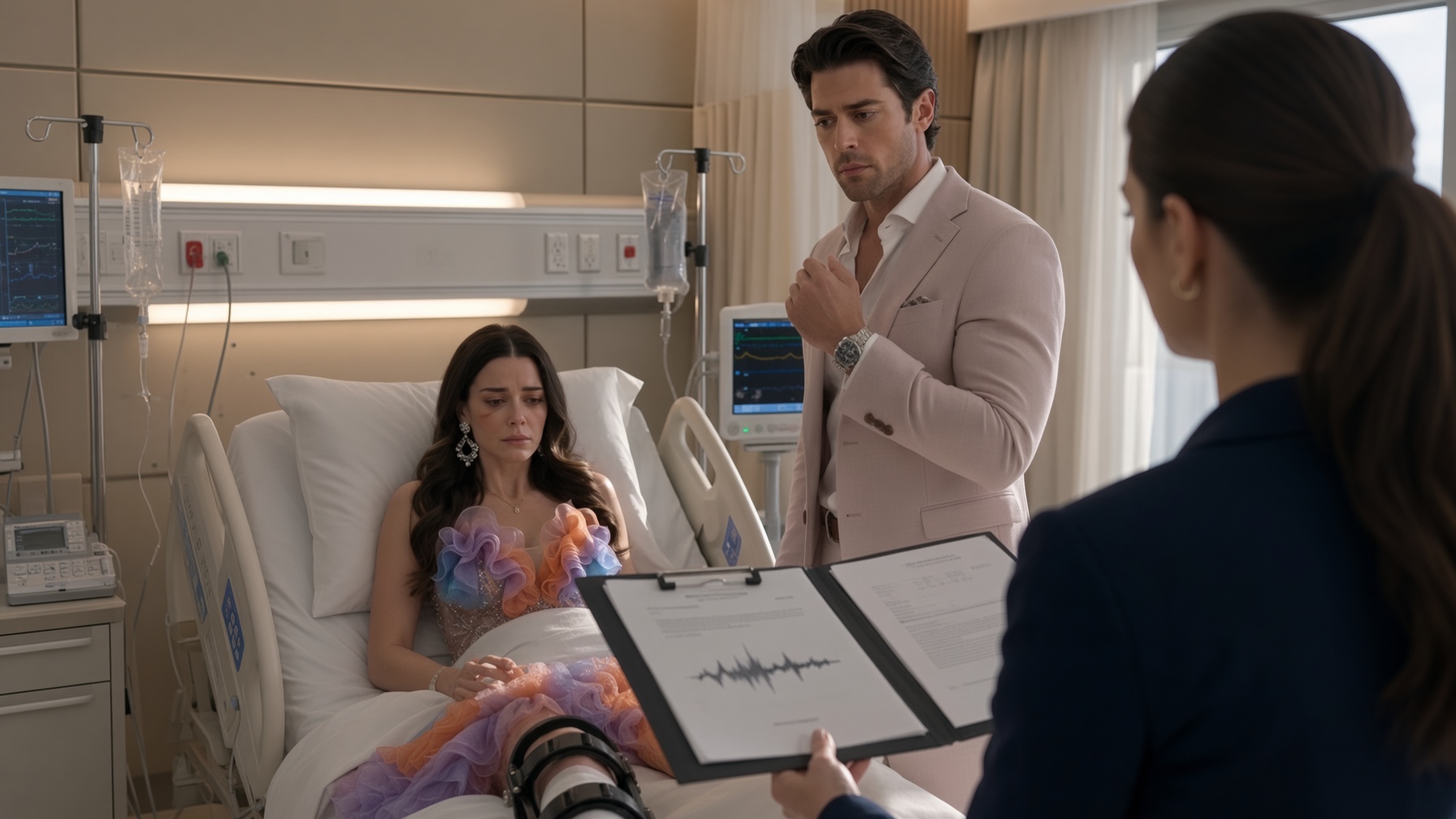
For several seconds, nobody in the hospital room moved.
The heart monitor beside the bed continued its steady rhythm.
Beep.
Pause.
Beep.
Outside the windows, late-afternoon traffic crawled along Peachtree Street as if nothing unusual had happened anywhere in Atlanta.
Inside Room 614, everything had changed.
Adrian Whitmore sat in the visitor’s chair near the window. Twenty minutes earlier, he had been smiling.
Not warmly.
Not because he was happy to see his wife.
It was the polite smile he used at charity dinners, business meetings, and uncomfortable conversations. The smile that made strangers think he was calm and reasonable even when the people closest to him knew better.
Now it was gone.
His expensive pale-gray jacket still sat perfectly across his shoulders. His dark hair was carefully arranged. The gold watch his mother had given him for his thirty-fifth birthday reflected the hospital lights.
Only his face looked different.
He stared at the black phone lying on top of the evidence folder.
Across from him, his mother, Margaret Whitmore, had stopped winding the chain of her handbag around two fingers.
Her pearls remained perfectly centered at her throat.
Her lipstick was untouched.
But the color around her mouth had faded.
At the center of the room, Naomi Whitmore lay propped against pillows.
Her left leg was fixed inside a medical frame that extended from her thigh toward her ankle. Thick padding protected the skin around the supports. Her right wrist was wrapped. A dark mark remained beneath one eye.
She was still wearing part of the silver evening dress she had worn to the Whitmore Foundation gala the previous night.
The hospital had removed what they needed during surgery, but Naomi had refused to let Margaret bring her replacement clothes.
She wanted the dress kept.
She wanted photographs of it.
She wanted everything documented.
Ten years earlier, Naomi would have found that idea ridiculous.
Five years earlier, she would have called it dramatic.
Even three months earlier, she might have allowed Adrian to convince her that documenting private family problems was disloyal.
That afternoon, she understood differently.
Attorney Rachel Sloan closed the folder.
“That was your voice, Adrian.”
Adrian’s eyes moved from Rachel to Naomi.
“You recorded us?”
Naomi said nothing.
Her ribs hurt whenever she took a deep breath, so she breathed carefully.
Adrian leaned forward.
“You recorded conversations inside our house?”
Rachel answered.
“My client does not need to discuss how evidence was obtained with you.”
“I wasn’t speaking to you.”
“You’re in my client’s hospital room.”
“She is my wife.”
“Currently, she is my client.”
Adrian looked at Naomi again.
He had always hated being ignored.
At restaurants, he became annoyed when waiters failed to notice him quickly.
At home, silence during an argument made him more irritated than shouting.
He wanted reactions.
Apologies.
Explanations.
Anything that confirmed he still controlled the conversation.
Naomi kept her eyes on him.
The phone vibrated.
Rachel glanced at the screen.
Then she said, “Detectives have entered the Whitmore residence.”
Margaret’s head turned sharply.
Adrian went still.
Rachel continued.
“They have a warrant.”
Margaret looked at her son.
For one second, the careful mask she had worn since arriving at the hospital disappeared.
“Where did you put the marble rolling pin?”
Adrian stared at her.
Naomi felt her heart rate increase.
The monitor immediately reflected it.
Margaret looked confused by her own words.
“I meant—”
“Mother,” Adrian said quietly.
“I was asking—”
“No, you weren’t.”
Rachel’s expression did not change.
Naomi saw everything.
The fear in Margaret’s face.
The irritation in Adrian’s.
The immediate recognition between them.
She had spent years wondering whether she imagined those silent conversations.
She had not.
Adrian adjusted his watch.
“The police can search whatever they want.”
Rachel nodded.
“Then there shouldn’t be a problem.”
“There is no problem.”
“Good.”
He laughed once.
The sound was hollow.
“You think you’re very clever.”
“No,” Rachel said. “I think the conversation is over.”
Adrian turned toward Naomi.
“Look at me.”
She already was.
“Whatever Rachel told you, you’ve had surgery. You’ve been given strong medication. You’re frightened. This isn’t the time to make decisions that could destroy your life.”
Naomi’s mouth became dry.
For hours after waking from surgery, she had imagined what she would say when Adrian appeared.
In some versions, she had a perfect speech.
She reminded him of every lie.
Every apology that arrived with jewelry.
Every dinner where he corrected her in front of people.
Every time Margaret called her sensitive after Adrian embarrassed her.
Every morning Naomi woke determined to leave and every evening she convinced herself the marriage could still be repaired.
But now, with Adrian sitting ten feet from her, she did not have a speech.
She only had one sentence.
“You already decided what happened to me before you knew whether I would wake up.”
Adrian’s expression tightened.
Margaret lowered her eyes.
The hospital room door opened.
A security officer entered with the nursing supervisor.
“Mr. Whitmore,” the officer said, “you and Mrs. Whitmore need to leave.”
Adrian stood.
“This is between my wife and me.”
“No,” the supervisor said. “This is about the patient’s safety.”
Margaret collected her handbag.
“Surely we can all behave like adults.”
Rachel gave her a long look.
“That would have been useful yesterday.”
Margaret’s lips pressed together.
Adrian ignored Rachel.
He walked toward the foot of Naomi’s bed.
The security officer shifted forward.
Adrian stopped before reaching it.
“You’re making a mistake,” he told Naomi.
For a second, something old moved inside her.
The urge to calm him.
To tell him things would be okay.
To apologize for creating a scene.
She had spent so many years arranging herself around Adrian’s moods that the instinct existed before conscious thought.
Her lips parted.
Then she remembered waking at the bottom of the stairs.
She remembered seeing the marble rolling pin near Margaret’s feet.
She remembered Adrian’s voice above her.
Not calling emergency services.
Not asking whether she could move.
Saying, “If she wakes up, she’ll say she slipped.”
Naomi closed her mouth.
The apology never came.
Adrian waited.
Then he understood.
For the first time in their marriage, Naomi was not going to rescue him from the discomfort he had created.
His jaw tightened.
He turned and walked out.
Margaret followed.
The security officer closed the door behind them.
Naomi stared at it.
Rachel returned to the chair beside the bed.
“You okay?”
Naomi looked at her.
“No.”
Rachel nodded.
“Fair answer.”
Naomi’s fingers loosened around the sheet.
“I almost apologized.”
“For what?”
“I don’t know.”
She gave a tired laugh that hurt her ribs.
“That’s the embarrassing part.”
Rachel opened a bottle of water and placed it within reach.
“It’s not embarrassing.”
“It feels embarrassing.”
“You spent years being trained to make peace.”
Naomi looked toward the window.
“That makes it sound like I was some helpless person.”
“You weren’t.”
“I stayed.”
“Yes.”
“I defended him.”
“Yes.”
“I told my sister she didn’t understand him.”
Rachel nodded again.
“You also came very close to not walking normally again.”
Naomi closed her eyes.
The surgeon had explained the damage that morning.
Her left leg had broken in three places.
The joint near her knee had been damaged.
She would need another procedure.
Then months of rehabilitation.
There were no promises about when she would walk without assistance.
There were definitely no promises about running.
Naomi had spent twelve years running.
Not competitively.
Just mornings around the neighborhood.
Three miles before breakfast.
Sometimes five on weekends.
Running had been the only part of her life Adrian never managed.
He hated exercise before sunrise.
Margaret thought sweating publicly was undignified.
So those mornings had belonged entirely to Naomi.
Now the idea of simply standing without support seemed distant.
Her eyes opened.
“Did I tell you what he said in the ambulance?”
Rachel shook her head.
“He wasn’t in the ambulance.”
“I know.”
Naomi stared at the ceiling.
“I kept asking for him.”
“You were confused.”
“I remember saying his name.”
“That doesn’t mean anything.”
“It means something to me.”
Rachel waited.
Naomi swallowed.
“I was lying there with my leg twisted, and I still wanted him.”
“That doesn’t erase what happened.”
“I know.”
“Do you?”
Naomi looked at her attorney.
Rachel had been her friend before becoming her lawyer.
They had met at Emory University fourteen years earlier.
Naomi had studied nonprofit management.
Rachel had studied law.
They had survived cheap apartments, terrible dating decisions, and too many late-night diners before their lives moved in different directions.
Rachel had never liked Adrian.
Not from the beginning.
She had been polite about it until Naomi married him.
After that, she became careful.
“I know now,” Naomi said.
Rachel leaned back.
“That will have to be enough for today.”
—
Naomi had met Adrian Whitmore at a fundraising dinner eight years earlier.
At the time, she was twenty-nine and worked for a literacy nonprofit in Atlanta.
She had spent most of the evening worrying about whether the microphone would work.
Adrian arrived forty minutes late.
Everyone noticed.
The Whitmore family owned a regional property development company and operated a charitable foundation that donated heavily to schools, museums, and hospitals.
Adrian entered the ballroom with the confidence of someone accustomed to being expected.
He wore a dark suit.
No tie.
Margaret walked beside him.
Naomi remembered thinking they looked like people from an advertisement.
Adrian found her after the speeches.
“You’re Naomi Reed.”
She looked at her name badge.
“Excellent detective work.”
He laughed.
“You spoke about the after-school reading program.”
“I did.”
“My mother wants to fund it.”
Naomi looked toward Margaret.
Margaret was speaking with a state senator.
“That’s generous.”
“Don’t thank me. It’s her money.”
“I’ll thank her.”
“You can thank me for introducing you.”
Naomi smiled.
“You haven’t introduced us yet.”
He stared at her for a second.
Then he laughed.
That had been the beginning.
Adrian could be charming.
That was important to remember.
People later talked about him as though he must have always been obviously difficult.
He wasn’t.
He remembered birthdays.
Sent flowers.
Made reservations at restaurants Naomi could not afford.
When her car broke down during their first year together, he drove across town in the middle of a thunderstorm and waited with her for the tow truck.
When Naomi’s father had surgery, Adrian spent twelve hours at the hospital with her.
He could make a room feel smaller when he focused on someone.
At first, Naomi loved that feeling.
Margaret took longer to win over.
“She’s protective,” Adrian explained.
“Of what?”
“Me.”
“You’re thirty.”
“That doesn’t matter to her.”
Margaret invited Naomi to lunch two months into the relationship.
The restaurant was expensive enough that Naomi spent the first five minutes wondering whether she had dressed correctly.
Margaret ordered tea.
“You seem sensible.”
Naomi laughed.
“Is that good?”
“It’s rare.”
“I’ll take it.”
Margaret studied her.
“Adrian becomes enthusiastic about people.”
Naomi waited.
“He gives too much too quickly.”
“I’m not asking him for anything.”
“I didn’t say you were.”
The words were polite.
The meaning wasn’t.
Naomi told herself Margaret simply needed time.
That became a pattern.
When Margaret criticized Naomi’s clothes, it was because she wanted to help.
When she questioned Naomi’s career, she was concerned about financial stability.
When she arrived at Adrian’s apartment without calling, it was because family didn’t need appointments.
Naomi translated every uncomfortable moment into something kinder.
Eventually she became very good at it.
She married Adrian two years later.
The wedding appeared in a local society magazine.
Margaret chose the florist.
Margaret selected the rehearsal dinner.
Margaret complained about Naomi’s first dress until Naomi bought another one.
When Rachel saw the second dress, she said, “Do you like it?”
“It’s beautiful.”
“That wasn’t my question.”
Naomi became annoyed.
“I like it.”
Rachel nodded.
“Okay.”
Naomi knew exactly what Rachel meant.
She also knew she didn’t want to hear it.
So they didn’t discuss it again.
For the first year of marriage, things were mostly good.
Adrian worked long hours.
Naomi became director of programs at her nonprofit.
They bought a large white house in Buckhead.
They traveled.
They hosted dinners.
Margaret came every Sunday.
Then small things changed.
Adrian began complaining when Naomi worked late.
“You don’t need that job.”
“I like my job.”
“You make less than my assistant.”
“That’s not why I work.”
“I know. I’m saying you don’t have to exhaust yourself.”
It sounded caring.
Later, he began commenting on her clothes.
“You’re wearing that?”
“Yes.”
“Nothing. It’s casual.”
“It’s dinner with Rachel.”
“Exactly.”
She changed anyway.
Then came finances.
Adrian suggested combining accounts.
Naomi agreed.
Afterward, he monitored everything.
A $200 purchase became a conversation.
A dinner with friends became a question.
Yet Adrian could spend $8,000 on a watch without mentioning it.
When Naomi challenged the difference, he laughed.
“I earn most of our income.”
“So?”
“So I understand our financial position better.”
Naomi stared at him.
“That doesn’t make sense.”
“It does if you stop looking for a reason to argue.”
The first time he shouted at her, he apologized the next morning with diamond earrings.
Naomi returned them.
He became offended.
“I’m trying to apologize.”
“Say you’re sorry.”
“I did.”
“No. You bought jewelry.”
“Most women would appreciate this.”
“Then give them to most women.”
He stared.
Then he smiled.
“That’s the Naomi I fell for.”
The fight became a joke.
Nothing changed.
When problems continued, Adrian began involving Margaret.
His mother never called it choosing sides.
She called it helping.
“Marriage requires patience,” Margaret told Naomi.
“So does accountability.”
“Adrian works under enormous pressure.”
“So do many people.”
“He isn’t like many people.”
That sentence explained the entire Whitmore family.
Adrian was always different.
More important.
More burdened.
More deserving of forgiveness.
Five years into the marriage, Naomi stopped arguing as often.
She told herself she had matured.
In reality, she had become tired.
—
The trouble that finally changed everything began with the Carter—now Whitmore—Foundation renovation fund.
Naomi had left her old nonprofit two years earlier and taken an executive role at the Whitmore Foundation.
Adrian encouraged it.
“At least your work will benefit our family.”
Naomi disliked the phrasing.
But the job gave her more influence over education grants, which she loved.
For eighteen months, things went well.
Then Naomi noticed invoices.
Three construction contracts had gone to a company called Braxton Urban Partners.
The company was owned by one of Adrian’s college friends.
That was not automatically illegal.
What bothered Naomi was the pricing.
Every contract exceeded competing estimates.
Sometimes by hundreds of thousands of dollars.
She asked the finance director.
He became uncomfortable.
“Those were board decisions.”
“Which board members?”
“You should ask Adrian.”
So she did.
Adrian smiled.
“Elliot’s company does good work.”
“I’m not questioning the work.”
“You are.”
“I’m questioning why we paid almost forty percent more.”
“Because reliability matters.”
“That explanation needs to be documented.”
He stopped smiling.
“Why?”
“Because we are a charitable foundation.”
“It’s our foundation.”
“No. It’s a nonprofit organization.”
“You sound like an auditor.”
“I’m doing my job.”
He stared at her.
Then he said, “Leave it alone.”
That was the moment Naomi knew there was more.
Not because of what he said.
Because he had become frightened before becoming angry.
She had seen that expression before.
So Naomi started keeping copies.
Invoices.
Emails.
Meeting notes.
Nothing dramatic.
Nothing stolen.
Documents she had legitimate access to through her role.
Then she found transfers from the foundation into a consulting firm that appeared to have no employees.
Rachel helped her research the public records.
The company was registered to an address connected to Margaret.
“That’s not good,” Rachel said.
Naomi sat across from her in a coffee shop.
“What do I do?”
“You take this to the board.”
“Adrian controls half the board.”
“Then outside counsel.”
“He’ll know it was me.”
“Would that be dangerous?”
Naomi immediately said, “No.”
Rachel stared at her.
Naomi looked down at her coffee.
“I don’t know.”
That answer frightened her.
Rachel became serious.
“Naomi.”
“He hasn’t…”
She stopped.
“What?”
“Nothing.”
Rachel waited.
Naomi hated the silence.
“He gets angry.”
“So do I.”
“He blocks doors.”
Rachel’s face changed.
“What do you mean?”
“If I try to walk away during an argument, sometimes he stands in front of the door.”
“How often?”
“I don’t know.”
“Does he let you leave?”
“Eventually.”
“Naomi.”
“It sounds worse when you say it like that.”
“I didn’t say anything.”
Naomi looked away.
Rachel lowered her voice.
“Has he injured you?”
“No.”
That answer was true at the time.
But there had been other things.
A glass thrown into the sink.
A chair kicked aside.
A plate swept from a countertop.
A bedroom door locked from the outside for twenty minutes because Adrian said Naomi needed time to calm down.
She had explained all of them.
Stress.
Alcohol.
Bad night.
Miscommunication.
Rachel said, “I want you to start documenting everything.”
Naomi almost laughed.
“You make marriage sound like litigation.”
“I hope it never becomes litigation.”
But Naomi listened.
She opened a secure cloud account.
She copied records.
She began saving text messages.
Then she bought a small audio recorder disguised as a phone charger.
At first, she felt ridiculous.
Until she heard what it recorded.
—
The gala happened three weeks later.
The Whitmore Foundation held its annual dinner at a luxury hotel in Midtown.
More than four hundred people attended.
Naomi wore silver.
Margaret wore dark green.
Adrian wore the pale pink dinner jacket everyone later remembered from the hospital.
The evening began normally.
Champagne.
Speeches.
Photographs.
Donors complimenting one another.
Naomi moved through the room smiling.
By nine-thirty, her cheeks hurt.
At ten, Adrian received an award from the board for “visionary leadership.”
Naomi clapped with everyone else.
While the room applauded, she looked at the man she had married.
Handsome.
Confident.
Gracious.
Completely comfortable in public.
For a moment, she wondered if she had imagined everything again.
Maybe the invoices had explanations.
Maybe Rachel was making her paranoid.
Maybe marriage was simply difficult.
Then Adrian stepped down from the stage, came near her, and whispered without moving his smile, “We need to talk when we get home.”
Her stomach tightened.
“What about?”
“You know.”
“No.”
“You contacted the outside accountant.”
Naomi looked at him.
He continued smiling for photographs.
“How did you know?”
“We’ll discuss it later.”
Then he raised his glass toward a donor.
Naomi knew immediately.
Someone in the accounting firm had warned him.
She considered leaving the gala alone.
She didn’t.
That decision replayed in her mind for weeks afterward.
She told herself there would have been consequences either way.
But part of her still wished she had walked directly into the hotel lobby, ordered a car, and gone to Rachel’s apartment.
Instead, she went home with her husband.
Margaret followed in another car.
That was the second warning.
Margaret rarely came to their house after events.
She said late nights damaged her skin.
When Naomi saw her mother-in-law’s car behind theirs, she asked Adrian, “Why is she coming?”
He stared straight ahead.
“She wants to talk.”
“About the foundation?”
“Yes.”
“What exactly are you hiding?”
“Not in the car.”
Their driver glanced at the mirror.
Naomi stopped talking.
When they reached the house, she went upstairs immediately.
Adrian followed.
“Where are you going?”
“To change.”
“Come downstairs.”
“I’m exhausted.”
“We’re talking tonight.”
Naomi turned.
“Then talk.”
“Downstairs.”
“No.”
His expression shifted.
“You contacted accountants without telling me.”
“Because you told me to ignore financial irregularities.”
“There are no irregularities.”
“Then an audit will confirm that.”
“You do not know what you’re doing.”
“I know exactly what I’m doing.”
Margaret appeared at the bottom of the staircase.
“Naomi.”
Naomi looked down.
Margaret gave a tired smile.
“Come have tea. Everyone is emotional.”
“I don’t want tea.”
“It wasn’t really about tea,” Margaret said.
That old habit returned.
The expectation that Naomi should smooth the situation.
She almost did.
Instead, she said, “If there’s something you need to say, say it now.”
Margaret glanced toward Adrian.
Naomi noticed.
Adrian said, “You need to withdraw the audit request.”
“No.”
“Tomorrow morning.”
“No.”
His voice lowered.
“This is not a negotiation.”
Naomi felt something inside her settle.
For years she had feared arguments because she believed the marriage might end.
That night she realized ending it might be the safest outcome.
“I’m leaving.”
Adrian laughed.
“Where?”
“Rachel’s.”
“You’re not driving after drinking.”
“I had half a glass of champagne three hours ago.”
“You’re upset.”
“I am.”
“Exactly.”
Naomi walked toward the bedroom where her overnight bag remained from a recent work trip.
Adrian followed.
She closed the bag, picked it up, and returned to the hallway.
He stood in front of the staircase.
“Move.”
“No.”
“Adrian.”
“We are not doing this.”
“Move.”
Margaret came upstairs.
“Naomi, please stop creating a scene.”
Naomi looked at her.
“In my own house?”
“You know what I mean.”
“Yes. I finally do.”
She reached into her purse.
Her phone was inside.
So was the small recording device Rachel had told her to keep.
Naomi pressed the side button without looking.
The recorder activated.
“Move away from the stairs,” she said.
Adrian frowned.
“Why are you talking like that?”
“Because I’m leaving.”
“No.”
Margaret said, “She’s trying to provoke you.”
Naomi’s heart began beating faster.
She turned toward the guest staircase at the opposite end of the hallway.
Adrian moved quickly and blocked that direction too.
“Stop walking away from me.”
“I’m calling Rachel.”
He reached toward her purse.
Naomi pulled it behind her body.
“Don’t.”
“Give me the phone.”
“No.”
“Naomi.”
She stepped backward.
Margaret moved closer.
Nobody raised a hand.
Nobody shouted.
That was part of what later made the recording so disturbing.
Everything sounded almost controlled.
Adrian said, “You’re going to call the accountant tomorrow and tell them you made a mistake.”
“No.”
“You will.”
“No.”
Margaret said, “Think about your marriage.”
Naomi answered, “I am.”
She turned toward the stairs again.
Adrian came after her.
Naomi remembered looking down.
Twenty-two steps.
Marble at the bottom.
A narrow runner in the center.
She remembered thinking she should stay away from the railing because her heels were high.
Then Adrian said her name.
She turned partly.
Something struck the back of her lower leg.
Not hard enough to knock her unconscious.
Hard enough to destroy her balance.
She fell sideways.
Her left foot caught beneath her.
Then everything became pain and noise.
She remembered hitting several steps.
She remembered Margaret shouting.
She remembered reaching the bottom.
She remembered trying to move her leg.
The pain became so intense that her vision blurred.
Then silence.
For several seconds nobody came down.
Naomi heard Adrian breathing above her.
She said, “Call an ambulance.”
Nobody answered.
“Adrian.”
Then Margaret’s voice.
“What have you done?”
Adrian said, “I barely—”
“You used that thing.”
“It wasn’t supposed to—”
Naomi tried to raise her head.
Near the staircase lay the marble rolling pin usually kept in the kitchen display rack.
Margaret came down first.
She crouched several feet away.
“Oh, Naomi.”
“Call someone.”
Margaret looked toward Adrian.
“Do it,” Naomi said.
Adrian came down.
He looked at her leg.
His face changed.
Naomi expected him to panic because she was injured.
Instead, he looked around the room.
“Where’s her phone?”
Naomi felt something colder than fear.
She reached toward her purse.
It had fallen halfway down the staircase.
Margaret climbed up and collected it.
“Call emergency services,” Naomi said.
Margaret held the purse.
“What was she recording?”
Adrian stared at her.
Naomi stopped breathing.
Margaret continued.
“She had something in here.”
Adrian took the purse.
Naomi’s recorder had slipped beneath the lining through a small tear in the fabric.
He did not find it.
“What are we going to say?” Margaret asked.
Adrian looked at Naomi.
His wife.
The woman he had married six years earlier.
The woman lying at the bottom of the stairs unable to move her leg.
And he said, “Tomorrow we tell everyone she missed a step.”
That sentence became the center of the police investigation.
The recorder captured everything.
The argument.
Naomi’s repeated requests to leave.
The fall.
Margaret asking about the rolling pin.
Adrian discussing a story.
Then, finally, a strange interruption.
Someone knocked at the front door.
Their housekeeper, Rosa Alvarez, had returned because she left her reading glasses in the laundry room.
Rosa heard Naomi crying.
She entered.
Then the plan collapsed.
“What happened?” Rosa shouted.
“She fell,” Adrian said immediately.
“Call an ambulance!”
Margaret tried to stop her.
“We have it handled.”
Rosa ignored her.
She called emergency services herself.
That was why Naomi reached the hospital alive before Adrian and Margaret could decide anything else.
—
Two detectives arrived at the hospital three hours after Rachel played the recording.
Detective Lewis Grant was in his fifties with gray hair and a tired expression.
His partner, Detective Simone Baker, was younger and carried a notebook she barely used.
Rachel stayed beside Naomi.
Grant pulled a chair forward.
“We recovered the rolling pin.”
Naomi closed her eyes briefly.
“Where?”
“Garage cabinet.”
She opened them.
“Adrian put it there?”
“We don’t know yet.”
Baker said, “We also recovered a damaged section of the staircase runner and several cleaning cloths.”
Naomi frowned.
“Cleaning cloths?”
“There appeared to be an attempt to clean part of the lower staircase.”
Rachel looked at Naomi.
“Anything spilled?”
“Not that I remember.”
Grant leaned forward.
“Mrs. Whitmore, I know you’ve already given an initial statement. I want to go slowly.”
Naomi nodded.
They went through the evening.
The gala.
The drive.
The argument.
The stairs.
Naomi became tired halfway through.
Rachel stopped the interview.
“We continue tomorrow.”
Grant agreed immediately.
Before leaving, Baker asked one question.
“Why do you think they were afraid of the audit?”
Naomi looked at Rachel.
Rachel said, “You can answer generally.”
Naomi described the contracts.
The inflated invoices.
The consulting company.
Margaret’s address.
Grant wrote several notes.
“This may become bigger than the incident at the house.”
“I know.”
“Do you have copies of those financial records?”
Naomi managed a small smile.
“Several.”
For the first time that day, she felt something besides fear.
Preparation.
Weeks earlier, keeping copies had felt like betrayal.
Now it felt like survival.
—
Adrian was arrested that evening.
Margaret was questioned and released pending further investigation.
Rachel told Naomi the news shortly before midnight.
Naomi stared at the television without seeing it.
“You don’t look relieved,” Rachel said.
“I’m not.”
“That’s normal.”
“I keep thinking about him sitting somewhere.”
“You’re worried about him?”
Naomi hated the answer.
“Yes.”
Rachel did not judge her.
“Does that make me ridiculous?”
“No.”
“He almost ruined my leg.”
“Yes.”
“He lied while I was on the floor.”
“Yes.”
“And part of me is wondering if he has his medication.”
Rachel looked at her.
“What medication?”
“Heartburn.”
Rachel laughed before she could stop herself.
Naomi started laughing too.
Immediately, her ribs protested.
She pressed a pillow against her side.
“Stop.”
“I’m sorry.”
“You’re terrible.”
“I know.”
Their laughter disappeared.
Naomi stared at the blanket.
“I loved him.”
“I know.”
“I think I still do.”
Rachel’s voice softened.
“That doesn’t mean you have to go back.”
Naomi cried then.
Not because she had just realized Adrian was dangerous.
Not because she had learned about the financial scheme.
She cried because love had not vanished on command.
She had expected betrayal to simplify things.
Instead, it made everything more complicated.
—
Margaret called the next morning.
The hospital blocked her first three calls.
Then she used another number.
Naomi answered before realizing who it was.
“Naomi.”
Her body became rigid.
Margaret continued quickly.
“Please don’t hang up.”
Naomi said nothing.
“I know you are angry.”
“Angry?”
“I know that word is inadequate.”
“Yes.”
“Adrian made a terrible mistake.”
Naomi stared at the hospital window.
“A mistake is forgetting a birthday.”
“He was upset.”
“He used a marble kitchen tool against my leg.”
“He didn’t intend for you to fall.”
“Why did he hide it?”
Margaret stopped.
Naomi continued.
“Why did you discuss a false story before anyone called for help?”
“We panicked.”
“Why did you take my purse?”
“To find your identification.”
“That’s not true.”
Margaret’s breathing changed.
“Naomi, the foundation supports hundreds of families.”
“Don’t.”
“If this becomes public—”
“It became public when your son decided protecting contracts mattered more than helping his wife.”
“You don’t understand what could collapse.”
“I understand exactly.”
“Employees could lose jobs.”
“Then you should have considered that before moving charity money.”
Margaret became silent.
Naomi felt her heartbeat increase.
“You know,” Naomi said.
“What?”
“You’re still not asking whether I can walk.”
Margaret inhaled sharply.
“Of course I care.”
“You haven’t asked once.”
“I assumed the doctors—”
“You sent flowers.”
“I wanted you to know—”
“The card said family survives everything.”
Margaret sounded confused.
“Yes.”
Naomi looked toward the roses.
“Not this family.”
She ended the call.
Then she asked the nurse to remove the flowers.
—
The financial investigation expanded rapidly.
The audit Naomi had requested eventually uncovered more than inflated construction contracts.
Braxton Urban Partners had overcharged the foundation repeatedly.
Part of the extra money returned through consulting companies.
One belonged indirectly to Margaret.
Another paid expenses for Adrian.
Cars.
Travel.
A private club membership.
Even renovations to the Whitmore family lake house.
Adrian had spent years giving public speeches about community responsibility while quietly using charitable funds as private money.
When Naomi first received the forensic accountant’s preliminary report, she became physically ill.
Rachel placed the pages face down.
“You don’t have to read everything today.”
“I signed some board reports.”
“You relied on financial information provided to you.”
“My name is there.”
“That’s why you raised concerns.”
“I should have noticed earlier.”
“Maybe.”
Naomi looked at her.
Rachel shrugged.
“You want me to lie?”
“No.”
“Then maybe you should have noticed sooner. But noticing late is still noticing.”
Naomi leaned back against the pillow.
“That’s not very comforting.”
“Truth rarely is.”
—
Naomi spent eleven days in the hospital.
Her second surgery happened on day six.
The surgeon repaired additional damage near her knee.
Afterward, she woke groggy and disoriented.
For several seconds, she thought Adrian would be sitting beside the bed.
That had happened after her appendix surgery years earlier.
He had held a cup of ice chips and complained that hospital coffee was terrible.
The memory arrived so clearly that Naomi turned toward the visitor’s chair.
Rachel was there instead, asleep with her head tilted against the wall.
Naomi stared at her.
Something inside her broke quietly.
Not dramatically.
No shouting.
No sudden revelation.
Just the understanding that the person she had expected to care for her was the reason she needed care.
She turned toward the window and cried silently until sleep returned.
—
Rehabilitation began before Naomi left the hospital.
At first, she hated it.
Physical therapist Daniel Cho arrived at eight every morning with irritating optimism.
“Good morning.”
“No.”
He laughed.
“That’s not technically a greeting.”
“It’s my greeting.”
“We’re sitting up today.”
“I already sit.”
“Without raising the bed.”
“No.”
“See? That word again.”
The first attempt lasted thirty seconds.
Pain spread through Naomi’s leg.
Sweat formed near her hairline.
Daniel remained calm.
“Breathe normally.”
“I hate you.”
“Most successful patients do during week one.”
By week two, she transferred from bed to wheelchair with assistance.
By week four, she could stand using parallel bars while keeping weight off the injured leg.
The first time she stood, she cried.
Daniel pretended not to notice.
Naomi appreciated that.
Her body felt unfamiliar.
Weak.
Unreliable.
But upright.
That mattered.
—
The divorce filing happened five weeks after the fall.
Naomi signed the papers at Rachel’s office.
Her left leg was still supported by a brace.
A walking frame stood beside the chair.
The signature took three seconds.
The marriage had lasted six years.
Three seconds ended it legally enough to begin the process.
Naomi stared at her name.
“Feel anything?” Rachel asked.
“Hungry.”
Rachel laughed.
“I’m serious.”
“So am I.”
They ordered sandwiches.
Halfway through lunch, Naomi started crying.
Rachel continued eating.
Naomi looked at her.
“You could pretend not to notice.”
“I’m hungry too.”
Naomi laughed through tears.
That was how the end of her marriage began.
With turkey sandwiches and a box of tissues between them.
Not dramatic.
Just sad.
—
Adrian called from his attorney’s office two months later.
Rachel strongly advised Naomi not to answer.
She did anyway.
“I need to hear him once.”
Rachel sighed.
“Speakerphone.”
Naomi agreed.
Adrian’s voice sounded tired.
“Naomi.”
She closed her eyes.
For one second, she was back in their kitchen on a normal Sunday.
Then she remembered the staircase.
“What do you want?”
“I wanted to hear your voice.”
“You heard it on the recording.”
Silence.
“That’s cruel.”
Naomi almost apologized.
Again.
Even after everything.
She recognized the impulse and let it pass.
Adrian said, “I’m sorry.”
She waited.
“I never intended for you to be injured.”
“You intended to stop me from leaving.”
“I was angry.”
“You brought the rolling pin upstairs.”
“I picked it up from the kitchen without thinking.”
“Why?”
“I don’t know.”
“Yes, you do.”
He exhaled.
“My lawyer says I shouldn’t discuss details.”
“Then why call?”
“Because I love you.”
Naomi looked at Rachel.
Rachel’s face revealed nothing.
Adrian continued.
“I have made mistakes.”
“You committed crimes.”
“You don’t know everything.”
“I know enough.”
“My mother created half this situation.”
There it was.
Naomi felt something inside her finally detach.
Not because he blamed Margaret.
Because she suddenly recognized the pattern completely.
Nothing belonged to Adrian.
Not responsibility.
Not consequences.
Not even his own apologies.
There was always someone else.
His mother.
Stress.
Work.
Alcohol.
Naomi.
“Adrian.”
“Yes?”
“I hope someday you understand that what happened to your life wasn’t something everyone else did to you.”
He became quiet.
Then his voice hardened.
“You think Rachel has turned you into somebody strong.”
Naomi almost smiled.
“No.”
“You were never like this before.”
“I was. I just spent years making myself smaller around you.”
He laughed bitterly.
“Good luck with that story.”
Naomi pressed the red button.
The call ended.
She looked at Rachel.
“That was easier than I expected.”
Rachel nodded.
“You ready to listen to me next time?”
“No.”
“Of course not.”
—
Margaret eventually accepted a plea agreement connected to financial misconduct and evidence tampering.
Adrian’s case took longer.
The recording mattered.
So did Rosa’s statement.
So did forensic evidence from the staircase and the hidden rolling pin.
Investigators also recovered messages between Adrian and Margaret from after Naomi entered the ambulance.
One from Margaret read:
**We need one version. She slipped. Nothing else.**
Adrian answered:
**Delete this conversation.**
They had not understood that deleted messages could sometimes be recovered.
Naomi learned that detail from the prosecutor.
She almost laughed.
For years, Adrian believed money and confidence could solve nearly everything.
Technology had been less impressed.
—
A year after the fall, Naomi walked into court without a cane.
Slowly.
Carefully.
But on her own.
Rachel met her near the elevators.
“You sure?”
“No.”
“Good.”
“Why good?”
“People who say they’re sure before testimony are usually lying.”
Naomi adjusted the sleeve of her navy dress.
“I’m going to throw up.”
“Not on me.”
“You’re supportive.”
“I’m wearing expensive shoes.”
Naomi smiled.
Then they entered.
Adrian sat beside his attorneys.
He looked older.
Not dramatically.
Just tired.
His hair was shorter.
The expensive confidence had thinned.
When Naomi passed, he looked at her leg.
Then at her face.
She kept walking.
On the witness stand, the prosecutor asked about the marriage.
The financial records.
The recorder.
The night of the gala.
Naomi answered carefully.
Then Adrian’s attorney stood.
He was polite.
That made the questions more difficult.
“Mrs. Whitmore, you and my client had been experiencing marital problems before that evening?”
“Yes.”
“You had discussed separation?”
“I had.”
“You had secretly recorded conversations?”
“Yes.”
“You had consulted an attorney?”
“Yes.”
“You were gathering documents related to your husband without informing him?”
“I preserved documents related to the foundation where I worked.”
“But you did not tell him.”
“No.”
“Would it be fair to say you no longer trusted your husband?”
“Yes.”
The attorney paused.
“So when you interpreted his actions that evening, you were already expecting the worst from him.”
Naomi looked toward Adrian.
Then back at the attorney.
“No.”
He frowned slightly.
“No?”
“I spent years expecting the best from him. That was the problem.”
The courtroom became quiet.
The attorney changed subjects.
Naomi answered every question.
When she left the stand, her hands were shaking.
Rachel met her outside.
“You did well.”
“I hated every second.”
“Both things can be true.”
—
The court proceedings eventually ended.
There was no single satisfying moment.
No dramatic speech.
No instant relief.
There were judgments.
Sentences.
Financial settlements.
Properties sold.
Foundation leadership replaced.
Board members resigned.
New compliance rules.
New auditors.
The Whitmore name disappeared from several buildings after other donors paid to rename them.
News stories ran for weeks.
Then months.
Then less frequently.
Eventually other scandals replaced theirs.
That surprised Naomi.
For nearly a year, the case had felt large enough to consume the entire world.
Then the world moved on.
She had to learn how to do the same.
—
Two years after her fall, Naomi returned to the park where she used to run.
She did not run.
Her surgeon had been honest.
She might someday manage short distances, but repeated impact could cause problems.
Instead, she walked.
Rachel came with her.
“You’re slow,” Rachel complained.
“You volunteered.”
“I expected inspirational speed.”
“You’re welcome to leave.”
“I brought coffee.”
“That’s why you’re still invited.”
They walked beneath oak trees beginning to change color.
Families pushed strollers.
A teenager rode past on a bicycle.
An older couple argued about directions.
Ordinary Saturday morning.
Naomi loved it.
At the halfway point, she stopped beside a bench.
Her leg ached.
Rachel sat beside her.
“Pain?”
“A little.”
“Want to turn around?”
“In five minutes.”
Rachel nodded.
They watched people pass.
Naomi said, “I used to think leaving would mean admitting the marriage failed.”
Rachel looked at her.
“And now?”
“Now I think staying forever would have meant admitting I failed myself.”
Rachel drank coffee.
“That sounds suspiciously like something you practiced saying.”
“I thought of it last night.”
“Still counts.”
Naomi smiled.
A year earlier, she might have hated the scar visible near her knee.
Now she rarely noticed it.
There were other scars no one saw.
Those took longer.
She still became uncomfortable when someone stood between her and a doorway.
She disliked raised voices in enclosed spaces.
For months she could not walk down marble staircases without gripping the railing.
She attended counseling every Thursday.
At first, she felt embarrassed about that too.
Eventually Thursday therapy became as normal as grocery shopping.
Healing turned out to be less like a transformation and more like maintenance.
Appointments.
Exercises.
Boundaries.
Sleep.
Good days.
Bad days.
Trying again.
—
Naomi eventually returned to nonprofit work.
Not the Whitmore Foundation.
That organization had been restructured under an entirely different board.
She joined a statewide education organization that funded school libraries.
Her office was smaller.
Her salary was lower.
Her happiness was larger.
On her first day, the executive director asked if she wanted the private corner office.
Naomi looked inside.
Large desk.
Glass walls.
Beautiful city view.
Then she noticed another office across the hallway.
Smaller.
Window facing a courtyard.
Door directly visible from the desk.
“I’ll take that one.”
The director looked surprised.
“Really?”
“Yes.”
She never explained why.
She didn’t need to.
—
Three years after the hospital recording played in Room 614, Naomi received a letter from Margaret.
She nearly threw it away.
Instead, she placed it unopened in a drawer.
A month passed.
Then another.
One rainy Sunday, Naomi opened it.
Margaret wrote seven pages.
She apologized.
Then explained.
Then apologized again.
Then blamed fear.
Family pressure.
Adrian’s demands.
Her late husband’s expectations.
The foundation.
Reputation.
Naomi read all seven pages.
At the end, Margaret wrote:
**I hope one day you can understand why I believed protecting my son was the same as protecting my family.**
Naomi stared at the sentence for a long time.
Then she turned the page over and wrote one line.
**Protecting someone from accountability is not the same as loving them.**
She never mailed it.
The sentence was for herself.
—
Five years later, Naomi was invited to speak at a nonprofit governance conference.
The organizer wanted her to discuss whistleblower protections and financial transparency.
Naomi almost declined.
She hated public discussions of the old case.
She did not want to become the woman from the staircase forever.
But the conference wasn’t asking for scandal.
They wanted lessons.
So she accepted.
Before walking onto the stage, Rachel called.
“You nervous?”
“No.”
“You’re lying.”
“Yes.”
“Good luck.”
“Thanks.”
“And don’t tell the turkey sandwich story.”
“I tell everyone that story.”
“It makes me sound emotionally unavailable.”
“You were eating while I cried.”
“You said you were hungry.”
Naomi laughed.
Then the event coordinator opened the curtain.
Naomi walked toward the stage.
Her left leg still had a slight stiffness when she was tired.
Most people never noticed.
She did.
She probably always would.
The room held nearly five hundred people.
Naomi stood behind the lectern.
For a second, she remembered another crowded ballroom.
Silver dress.
Champagne.
Adrian smiling beside her.
The memory passed.
She began speaking.
Not about him.
Not about Margaret.
Not about the fall.
She talked about institutions.
Why organizations need independent oversight.
Why family businesses should not confuse loyalty with exemption from rules.
Why people closest to power often need the strongest protections when they raise concerns.
Near the end, she said:
“The first warning is rarely the worst thing that happens. Usually it is something small that makes you uncomfortable. A question nobody wants answered. A document everyone tells you not to examine. A conversation you are told you misunderstood. We should pay attention when asking ordinary questions suddenly becomes treated as betrayal.”
The room remained quiet.
Naomi looked across the audience.
For years, she had believed strength meant never showing confusion.
Now she knew strength could simply mean refusing to lie to yourself about what you saw.
After the event, a young woman waited near the stage.
She looked nervous.
“Ms. Reed?”
Naomi had returned to her original surname after the divorce.
“Yes?”
“I just wanted to say thank you.”
“For what?”
The woman hesitated.
“My situation isn’t exactly like yours.”
Naomi waited.
“But sometimes I think I’m imagining things because everyone around me tells me everything is normal.”
Naomi recognized the expression.
Not fear exactly.
Uncertainty.
The same uncertainty she had carried for years.
Naomi did not tell the woman what to do.
She did not tell her to leave anyone.
She did not make assumptions.
She simply said, “Write down what you know. Talk to someone outside the situation who you trust. And don’t force yourself to call something normal just because other people need you to.”
The woman nodded.
“Thank you.”
After she left, Naomi stood alone for a moment.
Then she walked outside.
Atlanta was warm.
Traffic moved steadily.
People crossed sidewalks carrying shopping bags and coffee cups.
Nothing about the afternoon looked important.
Naomi liked that.
For years she had associated change with dramatic moments.
A staircase.
An ambulance.
A courtroom.
But most of the life she valued now had been rebuilt through ordinary choices.
Answering Rachel’s call.
Going to therapy.
Doing rehabilitation exercises when she wanted to stay in bed.
Signing divorce papers.
Taking a smaller office.
Walking instead of running.
Learning that disappointment did not require apology.
Learning that disagreement did not mean danger.
Learning to say no without explaining for twenty minutes afterward.
Small things.
Daily things.
They had rebuilt her.
—
That evening, Naomi went home to a townhouse she had bought near Piedmont Park.
Nothing inside it was particularly impressive.
She loved that too.
Her kitchen countertops were ordinary quartz.
Her dining table had a scratch from moving day.
There was a stack of mail near the door she had ignored for three days.
Rachel had given her a plant that was somehow still alive despite inconsistent watering.
Naomi changed clothes and reheated pasta.
While eating, she opened the cabinet where she kept old legal documents.
The original evidence folder was there.
Rachel had once asked why she kept it.
Naomi had not known.
That night she removed it.
Inside were photographs.
Reports.
Copies of messages.
And the printed waveform from the recording.
She turned on the old phone that still contained the audio.
The battery barely held power anymore.
She found the file.
For several seconds, her thumb hovered above it.
Then she pressed play.
Adrian’s old voice filled the kitchen.
Familiar.
Flattened by the speaker.
“Tomorrow we tell everyone she missed a step on the staircase.”
Naomi listened without moving.
Years earlier, those words had made her entire body tremble.
Now they sounded smaller.
Not harmless.
Never harmless.
Just smaller.
They belonged to another room.
Another house.
Another version of her life.
She stopped the recording.
Then she deleted the file from the phone.
Not the official evidence.
That remained preserved where it needed to be.
Just her personal copy.
The screen asked:
**Delete permanently?**
Naomi pressed yes.
The file disappeared.
She sat quietly.
No music started.
No dramatic feeling arrived.
She simply felt finished with hearing his voice.
Naomi put the phone in a drawer.
Then she carried her dinner plate to the sink.
Outside, rain had begun.
She opened the balcony door slightly.
Cool air entered the kitchen.
For a moment, she stood listening.
Cars moving over wet streets.
Someone laughing on the sidewalk below.
A dog barking from another building.
Normal sounds.
Her left knee ached slightly because rain sometimes did that now.
She bent it carefully.
Still strong.
Still hers.
Five years earlier, she had thought losing Adrian would mean losing the life she had built.
The house.
The foundation.
The social circle.
The family name.
The future she had spent years protecting.
She had lost nearly all of those things.
What surprised her was how little she wanted them back.
The life she had now was quieter.
Smaller in some ways.
More honest in every important one.
Naomi switched off the kitchen light and walked toward her bedroom.
Halfway down the hall, she passed the staircase leading to the lower level.
She stopped.
Years ago, stairs had become objects she studied.
Count the steps.
Check the railing.
Watch who stands behind you.
That habit had faded.
She looked down now without fear.
Then she walked downstairs to lock the back door.
One step.
Then another.
No rushing.
No hesitation.
At the bottom, she turned the lock, checked it once, and started back up.
She did not think about Adrian.
She did not think about Margaret.
She did not think about the recording.
She thought about the presentation she needed to finish for Monday.
Whether she had enough coffee for breakfast.
And whether Rachel would complain if Naomi canceled their weekend walk because rain was forecast.
Ordinary concerns.
For Naomi, ordinary had become one of the most beautiful words in the language.
At the top of the stairs, she switched off the hallway light.
The house became quiet.
And for the first time in a very long time, quiet did not mean waiting for someone else’s mood to change.
It simply meant she was home.