As his Democrat Party shifts further to the left, embracing anti-American political ideologies like socialism and Marxism, its House leader is facing a dilemma.
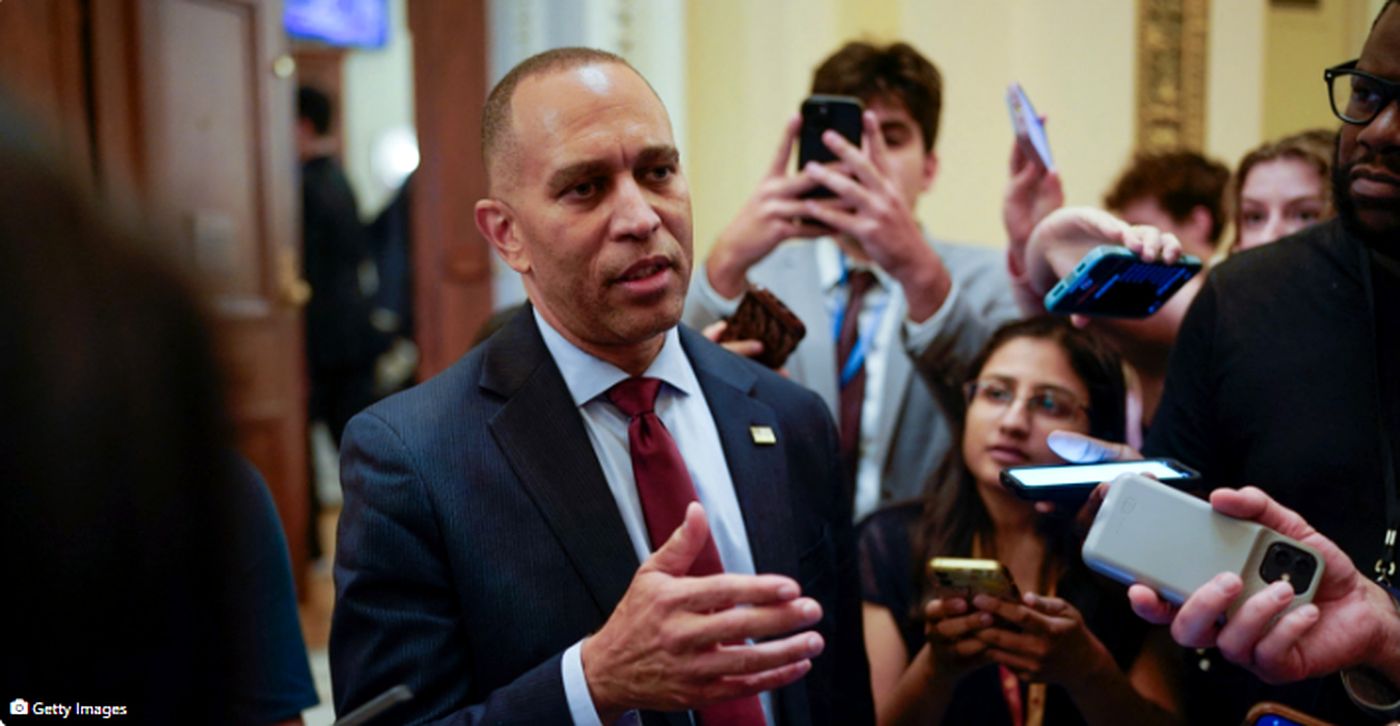
Minority Leader Hakeem Jeffries is quickly learning that the party is rapidly changing before his eyes, and there doesn’t seem to be much he can do about it.
House Democrats remain deeply divided over a proposal to reduce U.S. aid to Israel, and Jeffries has so far declined to take a public position that would unify the caucus, Politico reported this week.
Lawmakers had been expected to vote on the measure last week, but an unrelated Republican dispute derailed the House schedule and sent members home early for the Independence Day recess.
The delay also postponed a politically sensitive debate that has become a major point of contention within the Democratic Party during this year’s primary season, the outlet noted.
Recent Democratic primaries have underscored the party’s internal divisions over Israel policy.
In New York, Marxist anti-Semitic candidates Darializa Avila Chevalier and Brad Lander, and in Colorado, Melat Kiros, defeated incumbent Democrats after criticizing them—and party leaders—for accepting support from the American Israel Public Affairs Committee (AIPAC).
That debate has now reached Capitol Hill through an amendment offered by outgoing Rep. Thomas Massie, R-Ky., that would eliminate U.S. aid to Israel.
The proposal has intensified disagreements within the Democratic caucus and placed Jeffries at the center of the dispute.
As Democrats debated how to handle the politically sensitive vote, Jeffries offered little direction publicly, instead allowing members to air their differences during two lengthy closed-door caucus meetings, Politico said.
“Politics, at least in the Democratic primary, has evolved to the point where folks who don’t know this issue very well are looking for guidance,” Rep. Greg Landsman of Ohio, a pro-Israel Democrat, said in an interview last week.
Jeffries, whose Brooklyn district includes a large Orthodox Jewish community, has long been regarded as a strong supporter of Israel.
During his first campaign for Congress in 2012, Sen. Chuck Schumer endorsed him as a “true blue friend of Israel” in the Democratic primary for an open House seat, noted Politico.
The political landscape surrounding Israel, however, has shifted dramatically over the past decade, particularly following Prime Minister Benjamin Netanyahu’s military campaign in Gaza after the October 2023 Hamas terrorist attacks.
Support for Israel has since become one of the Democratic Party’s most divisive issues, creating a growing challenge for Jeffries as more candidates critical of Israel continue to win Democratic primaries, the outlet continued.
In recent months, Jeffries has signaled that he intends to navigate those divisions cautiously, avoiding moves that could further deepen the party’s internal rift.
Jeffries declined to publicly state his position on Massie’s anti-Israel amendment last week, telling Politico that “there’s a lot that needs to happen differently to get to a place where there’s a just and lasting peace between Israel and the Palestinians, and we all need to focus on actually achieving a two-state solution once and for all.”
According to a person familiar with the private discussions, Jeffries told House Democrats he would provide more specific guidance once a vote on the amendment is officially scheduled.
During one caucus meeting, he also referenced a statement from the left-leaning pro-Israel organization J Street opposing the proposal.
Lawmakers from across the Democratic ideological spectrum said they appreciated the opportunity to debate the issue in private meetings, with some suggesting the approach could serve as a model for managing a diverse caucus.
Others, however, cautioned that allowing members to simply agree to disagree may not be sustainable on highly divisive issues.
Although Massie’s amendment is widely viewed as unlikely to pass, given the expected lack of Republican support, it has nevertheless exposed significant ideological divisions within the House Democratic caucus, Politico added.