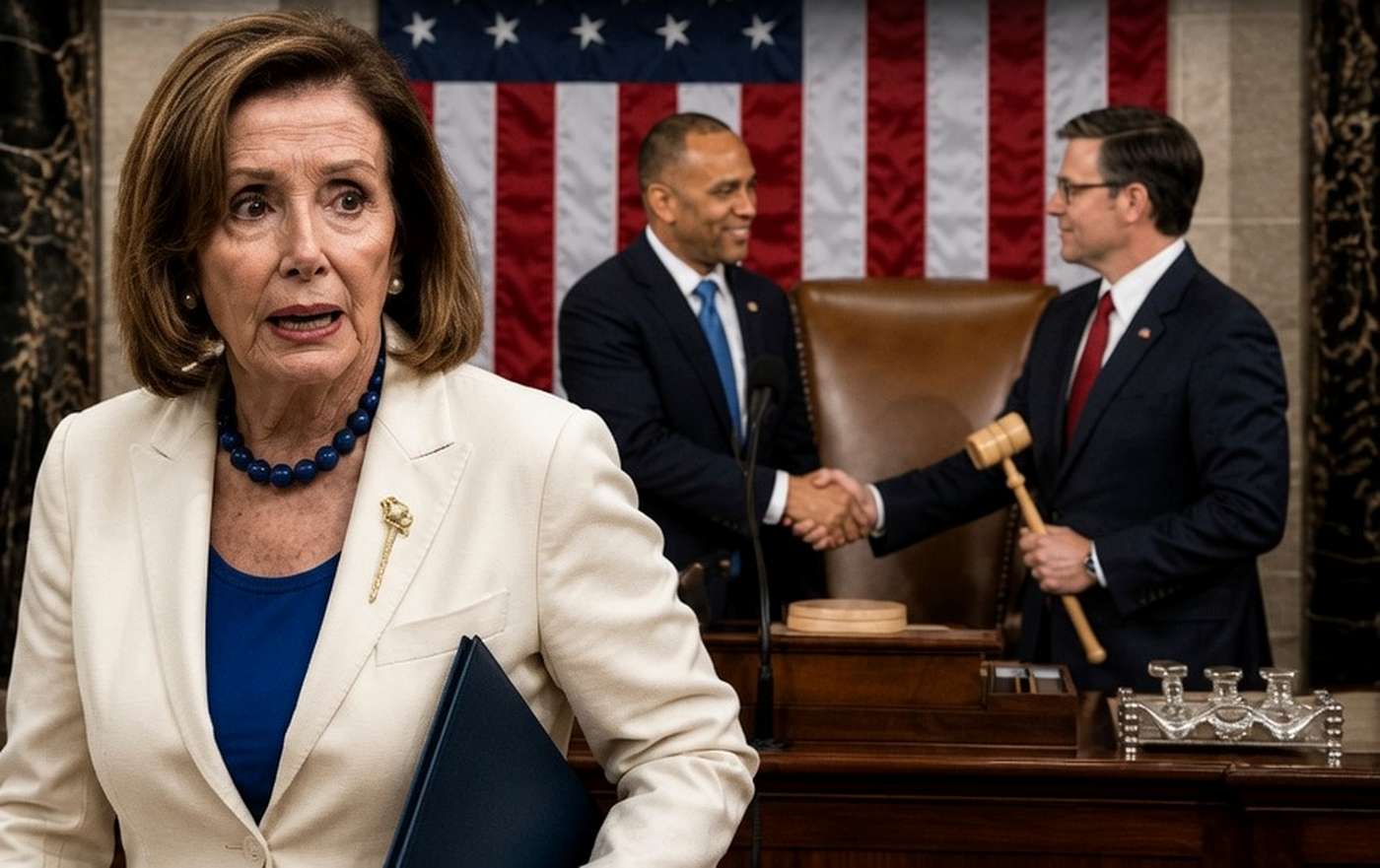
This week, House Speaker Mike Johnson rolled out a new plan to pressure the Senate to pass the SAVE America Act.
The Speaker said he plans to attach the election integrity measure to the must-pass National Defense Authorization Act after conservatives stalled House business.
The push comes after a group of hard-line Republicans declined to support procedural rules needed to move legislation unless the Senate takes up the SAVE America Act or the House does more to pressure the upper chamber.
The SAVE America Act would require voters to prove their U.S. citizenship to register to vote in federal elections and require voters to show identification when they cast a ballot.
Johnson told reporters Monday House Republicans will use a rare parliamentary tactic called “MIRVing” to combine the two bills before sending them over to the Senate. “We’re going to pass a MIRV, or what’s better known as a merge onto the rule,” Johnson said. “So that means when Republicans vote for the rule, they’re not just voting for the NDAA and everything else that’s there, they’re voting to merge onto that the SAVE America Act we passed back in February.”
Johnson said the move would guarantee that the Senate gets both measures at the same time.
That will send both of those items over to the Senate together, so if any Republicans vote to oppose the rule, they’ll be voting against that outcome. “ So we think this is another good way to show the resolve of the House.
The bill is intended to show support for election integrity legislation being pushed by House Republicans and also to increase pressure on the Senate to consider the bill.
Still, Johnson’s plan is facing serious hurdles.
Even if the package as a whole makes it to the Senate, lawmakers there could remove the SAVE America Act from the defense bill before final passage.
The approach risks complicating consideration of the National Defense Authorization Act, one of Congress’ annual must-pass pieces of legislation that authorizes military programs and defense spending.
Not all Republicans think Johnson’s plan is ambitious enough.
Rep. Anna Paulina Luna (R-Fla.) was quick to criticize the plan, saying that the Senate could still take the bill out of the final version just by adding the SAVE America Act procedurally. “‘MIRVing’ the NDAA plus either SAVE America or Voter I.D. “would still give the Senate the power to remove either or,” Luna wrote on X.The only way this gets through the Senate is if it is in the bill text of the NDAA, meaning my amendment(s) have to be made an order.
I’m not trying to be difficult but this is what 80% of Americans want and this is what we promised the American people so I will stand by my decision.”
Johnson’s proposal could also create new political challenges with Democrats, who have strongly opposed the SAVE America Act and are expected to vote against the NDAA if the election legislation remains attached.
Democrats say the bill would create unnecessary hurdles to voting while Republicans say it is necessary to protect the integrity of elections by ensuring only U.S. citizens vote in federal elections.
The bill now before the House also does not contain restrictions on mail-in voting, one of President Donald Trump’s key priorities in election reform.
Some conservatives said they’re still open to Johnson’s approach but need more detail before they can commit to backing him.
We might get everything we want but as Luna said, we’d have to see it on paper first,” Burchett said to reporters. Rep. Tim Burchett, R-Tennessee, said lawmakers still have to review the proposal.
But House Freedom Caucus Chairman Andy Harris, a Maryland Republican, told The Hill he backs any strategy that gets the bill passed. “Anything that is coming out of the House, I’m for it to put SAVE or the SAVE America Act on it,” Harris said.